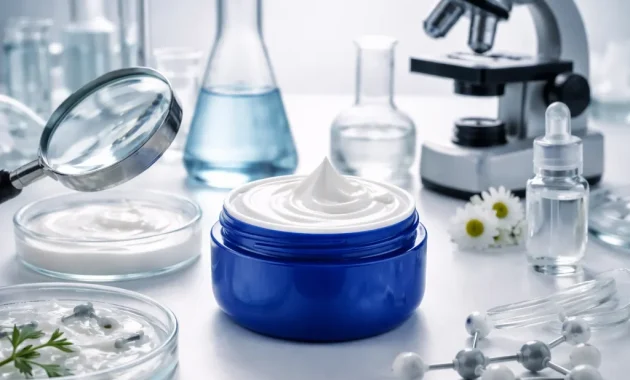
The blue tin was already dented when it slid out of her handbag and rolled across the dermatology clinic floor. You know the one: deep navy, white letters, a smell that feels like childhood. A 54-year-old office manager, cheeks glowing with pride, picked it up and smiled at the doctor. “I’ve used Nivea cream every day for thirty years,” she said, “and look, no Botox.” The dermatologist smiled back, but his eyes were already on the ingredients list. A few minutes later, he was calling in a colleague. Then another.
Something in this ordinary cream had just raised some very modern questions.
What experts really see when they read the Nivea label
The first thing experts do with Nivea cream isn’t to open the tin. They flip it over and read the back like a detective reading a suspect’s file. Petrolatum. Paraffinum liquidum. Glycerin. Panthenol. Fragrance. For most of us, it’s just cosmetic gibberish. For a cosmetic chemist, it’s a story about skin, industry, and culture packed into a few lines.
One scientist I spoke to calls Nivea “a time capsule you can buy at any supermarket.” Old-school base, modern tweaks, familiar promise.
Dermatologists often tell the same kind of story. A patient walks in swearing by their expensive nine-step routine, skin red and irritated, and then there’s another patient who uses nothing but Nivea and has the complexion of a well-hydrated peach. No toner, no serum, no 80-dollar cream with glacier water and exotic seeds. Just that heavy, iconic blue tin.
When researchers actually test classic occlusive creams like Nivea, they often find something surprising: in terms of pure hydration, the results can rival far more expensive products, at least for dry, non-sensitive skin. Not glamorous, but quietly efficient.
So what’s happening here? Nivea sits in the family of “occlusives”: creams that create a barrier on the skin to slow down water loss. Petrolatum and mineral oil, two ingredients that make many people nervous, are among the most effective moisture lockers on the planet. They don’t “feed” the skin, they protect it like a raincoat.
This is where experts raise an eyebrow. Mineral oil is highly purified and extensively tested, yet social media has turned it into a villain. At the same time, some trendy “natural” creams with beautiful marketing give weaker protection and more potential for irritation. The science is rarely as black and white as the label wars.
The good, the bad and the misunderstood side of Nivea cream
Ask three experts what they think of Nivea and you’ll get four opinions. One dermatologist will say it’s a solid, budget-friendly option for very dry hands and feet. A cosmetic chemist might praise its stability and safety record. Another skin specialist will gently warn against using it on acne-prone faces or very sensitive skin.
The method that comes up again and again is spot use. Hands. Elbows. Heels. Shins in winter. Dry patches that feel rough to the touch. Used like that, the thick texture becomes an advantage, almost like a balm rather than an everyday face cream.
Where things go sideways is when Nivea is treated as a miracle cure for everything. Some people slather it on irritated, inflamed or acneic skin and expect it to solve underlying problems that have nothing to do with dryness. That heavy, occlusive layer can trap sweat, sebum and bacteria on certain skin types.
➡️ If you feel drained after making small decisions, psychology explains the inner load
➡️ Forget vinegar and baking soda: pour half a glass of this simple ingredient and the drain cleans itself effortlessly
➡️ Science history: Richard Feynman gives a fun little lecture — and dreams up an entirely new field of physics — Dec. 29, 1959
➡️ According to Admiral Vaujour, the French Navy Is Making Life Hard for Russian Submarines
➡️ Warum du dich in neuen Situationen oft überfordert fühlst – und wie du dir selbst das Vertrauen gibst, dass du es schaffen wirst
➡️ Steve Jobs’s secretary was late to work because her car would not start so he gave her the keys to a brand new Jaguar saying Here do not ever be late again
➡️ Early stratospheric warming in February alarms experts: will drastic winter forecast changes prove science or fearmongering?
➡️ A mine worth a potential €120 billion found in the United States
We’ve all been there, that moment when a product “everyone loves” backfires horribly on our own face. You don’t see those photos on social media, only the before/after miracles. Experts quietly repeat the same message: context matters. Skin type, climate, how much you use, what else is in your routine.
When dermatologists speak off the record, many sound quite down-to-earth about the blue tin. One London-based doctor told me:
“On cracked winter hands, I love it. On a teenager’s oily T‑zone, not so much. The problem isn’t the cream, it’s the mismatch.”
To avoid that mismatch, they tend to share a simple mental checklist for heavy creams like Nivea:
- Use it mostly on body, not as a default everyday facial cream
- Apply on slightly damp skin to lock in water, not on bone-dry skin
- Skip if you’re very acne-prone or easily clogged
- Test on a small area first if you have sensitive or reactive skin
- Prefer the fragrance-free versions if your skin tends to complain
This is the quiet, unsexy expert advice that rarely goes viral but actually saves skin.
What Nivea reveals about our relationship with skincare
Experts analysing Nivea aren’t just dissecting petrolatum and panthenol. They’re also looking at something much more human: trust. That tin has been passed from grandmother to mother to daughter, sitting in bathrooms long before “skinfluencers” and double cleansing. It smells like safety for some people. For others, it smells like cheap filler and old-fashioned formulas.
When they compare Nivea to luxury creams in the lab, the blind results can be unsettling. Hydration levels often end up in the same ballpark, sometimes better, sometimes slightly worse, depending on the test. The price tags, of course, are not in the same universe. *This gap between emotion and evidence is where the real story sits.*
| Key point | Detail | Value for the reader |
|---|---|---|
| Old formula, strong record | Nivea’s base formula is decades old but heavily studied and widely used | Reassurance on safety and performance beyond trends |
| Occlusive power | Petrolatum and mineral oil lock in moisture very effectively | Helps very dry or rough areas recover faster, especially in winter |
| Not for every skin | Can feel heavy, may clog pores or irritate sensitive, acne-prone faces | Encourages smarter, targeted use instead of one-size-fits-all |
FAQ:
- Is Nivea cream safe for everyday use on the face?For many people with normal to dry, non-acneic skin, occasional use is fine, especially in cold climates. Experts are more cautious for oily, acne-prone or very sensitive faces, where a lighter, non-comedogenic moisturizer tends to work better.
- Does Nivea cream clog pores?The classic formula is rich and occlusive, so on some skin types it can contribute to clogged pores, especially if used in thick layers or combined with heavy makeup. On dry body areas, this is far less of a concern.
- Is mineral oil in Nivea dangerous?Dermatology bodies and cosmetic regulators classify cosmetic-grade mineral oil as safe and non-carcinogenic. The fear mostly comes from confusion with industrial mineral oils, which are not the same as purified cosmetic ones.
- Can Nivea replace expensive anti-ageing creams?It can help with plumpness and fine lines linked to dehydration, which sometimes makes skin look younger. What it doesn’t bring is a high dose of proven actives like retinoids or certain peptides, found in targeted anti-ageing formulas.
- Is the fragrance in Nivea a problem?For many users, no. For people with eczema, rosacea or easily irritated skin, fragrance is a common trigger. That’s why some experts recommend switching to fragrance-free versions when skin is already reactive.