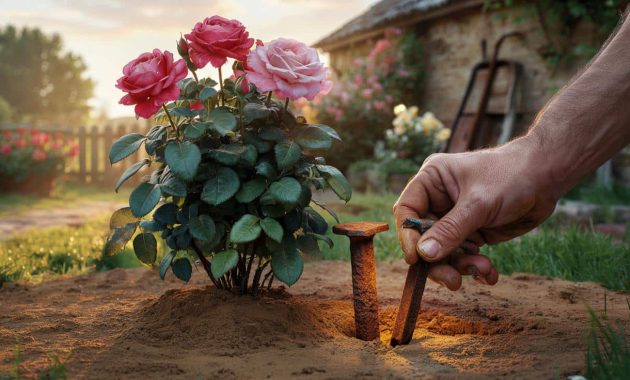
Ask around in older villages and you will often hear the same story: decades ago, people quietly slipped a rusty nail into the soil at the base of their favourite rose. Today, the gesture sounds almost like folklore, yet many swear those bushes never looked better. Behind this slightly eccentric habit sits a mix of thrift, observation and a bit of basic chemistry.
Between folklore and know‑how: a curious habit that stuck
Before garden centres and shelves of shiny fertilisers, people used what they had. Old tools, nails and bits of wire were rarely thrown away. Some of that scrap iron ended its days in the flowerbed, pressed into service under a rose bush.
In many European gardens, finding a corroded nail while turning the soil was normal. It often sat right next to a vigorous rose, with dark green leaves and heavy blooms. That visual link helped the idea to catch on: rusty iron equals healthy roses.
For earlier generations, the rusty nail was not superstition; it was a cheap, homemade way to “feed” the soil.
Garden conversations helped spread the trick. Stallholders at markets, allotment neighbours and grandparents around the kitchen table all repeated the same advice: if your roses start to yellow, give them a nail. The method did not require money, only patience and a bit of faith in old wisdom.
Why roses, specifically, became linked to rusty nails
Roses are demanding plants. They respond quickly when something is missing in the soil and show stress through their foliage. That makes them ideal “indicators” for gardeners watching closely.
When roses suffer from certain nutrient issues, the problem is often linked to iron. Over time, people noticed that where metal had rusted into the ground, roses sometimes stayed greener. The association stuck, and the rusty nail turned into a miniature talisman for rose health.
The science behind the myth: what iron really does
Behind the romantic image of an old nail lies a clear scientific story. Iron is a micronutrient, needed in small amounts but crucial for plant life.
Iron helps plants build chlorophyll, the green pigment that powers photosynthesis and keeps leaves richly coloured.
➡️ By doing MRIs on teenagers, researchers discovered why they don’t listen to their parents
➡️ [Analysis] Electronic warfare Rafale: why Paris and New Delhi have a unique window in 2025?
➡️ For the first time in 40 years, Panama’s deep waters failed to rise to the surface
➡️ Probably F?15s, F?16s, F?22s And F?35s : Dozens Of US Jets Now Converging On The Middle East
➡️ This 3 ingredient grout trick makes your tiles look new in 15 minutes but cleaners say it destroys your bathroom
➡️ Neither swimming nor Pilates: experts recommend a shocking weight bearing exercise for knee pain and it ignites a medical war
➡️ The overlooked cause of tension in the neck and upper back
➡️ Orion 26: the French Air and Space Force launches its major exercise of the year
Without enough available iron, a rose struggles to use light and produce energy. The plant weakens, flower buds remain small, and colours fade. The problem is not always that the soil lacks iron completely; often, the iron is present but “locked” in a form roots cannot absorb, especially in chalky or very alkaline ground.
Recognising iron deficiency in roses
Gardeners use the term “chlorosis” for this kind of shortage. The symptoms are easy to spot if you know what to look for:
- Leaves turn pale yellow while the veins stay green.
- New growth looks washed out and fragile.
- Flowers appear fewer, smaller or surprisingly dull in colour.
- The whole shrub seems weaker, with slower growth.
These signs can appear even when you are watering and feeding regularly. When that happens, an iron-related issue often sits in the background, especially on light, limestone or compacted soils.
What really happens when you bury a rusty nail
Rust is simply iron that has reacted with oxygen and moisture. Pushed into the soil, a rusty nail continues to corrode slowly. Raindrops, irrigation, and natural soil acidity all nibble away at the metal.
As the nail breaks down, tiny amounts of iron move into the surrounding soil solution, where rose roots can access them.
This release is extremely gradual. The rose does not receive a sudden “dose” of fertiliser, but a trickle of extra iron that may ease mild deficiencies. In very chalky soils, where iron tends to be chemically locked away, even that modest boost can make a visible difference over one or two seasons.
How effective can one nail really be?
From a strictly scientific point of view, one small nail does not contain much iron compared with modern products. Its effect is limited and can take months or even years to show. Yet in low‑input gardens with no other fertiliser, that tiny contribution might be enough to tip a struggling rose back toward decent health.
The technique has clear limits. It will not fix poor planting, extreme drought, root damage or serious fungal disease. Soil structure, drainage and organic matter affect rose performance far more than one piece of scrap metal.
Modern alternatives that respect the old idea
Gardeners today have more precise tools than their grandparents. Products specifically designed for iron‑hungry plants can act faster and in a more controlled way.
Instead of guessing, many gardeners now use iron‑rich feeds, chelated iron and balanced organic amendments to support their roses.
Comparing the rusty nail with other iron sources
| Method | Speed of effect | Control | Typical use |
|---|---|---|---|
| Rusty nail in soil | Very slow | Low | Traditional, low‑cost, symbolic boost |
| Iron chelate (liquid or powder) | Fast | High | Correcting clear chlorosis on roses and shrubs |
| Organic feeds (blood meal, rich compost) | Moderate | Medium | General soil improvement with added micronutrients |
| Rock dust or mineral amendments | Slow | Medium | Long‑term support in depleted or sandy soils |
Organic options, such as blood meal or well‑made compost, offer a broader range of nutrients along with iron. They encourage soil life and improve structure, giving roses a healthier rooting environment overall. Some gardeners also reuse cooled cooking water from green vegetables, which contains trace minerals that lightly enrich the soil around ornamentals.
Mistakes that can quietly harm your roses
Adding more iron is not always the right move. Too many separate “remedies” thrown at the same plant can unsettle the balance of the soil.
Before reaching for extra iron, gardeners gain a lot by checking pH, drainage and watering habits.
Saturating the soil around roses with bits of metal, especially painted or treated scraps, can release unwanted substances. Railway spikes, old screws coated with zinc, or heavily corroded structural parts should stay out of the flowerbed.
Good practice starts with a soil test, or at least an honest look at conditions: is the ground waterlogged in winter, bone‑dry in summer, or covered in thick grass that competes with shallow rose roots? Correcting those basic issues often gives better results than any nail or bottle of fertiliser.
What this old trick still teaches modern gardeners
The habit of burying a rusty nail reflects a certain mindset: pay attention, notice patterns, and make use of what is already lying around. That approach still has value in gardens shaped by climate stress and rising costs.
There is also a lesson in observation. The first gardeners to try this did not have lab tests or extension officers. They simply saw that roses near old metal sometimes looked greener, experimented, and passed the idea on. The method may be imperfect, but the curiosity behind it remains a powerful tool.
Practical scenario: trying the nail without risking your plants
A cautious gardener today might treat the rusty nail as a small side experiment. On a rose with mild chlorosis, they could press one or two clean, plain iron nails into the soil near the drip line, then combine that with mulch, regular watering and a balanced organic feed.
Over a season, they would watch for changes in leaf colour and vigour, comparing that shrub with a similar rose treated only with chelated iron or with improved compost. This kind of side‑by‑side test brings the old tradition into conversation with modern science and helps separate romance from real impact.
Key terms that help decode the practice
Two pieces of vocabulary clarify much of this story:
- Chlorosis: yellowing of leaves due to a lack of available nutrients, often iron, while veins remain greener than the rest of the blade.
- Soil pH: a measure of how acid or alkaline the ground is. In high‑pH, chalky soils, iron becomes harder for roots to absorb, even if large amounts are present.
Understanding these concepts gives context to the rusty nail ritual. It turns an old family tip into a starting point for more informed choices, where tradition and evidence can sit side by side at the foot of the same rose bush.
Originally posted 2026-02-20 07:55:17.