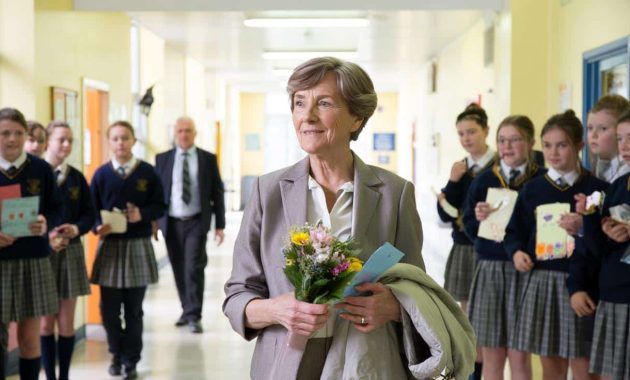
On a soft grey morning in Stranorlar, the corridors of Finn Valley College felt different. Not louder, not quieter, just charged with the kind of energy you get when everyone is pretending it’s a normal day, but everyone knows it isn’t. Outside the deputy principal’s office, a small queue had formed – former pupils who’d taken time off work, current students gripping handmade cards, staff holding back tears with practised smiles.
Inside, Kathleen Boland was doing what she’s always done. She was listening.
Forty years of faces, four decades of roll calls, detentions, phone calls home, whispered worries and proud results were walking past her door to say goodbye. She kept repeating the same line – “I’m the lucky one” – and you could tell she meant it.
There was only one problem. Nobody else in the building agreed with her.
Forty years of quiet leadership in Finn Valley
Ask anyone in Finn Valley College to describe Kathleen Boland and they don’t start with her job title. They start with memories. The teacher who spotted a talent for maths in a shy first year. The deputy principal who stood at the front door in the rain, greeting each teenager by name. The colleague who always had a spare pen, a quiet word, a Plan B.
Forty years is a long time in any school. Uniforms change, buildings grow, technology arrives in waves. Yet there was one constant in this Donegal school: the small, determined woman who walked the halls with a soft voice and a sharp eye, ready to catch the kid who was slipping before anyone else saw it.
One former student, now a nurse in Letterkenny, arrived on her day off with a box of Roses and a shaky speech she’d scribbled on the back of a payslip. She told the staffroom how, at 15, she’d been on the verge of dropping out. Her dad had lost his job. Money was tight, tempers shorter. Homework had fallen off the list.
Kathleen had called her out of class, not to lecture her but to sit her down and ask a simple question: “What’s going on?” That conversation turned into weekly check-ins, a quiet word with teachers, help filling out college forms years later. “I’d never have been a nurse without you,” the former pupil said, eyes wet, voice breaking. And the strangest part was how genuinely surprised Kathleen looked hearing it.
Stories like that floated around the school all week. They weren’t dramatic rescues or heroic Hollywood moments. They were the small, repeated acts that build a school culture across generations.
Teenagers at Finn Valley will tell you straight: they knew where they stood with her. Expectations were clear. Respect went both ways. When rules were broken, there were consequences, but there was also context. She understood the reality of rural life, long bus journeys, part-time jobs, families under pressure.
➡️ One bathroom product is enough: Rats won’t overwinter in your garden
➡️ Designing AI Workplaces That Support Early Career Growth
*That blend of firmness and fierce care is what left such a deep, almost invisible mark on the place.* You don’t always see leadership on a stage. Sometimes you feel it in how safe a corridor feels at 9.05am on a Monday.
The art of being “the person in the middle”
If the principal is the public face of a school, the deputy is the hinge. The person in the middle. The one who holds the line between policy and people. Over four decades, Kathleen became expert at that balancing act.
Her typical day rarely looked like the timetable suggested. She might start the morning solving a bus route issue, shift straight into managing a conflict between two classmates, then spend break time calming a worried parent on the phone. After lunch, she could be tracking attendance data, then rushing to supervise an exam.
The method behind it all was deceptively simple: be visible, be calm, be consistent. She walked the corridors, popped her head into classrooms, stood at the school gate. Every gesture said, “I’m here, I’m watching, and I care what happens next.”
Staff talk about her as “the glue”. Never the loudest voice in the room, rarely the one making a speech at assembly, but always the one quietly fixing what was about to fall apart.
There was the day a whole year group was on edge after a local tragedy. Rumours and half-truths drifted through WhatsApp groups before class. Kathleen spent that morning doing short, honest briefings with each group, grounding them with facts, clearing space for grief, carefully steering them back towards a normal day. No drama. No social media declarations. Just sleeves rolled up and heart fully engaged.
We’ve all been there, that moment when you walk into a room and feel tension before anybody says a word. She was the kind of leader who noticed that feeling first, named it, and began gently turning it down.
The logic behind her approach wasn’t complicated. Teenagers, especially in a close-knit community, need steadiness more than speeches. They remember who showed up consistently, not who arrived once with a big gesture.
Her retirement speech to staff was short, almost stubbornly modest. She thanked the cleaners by name. She mentioned the secretaries and the caretakers before she mentioned herself. Then she landed on a plain-truth sentence that hung in the air: “A school is only as strong as the way it treats the child who’s having their worst day.”
That line, by itself, explains why so many parents were quietly emotional reading the retirement notice on the school’s Facebook page that evening.
What her legacy quietly teaches the rest of us
Underneath the tributes and the flowers, there’s a kind of practical lesson in how Kathleen worked. She didn’t turn up to school each day to be “inspirational”. She turned up to be steady.
One of her little rituals was the morning door duty. Standing near reception, or just inside the main entrance when the buses poured in. A quick nod to the lad with the headphones. A raised eyebrow at the untucked shirt. A grin for the girl clutching a folder of notes for the mock exams.
If you watched closely, you’d see she was scanning. Who looked tired. Who didn’t make eye contact. Who was fashionably late three days in a row. Her trick was simple: catch the problem while it’s small. A quiet, “You alright?” at 9am can save a crisis at 2pm.
People on the outside sometimes imagine school leadership as a never-ending string of big decisions. In reality, most days are made of tiny, repetitive choices. Say something or let it slide. Walk past or walk towards.
Kathleen’s colleagues say she rarely let things slide. Not in a harsh way, but in a way that said, “You matter, and so does your behaviour.” She’d pull a student aside for a chat about language used in the yard, but she’d also be the first to notice when that same student went three weeks without a single note home.
Let’s be honest: nobody really does this every single day. Everyone gets tired. Everyone misses signals. Her gift was that she kept coming back to the basics, even on hard days. She forgave herself the off-moments, then reset. That’s a more realistic model of care than any glossy poster on a staffroom wall.
On her last week, a group of senior students asked if they could interview her for the school website. They expected talking points about exam results and new buildings. What they got was something much more down-to-earth.
“I won’t remember the grades as much as I’ll remember the faces,” she told them. “The first generation of a family who stayed in school. The student who came back to visit just to say they were doing okay. If I helped even a handful of young people to believe they belong here, that’s enough for me.”
Then she scribbled three bullet points on the back of a worksheet and laughed, calling it her “retirement homework” for the students coming behind:
- Show up, even when you don’t feel like it.
- Ask for help earlier than you think you should.
- Remember that one kind teacher can change everything.
A door closes, and the corridor keeps echoing
The day the staff gathered for her final send-off, the bell sounded as usual. First years rushed to lockers. Seniors compared CAO choices on their phones. Somewhere down the hall, a printer jammed and someone cursed quietly. Life in Finn Valley College didn’t stop. It bent around the absence that was starting to form.
Her office would soon belong to someone else. The noticeboard would lose the yellowing photos of old sports teams she refused to take down. The timetable would gain a new name in the deputy principal slot. Yet anyone who passed through that building over the last forty years will tell you: certain ways of doing things stay baked into the walls.
You see it in the way younger staff step in to de-escalate a heated moment instead of sending a student straight out. In the way students pause to hold the door for each other. In the way parents, who once walked those corridors as teenagers, now walk them again with their own children and feel, oddly, at home.
Her story is local and specific – a deputy principal in a Donegal college who gave forty years of her life to one community. At the same time, it taps into something bigger. All over Ireland, and far beyond, there are Kathleens quietly hanging up their lanyards, clearing their desks, and walking out through school gates they’ve opened before sunrise more times than they can count.
Maybe that’s the quiet invitation in her retirement. To notice the people who keep our schools, clubs, and communities stitched together. To tell them while they’re still in the building what they meant to us. And, if we’re lucky enough to be in any kind of leadership role, to ask ourselves a simple question: when we leave, what small, human habits will keep echoing down the corridors we once walked.
| Key point | Detail | Value for the reader |
|---|---|---|
| Long-term commitment shapes culture | Forty years in one school allowed Kathleen to influence generations of students and staff | Shows how consistent presence can quietly transform any workplace or community |
| Small actions matter more than big gestures | Daily door duty, quiet conversations, early interventions with struggling students | Encourages readers to focus on everyday habits rather than waiting for “big moments” |
| Legacy lives in people, not titles | Her impact is seen in former students’ stories and colleagues’ behaviour, not in awards | Invites readers to reflect on the kind of influence they want to leave behind |
FAQ:
- Why is Kathleen Boland’s retirement such a big moment for Finn Valley College?
Because she spent four decades as a steady presence in the school, shaping its culture, supporting generations of students, and guiding staff through change. Her departure closes a significant chapter in the college’s history.- What roles did she have during her 40 years at the school?
She began as a classroom teacher and later became deputy principal. Across those years she handled student support, discipline, communication with parents, and day-to-day problem-solving around the campus.- How did students describe her leadership style?
Many remember her as fair, calm, and quietly firm. She knew students by name, noticed when someone was struggling, and balanced clear expectations with genuine care.- What can other schools learn from her example?
That visibility, consistency, and early intervention go a long way. Being present in corridors, greeting students, and addressing issues while they’re still small can build a strong, respectful school environment.- How will her legacy continue at Finn Valley College?
Through the routines, attitudes, and values she helped embed: staff who de-escalate instead of explode, students who feel they belong, and a community that sees education as a shared, long-term project.