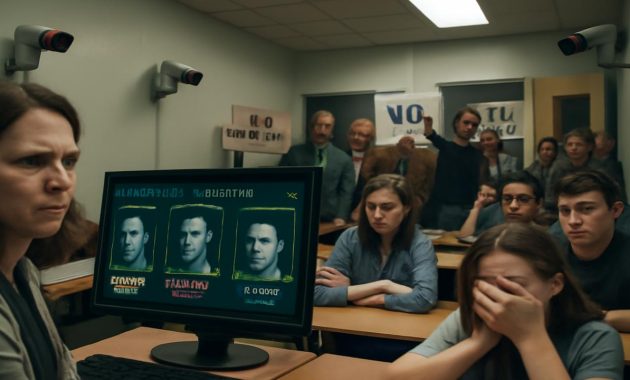

The email landed in inboxes at 6:42 a.m., just as coffee makers hummed to life and kids pulled on backpacks. By 7:03, the parent group chat was on fire. By 8:15, three parents had already driven to the school without appointments, hair still damp, confusion slowly hardening into anger. And by pickup time, the quiet little town that liked to brag about its “close-knit school community” had a new, unsettling claim to fame: it was the first in the district to install emotion-tracking cameras in every classroom, in the name of “protecting students.”
The First Time a Camera Stared Back
On Monday morning, thirteen-year-old Mia didn’t notice anything different as she shuffled into homeroom, hoodie pulled tight around her headphones. The fluorescent lights buzzed overhead, the usual low-grade headache of middle school. Posters lined the walls: “Growth Mindset!” “Be Kind!” “You Matter!”
But then she looked up.
It wasn’t the chalkboard or the clock that caught her gaze. It was a small, dark circle mounted high in the corner of the room, above the whiteboard. Except it wasn’t like the old security cameras in the hallways—the ones that everyone ignored. This one had a sleek black glass eye, polished and new, tracking the room from the corner like a bird of prey waiting for the right moment to move.
“What’s that?” she whispered to her friend Jonah, sliding into her seat.
“New cameras,” he shrugged, not looking up from his phone. “They put them in every room on Friday. My mom said something about safety.”
As more students filtered in, the buzz started. Some kids joked about their “good side” and fake-smiled at the lens. Others ducked their heads. A few simply pretended it wasn’t there. But the awareness of being watched threaded through the air like a new smell no one could quite identify yet.
The intercom crackled. The principal’s voice, usually calm and slow, carried an unfamiliar stiffness.
“Good morning, students. As you may have noticed, we have installed new classroom cameras to help us better protect you and support your emotional well-being. These cameras, powered by advanced artificial intelligence, help us identify when students might be struggling or in distress so we can intervene sooner. They are here to help keep you safe.”
The word “safe” hung in the room like a promise—and a threat.
“You Did What Without Telling Us?”
In the parking lot that afternoon, the air smelled like exhaust and dry leaves and outrage.
“You knew?” demanded one father, his voice a strained whisper on the edge of shouting, his hands gripping a crumpled printout of the school’s email.
“Know what?” asked another mom, shifting her toddler from one hip to the other.
He held up the paper so hard it shook. “Emotion-tracking cameras. They’re analyzing the kids’ faces. Detecting their moods. In real time.”
A small circle formed—parents in work clothes and gym shorts, some with coffee, some with dogs on leashes. Each of them had read the same email that morning. Some had skimmed it. Some had ignored it entirely. But now, as the details filtered through the whispered conversations, phones came out, thumbs scrolled, and the tone in the air changed.
“Wait, they can track emotions?”
“Is that even legal?”
“My daughter didn’t say anything about cameras this morning.”
“My son thought it was just ‘new security.’”
The email, with its sterile language, had sounded almost boring at the time: “In alignment with our mission to foster a safe and supportive school environment, we are implementing an advanced AI-based classroom monitoring system designed to recognize indicators of emotional distress and potential threats.”
But now, standing under the sharp afternoon sun, the implications unfolded like a slow, sick realization: their children’s faces, captured and analyzed; their micro-expressions quantified; their moods converted into data points in a system none of them had agreed to.
The School’s Promise vs. Parents’ Fear
Later that evening, the school’s website added a glossy new banner: “Pioneering Student Safety with Smart Technology.” A bulleted list described the supposed benefits:
- Real-time detection of student distress or agitation.
- Alerts to staff when patterns suggest bullying or emotional withdrawal.
- Data-driven insights to improve mental health support and classroom climate.
- Enhanced security against potential violent incidents.
To administrators and some teachers, the system sounded like a miracle tool—a new window into the mental and emotional worlds of students, many of whom suffered in silence. They pictured a quiet child finally getting help before things spiraled; a bullied student being noticed sooner; a potential act of violence averted by data that said, “Something is wrong here.”
But to many parents, it felt less like a window and more like a one-way mirror.
“I don’t care what they say it does,” one mother said flatly in a parent forum that quickly ballooned to hundreds of comments. “You do not get to turn my child’s face into data without my consent. You don’t get to read their emotions like a lab experiment.”
The deeper they dug, the more complex—and ominous—the situation became. The cameras weren’t just recording; they were running facial recognition-like software, mapping tiny muscle movements around the eyes and mouth, assigning emotional “scores” to students throughout the day.
Fear, frustration, boredom, engagement. Calm. Anger. Anxiety.
All transformed into neat little graphs and dashboards.
When Safety Starts to Feel Like Surveillance
Inside the school, the system hummed quietly in the background, invisible but always present. A teacher lectured on the American Revolution while, in a server room nearby, the software tracked how many students looked “disengaged” versus “attentive.” A group presentation unfolded—one student beaming with confidence, another shrinking into herself—and somewhere, a data log captured the difference in their emotional states in numeric form.
In principle, the idea seemed compassionate. The school hadn’t forgotten the stories: the student who stopped turning in homework, grew quieter and paler, and weeks later was hospitalized after a suicide attempt. The boy who joked and laughed his way through classes, then exploded into violence one day in the cafeteria. The subtle signs that so many adults missed until it was too late.
“If we had just known,” people always said afterwards.
The promise of emotion-tracking cameras whispered back: Now you will.
But what does it mean to grow up under an unblinking gaze? To sit in math class knowing that every frown, every smirk, every long stare at the window might be flagged as a risk signal? How does it change your sense of self to know that an algorithm is judging your inner life in real time?
Some students shrugged it off. Privacy, to them, was already a thin, tattered thing, worn down by social media, tracking cookies, and apps that knew more about their sleep habits than their parents did. The cameras were “just another thing.”
Others felt something more visceral—a quiet tightening in the chest, a sense that they could no longer just be.
“So if I zone out, I’m ‘disengaged.’ If I’m anxious, I’m ‘high-risk.’ If I laugh too loud, I’m ‘disruptive,’” one high schooler said at the dinner table, picking at her food. “Who decides what any of that really means?”
The Illusion of the Perfect Watcher
The technology company behind the system boasted a 90-plus percent accuracy rate in detecting basic emotions. Their promotional materials showed heat maps of classrooms, dots of color swirling over rows of desks, revealing who was “thriving” and who was “struggling.” Their reps talked about early intervention, personalized learning, safer schools.
But in the calls and messages between parents, a different set of questions circulated:
- Can a camera tell the difference between cultural norms of eye contact and “avoidance”?
- Will Black students be more likely to have their expressions misread as anger or threat?
- What happens when a kid on the autism spectrum is flagged as “abnormal” by software that doesn’t understand neurodiversity?
- Who is training the algorithm, and on whose faces?
Emotion AI, experts have quietly warned for years, is far from perfect. It struggles with nuance. It struggles across cultures. It struggles with the messy, complex reality of human feeling. Yet here it was, embedded in the daily life of children, making tiny decisions that might ripple into serious consequences: a call home, a meeting with a counselor, a note in a file.
The illusion of the perfect watcher is seductive. It suggests that if we just collect enough data—enough glances, flinches, furrowed brows—we can finally make sense of suffering and danger before they explode into the headlines that keep school leaders up at night.
But it also asks us to accept something enormous and unsettling: that constant emotional surveillance of children is a reasonable cost for a promise of safety that can never be fully guaranteed.
The Fine Print No One Saw Coming
At an emergency school board meeting called a week after the cameras were installed, the room overflowed. The air smelled like sweat, paper, tension. Some parents stood against the back wall. Others sat with arms crossed tight across their chests, phones recording.
The superintendent, flanked by legal counsel and the tech company’s representative, clicked through a PowerPoint presentation. Charts, bullet points, soft blue gradients trying to soothe the room.
“This system does not store video off-site,” the superintendent assured. “It does not identify specific students by name. Its sole purpose is to support the safety and well-being of our children.”
Hands shot up. Voices cut in.
“Who owns the data?”
“How long is it stored?”
“Can law enforcement request it?”
“What happens if the company gets bought, or hacked?”
A mother at the front held up a printout of the vendor contract, obtained through a public records request. Her voice shook, but her words were clear.
“Section 4.3: ‘Aggregated and anonymized data may be used to improve services and may be shared with research partners.’ Aggregated and anonymized. That’s my kid’s face. That’s her sadness. That’s his anxiety, his meltdown, turned into ‘research data.’ You told us this was about safety. You didn’t tell us it was about turning our children’s emotions into a product.”
On the projector screen, a calm slide labeled “Data Governance” looked suddenly thin and inadequate, like a flimsy lock on an overstuffed diary.
| Key Concern | What the School Says | What Parents Worry About |
|---|---|---|
| Student Privacy | No names stored; data “anonymized.” | Faces are still unique identifiers; anonymization can fail. |
| Data Ownership | District “controls” data use. | Vendor contract allows broader use for “improvement” and research. |
| Accuracy of Emotion Tracking | “High accuracy” in tests. | Bias, misinterpretation, and cultural differences could harm students. |
| Consent | Parents “notified” via email. | Notification is not meaningful consent or choice. |
Safety, at What Cost?
For the parents who had already lived through school lockdown drills, tragic news alerts, and sleepless nights, the idea of one more tool to keep their children safe wasn’t inherently outrageous.
What felt outrageous was the trade that had been made quietly, almost casually: a trade of privacy for the suggestion of protection, negotiated without them, on behalf of people too young to truly understand what they were giving up.
Because once children grow used to surveillance—once cameras watching their feelings become as normal as whiteboards and desks—something subtle but profound begins to shift.
They learn that their inner worlds are never fully their own. That adults and machines can lay claim not just to where they are and what they say, but to how they feel. That every flicker of emotion might be graded, logged, judged.
For some, it breeds self-consciousness. For others, it breeds a quiet resentment. And for a few, perhaps, it reinforces a dangerous lesson: that you survive by performing the “right” emotions, not by being honest about the wrong ones.
The Children Caught in the Middle
Lost in the arguments about contracts and data and legal standards is a simple, humbling reality: this is not an abstract debate for the students. It’s their lives, their classrooms, their skin prickling with the awareness of an invisible watcher.
Some kids react with brittle humor.
“Better smile,” one boy jokes as he opens his laptop. “Don’t want the robot to think I’m depressed.”
Others bristle.
“I already have anxiety,” a shy girl says in a small voice to her counselor. “Now I’m scared of my own face.”
And some, perhaps the most precariously balanced, retreat. They pull their hoodie strings tighter. They perfect blankness. They give the algorithm nothing to read.
There is a peculiar cruelty in asking children to simultaneously open up about their feelings and submit those feelings to mechanical judgment. Mental health advocates preach vulnerability, authenticity, permission to not be okay. But how authentic can anyone be when they know that even their unguarded moments are being harvested as data?
Imagining Another Way Forward
The question that haunts these debates is not simply, “Do we want safer schools?” Everyone, from the angriest parent to the most cynical teenager, wants that.
The real question is, “What are we willing to surrender in the name of that safety—and who gets to decide?”
Could there be a different path? One that invests less in watching and more in listening?
- More counselors with time to build real relationships, not just react to crises.
- Smaller class sizes so teachers can notice changes that no camera could understand.
- Spaces where students can speak about their fear, anger, and loneliness without fearing those emotions will be archived.
- Honest conversations with kids about technology, privacy, and consent—treating them as partners, not data sources.
The temptation of AI surveillance is that it seems to offer a shortcut. It suggests we can automate care, quantify concern, and algorithmically predict despair. But human safety, especially for children, has always been something slower, messier, and more relational. It happens in the pause after class when a teacher asks, “Are you okay?” and really means it. In the trust a student feels when they walk into a counselor’s office and know that their tears are not being fed into a dashboard.
In that crowded school board room, as the meeting dragged toward midnight, one parent stood up and said quietly, “If my child is hurting, I want a human being to notice—not a machine to measure it.”
It wasn’t a rejection of technology altogether. It was a plea for priorities.
Between Fear and Freedom
As the fight over emotion-tracking cameras spreads beyond a single school—to districts, state legislatures, tech panels, dinner tables—it forces a broader reckoning that reaches far beyond any one building or one brand of software.
What does childhood look like in an age when almost everything can be monitored, recorded, analyzed? Do we teach our children that the world is a place where danger lurks in every hallway, requiring constant surveillance to keep them alive? Or do we teach them that safety is something we build together—through trust, community, and the imperfect, face-to-face work of caring for one another?
The parents who stormed into the principal’s office that first bewildering morning weren’t just angry about a new device on the wall. They were grieving something more intangible and harder to name: the loss of the unobserved moment, the right to have a bad day without it becoming a data point, the fragile privacy of growing up.
For now, in that school and others like it, the cameras remain, their small dark eyes reflecting fluorescent light and teenage faces and the messy, complicated mixture of fear and hope that fills every classroom.
Some parents will keep fighting until the cameras come down. Others will reluctantly accept them, bargaining silently with their own unease: If this keeps my child safe, maybe it’s worth it. Students will adapt in ways adults can’t yet see, shaping themselves subtly around the gaze that never blinks.
Years from now, when today’s middle schoolers are grown, they may look back on those classroom cameras as a strange footnote of their youth—or as the moment a cultural line quietly shifted, and the private world of feeling became just another territory mapped, measured, and mined.
Between the promise of safety and the death of privacy, there is no easy answer—only a choice, made again and again, about how much of our inner lives we are willing to trade away, and whether we will let our children decide for themselves where that line should be drawn.
Frequently Asked Questions
Do emotion-tracking cameras actually work?
Emotion-tracking systems can sometimes identify basic expressions like smiles or frowns, but their accuracy drops with nuance, cultural differences, neurodiversity, and complex emotions. Many experts warn that these tools can misinterpret normal behavior and reinforce bias, especially for marginalized students.
Are schools allowed to install these cameras without consent?
Legality varies by region, but many schools rely on broad security or technology policies to justify installation with only minimal notification, not explicit consent. This legal gray area is one reason parents and privacy advocates are pushing for clearer regulations.
What happens to the data these cameras collect?
Typically, data is stored by or accessible to the district and sometimes the vendor. Contracts may allow the use of “anonymized” or aggregated data for system improvement or research. The long-term storage, potential sharing, and risk of breaches are major concerns for families.
Can this technology really prevent violence or self-harm?
There is little solid evidence that emotion-tracking cameras reliably prevent severe incidents. They may occasionally flag concerning patterns, but they can also generate false alarms or miss subtle distress. Many experts argue that investing in counselors, training, and community building is more effective for safety and mental health.
What are alternatives to emotion-surveillance in classrooms?
Alternatives include hiring more mental health professionals, reducing class sizes, training staff in trauma-informed and culturally responsive care, creating strong anti-bullying programs, and building channels for students to seek help voluntarily. These approaches focus on relationships and trust instead of constant monitoring.

Originally posted 2026-02-19 06:14:35.