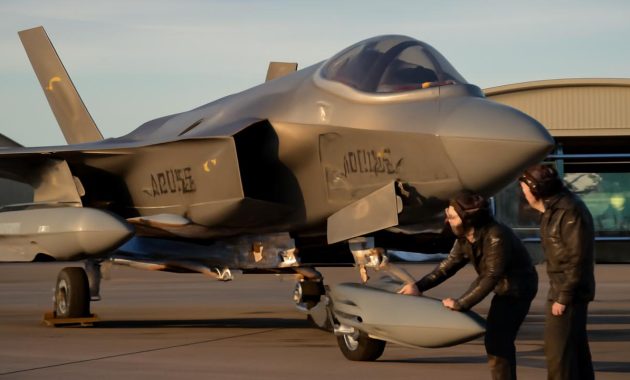

The rumble comes first, low and distant, like an approaching storm that never quite breaks. Then the shape materializes out of a colorless northern sky: a dark, angular triangle sliding silently over German fields and forests. Somewhere inside that aircraft, invisible to any eye on the ground, a weapon waits—one that can slip more than 500 kilometers through defended airspace without a whisper on enemy radar. In that quiet, in that strange combination of routine flight and latent power, a new strategic era for Europe is quietly taking shape.
A Sky That Suddenly Feels Smaller
Stand on a cold morning near Büchel Air Base in western Germany and the air feels charged in a way that has less to do with weather and more to do with history. For decades, this landscape has lived with the hum of fighter jets—first Phantoms, then Tornados—slicing the air above gentle hills and tidy villages. Their sound was part reassurance, part reminder: Europe still lives in a world where power needs wings.
But today, the noise is changing. The old, smoky roar of the Panavia Tornado is slowly giving way to the tighter, more controlled thunder of the F‑35A Lightning II, the stealth fighter that looks less like a traditional jet and more like something drawn with a ruler and a secret in mind. Its surfaces are razor-clean, its angles deliberate, its skin designed to bend hostile radar waves away like a mirror angled to throw back light.
Until recently, the arrival of the F‑35 alone would have been the story. Now, it’s only half of it. The other half travels hidden under a wing or tucked inside a weapons bay: a stealthy cruise missile, designed to slip through advanced air defenses and strike from hundreds of kilometers away—somewhere beyond the horizon, somewhere beyond human hearing. Europe, for the first time in its modern history, is on the verge of fielding a combination of aircraft and missile that can quietly reach deep into an adversary’s territory without being seen.
How a Silent Missile Changes the Map
To understand the significance, imagine standing in a control room with a digital map of Europe glowing softly on the wall. Borders shine in quiet, careful lines. Military planners talk in circles and ranges, not countries: what can be reached, from where, and how fast. For decades, that map was defined by aircraft like the Tornado that had to fly low and fast, dodging enemy radar, to deliver their weapons. The risk to pilots was enormous; the penetration distance was limited by human endurance, radar coverage, and the unforgiving geometry of missiles and fuel tanks.
Now, picture the same map, but change two things: the aircraft is stealthy, and the missile it carries can fly more than 500 kilometers, hugging the earth or slipping through valleys of radar shadow. Suddenly, circles of potential reach bloom outward like ink in water. An F‑35 doesn’t need to fly all the way to a target—it needs only to get close enough, quietly enough, for its missile to do the rest.
This is the world Germany is entering as it arms its F‑35s with a low‑observable, long‑range cruise missile. From German bases, the combination can cover swaths of airspace stretching far beyond Central Europe. To the east and north, areas that previously would have demanded large strike packages, electronic warfare escorts, and a considerable dose of luck can now be approached with a different logic: stay low on the radar, stay far from enemy fighters, let the missile slip in alone.
The technical language for this reads like a catalog of acronyms—LO (low observable), SEAD (Suppression of Enemy Air Defenses), A2/AD (anti‑access/area denial). But behind the jargon lies something more visceral. For the first time since the end of the Cold War, Germany isn’t just rebuilding its armed forces; it’s equipping them with tools that fundamentally change how deterrence feels, both to those who wield it and to those who might test it.
The Promise and Shadow of Stealth
Stealth, for all its mystique, is not invisibility. It is misdirection, a subtle kind of disappearance. On a radar screen, a stealth aircraft like the F‑35 is not a bold, bright streak but a hesitation, a whisper, a fragment that might be a bird, might be clutter, might be nothing at all. The missiles it carries echo that philosophy. Their shapes are smoother, their surfaces tuned to slip through radar frequencies like a swimmer slipping between waves. They fly low, following the earth’s contours, darting through gaps in sensor coverage with the quiet insistence of something that has studied its opponent’s defenses and found the seams.
When such a system exists in theory, it is impressive. When it exists in the inventory of a central European democracy with a deep historical unease about military power, it is something else entirely. It is both reassurance and provocation—a tool built not to be used, but to ensure certain lines are never crossed. Deterrence is always part psychology. A long‑range stealth missile in the bay of an F‑35 is a message written in metal: we can reach you, even if you don’t see us coming.
Germany’s Strategic Turning Point
The decision to purchase F‑35s was already a sign that Germany’s long post‑Cold‑War hesitation was cracking. Russia’s full‑scale invasion of Ukraine jolted Berlin into creating a special defense fund of 100 billion euros—a sum that would have seemed politically impossible only a few years before. The F‑35 program became one of its most vivid symbols: a fifth‑generation fighter to replace the aging Tornado, preserve Germany’s role in NATO’s nuclear‑sharing arrangements, and pull the Luftwaffe decisively into a new technological age.
But stealth aircraft alone do not shape strategy; the weapons they carry complete the picture. Arming those F‑35s with a low‑observable missile that can fly more than 500 kilometers means Germany is no longer thinking purely in terms of air defense or symbolic contributions. It is thinking in terms of deep strike, strategic reach, and the ability to directly threaten high‑value targets that sit far inside heavily defended territory—air defense hubs, command centers, logistics nodes, and critical infrastructure.
In war colleges and planning cells, this transforms Germany from a largely defensive actor to a country with credible first‑response options under a NATO framework. In living rooms and evening news panels, it raises older, more emotional questions: What does it mean, historically and morally, for Germany to hold such capabilities again? Can a country so haunted by its past ever sit entirely comfortably with silent weapons that can travel so far, so unseen?
Berlin’s answer, at least in official language, is carefully calibrated. These systems, it insists, are not about aggression but about insurance. They are about making sure no potential adversary miscalculates, no one looks at a map of Europe and sees a soft center. Yet even as politicians choose their phrases with surgical precision, the hardware on the tarmac tells its own story: Germany is stepping into a strategic role more assertive than any it has played in generations.
A New European Deterrent Landscape
To walk along the edge of a modern European air base is to be constantly reminded of coalition—flags from multiple nations, mixed crews, joint exercises that fold national lines into shared formations. NATO’s air power has always been collective. But capability is never perfectly symmetrical; some aircraft, some bases, some nations matter more in certain scenarios.
With stealth‑armed F‑35s, Germany begins to move into a category previously dominated by the United States and, to a growing degree, by a handful of other F‑35 operators like the UK and Italy. The shared picture of European deterrence starts to tilt and strengthen where those circles of range overlap. A crisis in the Baltic? F‑35s with long‑range missiles can threaten the air defenses and infrastructure supporting any move there. A flare‑up in the High North? The same combination provides a quiet but potent shadow over key nodes. And all of it can happen with fewer aircraft, from farther away, with less warning.
The psychological effect on adversaries is as important as the technical one. Defensive planners in Moscow or elsewhere must now assume that, in any serious confrontation, stealthy aircraft from multiple European countries could launch coordinated long‑range strikes against sensitive targets early in a conflict. That complicates planning, demands more investment in sensors and interceptors, and raises the risks of escalation for any move against NATO’s eastern flank.
What Power Feels Like in the Cockpit
Strip away the grand strategy, and the reality of this new capability comes down to something almost intimate: a pilot in a cockpit, a target on a screen, a decision made in a padded helmet and a suit that smells of coolant and flight hours. For the men and women who will fly these future missions, the arrival of a 500‑kilometer‑plus stealth missile changes the geometry of fear and responsibility.
In the days of low‑level penetration with older jets, a strike mission meant skimming the earth at high speed, trusting radar‑warning receivers and terrain‑following radars, feeling each gust of wind like a hand on the aircraft’s skin. Air defenses were not abstractions; they were specific hillsides, known SAM sites, expected trajectories of enemy fighters. The danger was personal, immediate, physical.
With a stealthy F‑35 and a long‑range missile, the personal risk line moves. The pilot may still face danger—no stealth is perfect, no airspace completely safe—but the deepest, most heavily defended targets no longer require them to fly into the teeth of enemy defenses. Instead, they can launch from a safer distance, watching the missile slip away on their displays before turning back toward home.
Yet if personal risk diminishes, moral weight grows heavier. The targets at the far end of a 500‑kilometer trajectory are no less real for being distant. A command bunker, an integrated radar facility, an air base quietly coming to life as crews prepare aircraft—all of these can be reduced to coordinates and timing sequences. It is one thing to drop a bomb on a visible runway; another to send a silent shape gliding into the darkness toward a place you will never see with your own eyes.
Numbers Behind the Quiet
In policy briefs, this transformation shows up as emission graphs and procurement schedules. Somewhere on a line item, the number of stealth jets and long‑range missiles turns from concept to inventory. Simplified, the mix looks something like this:
| Element | Old Reality | New Reality |
|---|---|---|
| Primary strike aircraft | Non‑stealth Tornado | Stealth F‑35A |
| Typical target distance | Short/medium range, closer penetration | Deep strike beyond 500 km from launch |
| Survivability against modern air defenses | Limited, high pilot risk | Significantly increased via stealth pairing |
| Deterrence impact | Regional and largely defensive | Strategic, deep‑reach deterrent |
On a mobile phone screen, those three columns compress into something easily scrolled past: old, new, more, less. On the ground, those differences reshape how Europe thinks about war and peace.
Echoes of History, Eyes on the Horizon
Germany’s landscape holds memories heavier than the aerodynamic weight of any modern jet. In forests and fields, in the silent relics of old airfields and underground bunkers, the continent’s twentieth‑century trauma hums softly beneath the surface of present‑day debates. It is no coincidence that every conversation about new German military capabilities carries an undertone of “never again”—never again aggression, never again complacency in the face of aggression.
The arrival of F‑35s armed with long‑range, stealthy missiles fits awkwardly and necessarily into that narrative. To some, this is overdue realism: a wealthy, central European state taking on a fair share of the burden of deterrence in a rougher world. To others, it is a dangerous step back toward a version of German power they thought had been locked away in the past. Between those poles, the majority live with a more complicated truth: power can protect and provoke at the same time, and there are no perfectly clean choices in a world where missiles already sit, visible and invisible, pointing both ways across borders.
On a crisp evening, as the last F‑35 of the day returns to base and its landing lights glow against the dusk, the question of what this all means condenses into something you can almost taste in the air. The aircraft taxis past hangars that hold maintenance crews, quiet tools, fuel lines, and somewhere behind secure doors, missiles resting on racks—sleek, patient, waiting for a mission everyone hopes will never come.
If deterrence works, they will age out quietly, replaced not by the concussion of war but by the dull bureaucracy of procurement cycles and budget lines. If it fails, they will streak into a night thick with the noise of interception attempts and the silent arithmetic of flight paths and impact points. The stakes, as ever, are far larger than the machines themselves.
Europe’s New Strategic Weather
Strategy, like weather, is something you feel before you can always name it. A chill in the air. A political statement phrased a little more sharply than usual. A series of exercises that move from theoretical to urgent in tone. Germany’s decision to arm its F‑35s with a stealth missile capable of striking more than 500 kilometers without detection is one of those changes in the strategic weather—subtle at first glance, profound when you trace the fronts on a map.
Across Europe, from the Baltic shores to the Alpine valleys, other nations are watching, adapting, and making their own choices. Some will deepen their own F‑35 fleets and long‑range strike options. Others will focus on air defense, on hardening infrastructure, on making it more difficult for any stealthy missile to arrive unchallenged. In Moscow and beyond, analysts will recalculate risk curves and escalation ladders, deciding how far they can lean without falling.
In that sense, each new F‑35 rolling out of a hangar in Germany is more than a machine. It is a signal, a vote, a quiet rewriting of the unwritten rules that have governed European security since the end of the Cold War. And the stealthy missiles that will one day slide into its bays are commas in that same unfolding sentence—pauses pregnant with meaning, barely visible until the moment someone tests where the period really sits.
For now, the skies above Germany remain mostly peaceful: contrails against high blue, the distant thrum of engines, birds wheeling over plowed fields. Down on the ground, technicians run their hands over composite skin, software teams patch code, planners refine scenarios that live, for the moment, only in simulations and classified binders. Somewhere between that quiet labor and the cold logic of deterrence, a new strategic era for Europe is being built—one stealthy jet, one silent missile, one uneasy but deliberate decision at a time.
Frequently Asked Questions
Why is Germany’s arming of F‑35s with long‑range stealth missiles so significant?
It marks a shift from primarily defensive, short‑range capabilities toward deep‑reach, high‑survivability strike options. This changes how potential adversaries must calculate the risks of confronting NATO and gives Europe more credible deterrence and response options.
Does this development make war in Europe more likely?
The intent is the opposite. By raising the potential cost of aggression—through systems that can strike critical targets far behind enemy lines—Germany and its allies aim to discourage any move that might escalate into open conflict. Stronger deterrence can, if managed carefully, reduce the likelihood of miscalculation.
Are these missiles nuclear‑armed?
The long‑range stealth missile concept is primarily about conventional precision strike—destroying key military and strategic targets without using nuclear weapons. Germany participates in NATO’s nuclear‑sharing arrangements, but its F‑35‑borne long‑range cruise missiles are focused on conventional deterrence and strike capability.
How does this affect NATO’s overall defense posture?
It strengthens NATO’s ability to penetrate advanced air defenses and threaten high‑value targets early in a crisis. Combined with similar capabilities in other allied F‑35 fleets, it creates overlapping zones of long‑range, low‑observable strike potential across Europe.
Is there a risk of escalation if such missiles are ever used?
Yes. Any deep‑strike capability carries escalation risks, especially if it threatens critical command and control nodes. That’s why such systems are embedded in tight political control frameworks and are intended primarily for deterrence—used only if other means have failed and under strict alliance decision‑making processes.

Originally posted 2026-02-10 03:47:25.