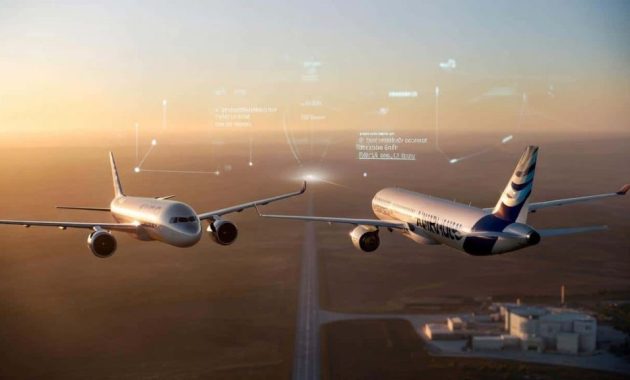
In a breakthrough demonstration of advanced flight coordination and automation, European aerospace manufacturer Airbus has successfully conducted a controlled test in which two aircraft converged toward the same spatial point under tightly managed conditions — without colliding.
While modern aviation already relies on highly sophisticated collision-avoidance systems, this test pushed the boundaries of precision timing, trajectory management, and automated decision-making. Engineers described the maneuver as a proof-of-concept for next-generation air traffic optimization systems.
What Actually Happened?
During the demonstration, two test aircraft were programmed to approach a predetermined intersection point in controlled airspace. Using advanced communication systems, real-time data sharing, and automated avoidance protocols, both aircraft adjusted speed and altitude with millisecond precision to ensure safe separation.
The result: both aircraft crossed the same geographic coordinates — but at precisely calculated microsecond offsets in time, ensuring zero risk of impact.
Why This Is Significant
Traditional air traffic control maintains strict horizontal and vertical separation standards between aircraft. This demonstration explored whether future automation systems could safely allow more dynamic routing without increasing collision risk.
| Feature Tested | What It Means | Why It Matters |
|---|---|---|
| Real-Time Data Exchange | Aircraft continuously shared speed and trajectory data | Improves predictive safety margins |
| Automated Conflict Resolution | AI-assisted adjustments in flight path | Reduces human reaction delay |
| Precision Navigation | Satellite-guided micro-adjustments | Enables tighter routing efficiency |
| Safe Separation Timing | Microsecond timing offsets | Maintains zero collision risk |
The Technology Behind the Achievement
The test relied on enhanced versions of Traffic Collision Avoidance Systems (TCAS), satellite-based navigation, and secure aircraft-to-aircraft communication protocols. Engineers say the system can predict potential conflicts far earlier than traditional radar-based methods.
By calculating trajectory intersections in real time, the system can determine whether two aircraft will occupy the same space at the same moment — and adjust speed or altitude automatically to prevent that scenario.
What This Means for U.S., UK, and Canadian Aviation
Aviation authorities such as the Federal Aviation Administration, the Civil Aviation Authority, and Transport Canada are closely monitoring advancements in automated separation technology.
Potential long-term benefits include:
• Reduced air traffic congestion
• Shorter flight times
• Lower fuel consumption
• Reduced emissions
• Increased airspace capacity
However, regulators emphasize that widespread deployment would require extensive safety validation and international coordination.
Not a Removal of Safety Margins
Experts stress that the test does not mean aircraft will begin flying dangerously close to each other in commercial operations. Instead, it demonstrates how predictive automation can enhance safety while optimizing efficiency.
Modern aviation remains one of the safest modes of transportation, with strict global separation standards still firmly in place.
Final Perspective
Airbus’s successful convergence test marks a significant step toward smarter, more automated skies. By proving that two aircraft can safely approach the same spatial point through advanced timing and coordination, engineers have opened the door to a new era of air traffic management — one focused on precision, efficiency, and enhanced safety rather than simple distance-based separation.
While commercial implementation remains years away, the demonstration highlights how aviation technology continues to evolve beyond what once seemed operationally impossible.
Originally posted 2026-02-19 22:22:48.