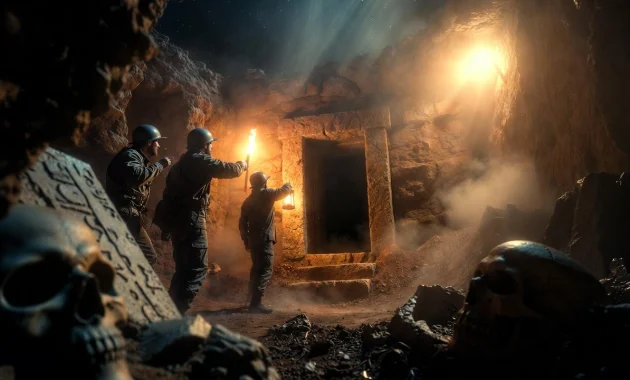
Imagine digging under a quiet green hill and suddenly finding a hidden medieval tunnel running through a 6,000-year-old burial site. That is exactly what happened in central Germany.
Archaeologists working before a wind farm project made an amazing discovery — a narrow underground tunnel called an Erdstall carved straight through ancient Stone Age graves.
This discovery is not just exciting; it changes how we understand history. It shows that people from different time periods used the same land in surprising ways.
Let us explore what this discovery means and why it is so important.
What Was Discovered?
Archaeologists found a medieval underground tunnel system beneath a hillside in Germany. The tunnel is known as an Erdstall, a type of narrow passage built during the medieval period.
What makes this discovery special is that the tunnel was carved through a much older Neolithic burial site that dates back around 6,000 years. The burial ground belonged to people from the Stone Age.
Key Facts About the Discovery
| Key Detail | Information |
|---|---|
| Location | Central Germany |
| Oldest Layer | Neolithic burial site (6,000 years old) |
| Later Structure | Medieval Erdstall tunnel |
| Discovery Trigger | Excavation before wind farm project |
| Tunnel Size | Less than 1 meter high and wide |
| Length | Several hundred meters |
This shows that the land was used again and again by different generations.
What Is an Erdstall?
An Erdstall is a small underground tunnel system found in parts of central Europe. These tunnels are usually very narrow — often less than one meter high — so people had to bend or crawl inside them.
Hundreds of Erdstalls have been found in places like:
- Germany
- Austria
- Bavaria
- Bohemia
But many questions still remain about their real purpose.
How Was the Tunnel Built?
The medieval builders carefully carved the tunnel through the ancient burial site without destroying most of the graves. That shows great skill and planning.
The tunnel has:
- Smooth curved walls
- Carefully shaped passageways
- Strong supporting beams
- Signs of repairs and long use
Even after hundreds of years, the tunnel remains well preserved. Archaeologists found tools and objects inside, showing that the tunnel was used for a long time.
Why Would People Dig Through an Ancient Burial Site?
This is one of the biggest mysteries.
There are several possible reasons:
1. Safety and Hiding
Some experts believe Erdstalls were used as secret hiding places during wars or attacks. People may have used them to escape danger.
2. Transportation or Communication
The tunnel could have helped people move secretly between places.
3. Religious or Spiritual Purpose
Because the tunnel passes through a burial site, it may have had a ritual or spiritual meaning. People in the medieval period might have believed the land was sacred.
Whatever the real reason, it is clear that the burial site still mattered centuries later.
How This Discovery Changes History
Before this finding, archaeologists thought the burial site was mostly untouched after the Stone Age. Now we know that medieval people interacted with it.
This shows something very important:
History is not separate layers — it overlaps.
The land is like a history book with many chapters written on top of each other.
The discovery proves that:
- Medieval communities respected or reused ancient sites.
- The landscape remained meaningful for thousands of years.
- Human activity in the area was continuous, not isolated.
Why the Wind Farm Project Was Important
Interestingly, the tunnel was discovered because of a wind farm construction project. Before building large projects, companies must allow archaeological surveys.
This proves why heritage preservation is important. If archaeologists had not checked the land first, the tunnel might have been destroyed.
Today, modern technology like ground scanning and soil imaging helps experts find hidden structures underground.
What This Means for the Future of Archaeology
The Erdstall discovery teaches us important lessons:
- Always study land carefully before construction.
- Ancient sites may contain surprises.
- Different time periods can connect in unexpected ways.
It also reminds us that we share the land with people who lived thousands of years before us.
Timeline of the Site
| Time Period | Event |
|---|---|
| 6,000 Years Ago | Neolithic burial site created |
| Medieval Period | Erdstall tunnel constructed |
| Present Day | Tunnel discovered during excavation |
This timeline clearly shows how history builds on itself.
The discovery of the medieval Erdstall tunnel inside a 6,000-year-old burial site is more than just an exciting news story. It shows how deeply connected humans are to the land. Generations separated by thousands of years used the same ground, each leaving their mark.
This finding reminds us that history is not simple or straight — it is layered and complex. It also highlights the importance of protecting our cultural heritage before modern development begins.
As archaeologists continue their work, we may discover even more hidden stories beneath our feet. The past is still alive, waiting to be uncovered.
FAQs
1. What is an Erdstall?
An Erdstall is a small medieval underground tunnel found in central Europe. It is usually very narrow and built below the surface.
2. How old is the burial site in Germany?
The burial site is around 6,000 years old and belongs to the Neolithic or Stone Age period.
3. Why is this discovery important?
It shows that medieval people used ancient burial land, proving that history overlaps and different time periods connect in surprising ways.
Originally posted 2026-02-01 09:23:07.