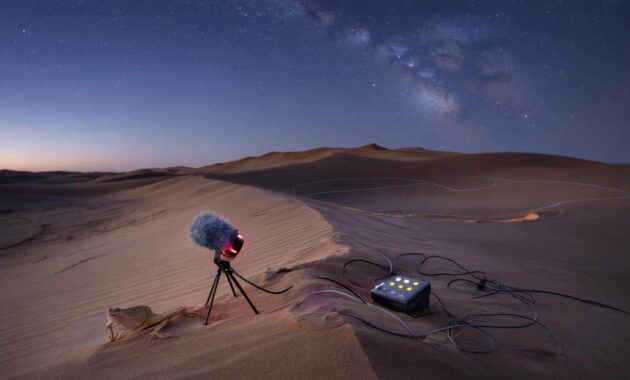
A desert dune doesn’t just sing in shimmering mids. Under the sand, an even slower voice beats—a low, pulsing rhythm too deep for human ears, now captured by ultra-sensitive microphones in the quiet hours between wind and dawn.
I watched a red LED blink against the Milky Way, a pulse the size of a firefly, and the wind’s hiss crawled back into its hole. The sand felt damp-cool on the skin, the way a wall stays cool after sunset, and the dune exhaled a whisper you could almost mistake for traffic from a faraway city. Then it happened, this soft, impossible thump, steady as a sleeping heart and too low to hear, recorded like a footprint. The equipment trembled a little. A gecko paused and listened, too. Something living was happening just beneath our boots. A bass secret rose.
The bass heartbeat hiding in the dunes
The desert is louder than you think, it just keeps most of the show below 20 Hz. With ultra-sensitive microphones tuned for infrasound, researchers are finding a slow, organized rhythm under the famous “booming” sands, a pulse that rides beneath avalanches and wind-borne ripples. **The low-frequency beat shows up as a clean, repeating pattern—like a metronome heard through a wall.** It doesn’t care if your ears miss it, because the dune hears it, and the dune responds. This under-sand tempo bends around ridges, threads through grasses, and sometimes echoes longer than the gust that made it.
In one field run near Morocco’s Erg Chebbi, a three-microphone array logged a regular 0.7–1.3 Hz rhythm for thirty minutes, its harmonics peeking at 2–4 Hz when a slip-face avalanche rolled. The audible “boom” spiked near 80–100 Hz, but the steady bass kept time like a drummer who never tires. Another team in China’s Badain Jaran caught similar pulses at 0.9 Hz with amplitude bursts just after each gust, as if the dune were syncing to breath. It wasn’t random weather noise stacked on weather noise. It had shape. It had timing.
Why a rhythm at all? Part of the answer sits in the boundary layer, that thin cushion of air sliding over the sand and picking up muscle from gusts. When wind crosses a dune crest, it sheds eddies at repeatable intervals, seeding grain flows that thicken into avalanches—and those avalanches can lock grains into synchronous collisions, a kind of granular choir. The dune also behaves like an acoustic waveguide, trapping energy and nudging it into set tempos tied to its size and slope. Some of that energy couples with the ground, some loops in the air above, and the rest hums in the deep.
How to capture the dune’s hidden beat
Pick the calm edges of the day—pre-dawn or the hour after sunset—when wind steadies and the dune stops shouting. Use an infrasound-capable mic or microbarometer (0.1–200 Hz), wrap it in a fluffy windscreen, and seat it in a shallow pit so the lip shields cross-breeze. Place a second sensor 10–20 meters away for context, and log at 500–1000 Hz to catch both bass and boom. If you can, map a small triangle to triangulate direction. Let the rig sit fifteen minutes before rolling, so the dune can forget you’re there.
Wind is your enemy and your signal, and this is where the craft lives. Keep cables loose to dodge handling noise, and tuck the recorder under a cloth to avoid thermal crackles when the air flips from warm to cold. We’ve all had that moment when a perfect take dies because a zipper tapped the housing. Bring extra batteries, because the desert eats power in ways that make no sense. Let’s be honest: nobody does that every day.
There’s also a mindset: patience over heroics, small adjustments over big moves, and a willingness to leave with “almost” and still feel proud.
“The dune is both instrument and room,” a geophysicist told me in the dark, “and your job is to stop conducting long enough to hear it conduct you.”
- Record in pairs: one on the slip face, one on the stoss side, to compare rhythm and boom.
- Bury a contact mic 5–10 cm deep to hear grain drumming without wind smear.
- Note gust intervals by feel or smartwatch; your notes will match the bass peaks later.
- Leave 60 seconds of “nothing” at the end; silence teaches you what’s signal.
What this low rhythm asks of us
Stand long enough on a dune and the landscape starts to feel like a lung. The low-frequency rhythm ties weather to geology, and geology to us, in a loop that’s both scientific and weirdly tender. **Field teams will argue models for years, but the recordings already change how we think about “silence.”** If a dune keeps time with a bass pulse, what else is moving to tempos we can’t hear—tundra ice, coral reefs, city blocks at night. Share the clip with a friend who swears the desert is empty and watch their face tilt into wonder. I kept thinking: the dune is breathing.
➡️ The trick with cling film that stops freezer burn on ice cream tubs
➡️ How to build passive income streams that generate £1,000 monthly without quitting your day job
➡️ Barbers explain why this haircut suits active lifestyles
| Point clé | Détail | Intérêt pour le lecteur |
|---|---|---|
| Hidden low-frequency rhythm | Dunes pulse at ~0.5–1.5 Hz beneath audible “booms” | Reframes the desert from silent to musical system |
| Best time and method | Record near dawn/dusk, pit-mounted infrasound mics | Practical steps to capture the rare bass beat |
| Why it happens | Wind eddies, granular sync, dune-scale resonance | Simple physics story you can retell and explore |
FAQ :
- What makes dunes “boom” and also throb in bass?The boom comes from grains colliding in sync around 70–100 Hz, while the bass rhythm rides the dune’s larger air–sand resonance and gust timing around 0.5–1.5 Hz.
- Can I hear the low rhythm without gear?Not directly. It sits in infrasound below human hearing, yet you can feel hints as faint pressure shifts on an incredibly calm night.
- Where are the best dunes to try this?Look for dry, well-sorted sands: Morocco’s Erg Chebbi, China’s Badain Jaran, Oman’s Wahiba, parts of Death Valley and the Namib.
- Will a phone mic capture it?A phone can catch the audible boom in perfect conditions, but the sub-20 Hz rhythm needs a dedicated infrasound mic or microbarometer.
- Is the phenomenon dangerous?No. It’s natural and gentle, though dunes shift terrain. Watch your footing, mind heat and wind, and go with a partner.