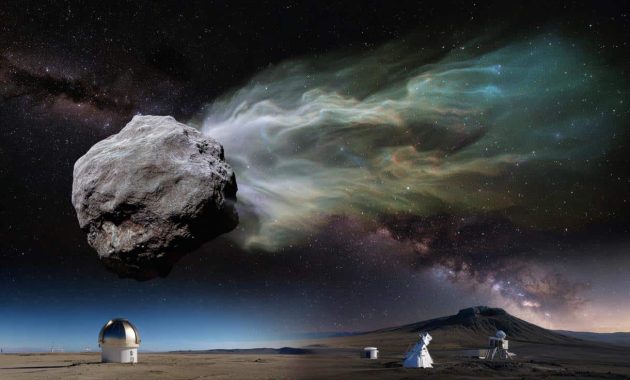
On a bare, wind-stung mountaintop in Hawaii, a small group of astronomers stare at a monitor that looks, at first, like static. A blurred smudge creeps pixel by pixel across a field of pinprick stars. Someone leans closer, pushes their glasses up, and the room goes quiet in that sideways way you only get in a control room at 3 a.m.
The smudge sharpens. Its tail flares, not quite like any tail they’ve seen from a local comet. The orbit, the speed, the angle — none of it sits comfortably inside the usual Solar System playbook.
That’s the moment they realize: this icy traveler has come from somewhere far beyond our Sun’s backyard. And it’s about to pose more questions than it answers.
A new interstellar visitor steps into focus
Astronomers are now unveiling a fresh batch of images of 3I ATLAS, an interstellar comet that’s been quietly rewriting what we thought comets could be. Captured across several observatories — from Chile’s dry, high deserts to Hawaii’s volcanic summits and space-based telescopes looking down from orbit — the views are breathtakingly different, yet strangely consistent.
On screen, 3I ATLAS doesn’t look like a tidy textbook comet. Its coma appears ragged, the tail kinked and twisted, as if carrying scars from a very long journey. That visual oddness is exactly what has scientists so excited.
The comet was first flagged by the ATLAS survey — the Asteroid Terrestrial-impact Last Alert System — which usually hunts for threatening near-Earth rocks, not interstellar wanderers. The software spotted an object moving just wrong enough that it wouldn’t fit any known orbit.
Follow-up observations poured in. The Pan-STARRS telescope in Hawaii tracked its path, while the Gemini Observatory snapped higher-resolution frames, and the European Southern Observatory’s VLT dissected its light into spectra. Each observatory added a thin slice of clarity. Together, they built a full-bodied portrait of an object that doesn’t belong here at all.
We’ve all been there, that moment when you sense something is out of place but can’t say why — that’s essentially what happened on a planetary scale.
What makes 3I ATLAS so striking is its hyperbolic trajectory. Rather than looping around the Sun in a closed ellipse, it’s on an open escape path, arriving fast and eventually leaving for good. That path, when plotted, refuses to bend into anything that could have started inside our Solar System.
Its speed and angle hint at a violent ejection from another star’s planetary nursery long ago. The new composite images — some combining visible, infrared, and even ultraviolet data — show a nucleus surrounded by dust grains that don’t quite match the size distribution seen in local comets. Astronomers suspect they’re looking at ice and rock that condensed under different starlight, in a different cosmic neighborhood, countless light-years away.
➡️ “A rejuvenating cut after 50”: The gloss bob is the trendiest hairstyle for spring 2026
➡️ Gray hair: 3 hair experts share their tips for rejuvenating salt and pepper hair without coloring it.
➡️ Airbus hailed and condemned after guiding two passenger planes to the same point in the sky with no crash “a daring breakthrough or sheer madness”
➡️ Science miracle: a baby is born in July 2025 from an embryo frozen since 1994
➡️ A “living fossil”: for the first time, French divers photograph an emblematic species in Indonesian waters
➡️ Keeping your bedroom door open at night might improve airflow enough to lower carbon dioxide levels and deepen your sleep but many experts say it also invites more noise light and security risks
➡️ Officially confirmed : heavy snow begins late tonight as weather alerts warn of major disruptions, travel chaos, and dangerous conditions
➡️ A Nobel Prize winning physicist says Elon Musk and Bill Gates are right about the future, with far more free time but fewer traditional jobs
Plain truth: we are literally photographing the debris of someone else’s solar system.
How the new images were captured — and what they really show
Getting these images wasn’t a case of just pointing a giant telescope and clicking a cosmic shutter. 3I ATLAS is faint, fast, and on a one-way track, which means observers had to plan their shots like a carefully choreographed heist.
Teams coordinated time slots across observatories so that as night fell in Chile, then in Hawaii, then in space, the comet could be followed almost continuously. Long exposure times risked turning it into a streak, so astronomers used “track-and-stack” techniques, digitally following the comet’s motion while the shutter stayed open.
The raw frames were messy, bathed in noise and background stars. Only after heavy processing did the comet emerge with its eerie, off-kilter tail.
One of the most striking sets comes from a collaboration between ground-based telescopes and the Hubble Space Telescope. Ground observatories captured the wide sweeping tail, revealing subtle ripples that hint at jets of gas breaking free. Hubble zoomed in tighter, isolating the coma and the inner dust envelope with a sharpness no Earth-bound lens can reach.
Astronomers describe a “layered” structure around 3I ATLAS: an inner core of denser material, wrapped in a more diffuse cloud that seems oddly asymmetrical. On some images, the tail almost bends sideways, like smoke blown across lanes of highway traffic. That asymmetry could be a clue to how its ices respond to the Sun — or to how they formed under a different star’s warmth in the first place.
*The closer they zoomed, the more alien it started to look.*
From a scientific angle, these images are more than pretty wallpapers. By measuring brightness in different filters, astronomers infer what kind of ices and dust are sublimating off the comet. Early analysis suggests a mix of carbon monoxide and carbon dioxide ices that’s richer than some local comets, hinting that 3I ATLAS might have formed farther from its original star than our own comets typically do.
Spectral fingerprints taken with the VLT and Gemini show subtle dips and peaks that point to complex organics — carbon-based molecules that, while not life, are often associated with the raw chemistry that precedes it. That doesn’t mean 3I ATLAS is a carrier of alien microbes. It does mean that the building blocks of biology might be floating between stars more often than we thought.
These new images, pixel by stitched pixel, are turning a faint blur into a detailed biography of a traveler from deep space.
Why this interstellar comet matters for the rest of us
For most people, a fuzzy dot in a telescope doesn’t sound life-changing. Yet the way scientists approached 3I ATLAS holds a lesson that translates far beyond astronomy: they treated a fleeting visitor as a one-shot chance to learn, then built a global network around that urgency.
If you want to follow along from home, there’s a surprisingly practical method. Start with the public image releases from observatories like ESO, Gemini, and NASA, then look for their “data stories” or observing logs. These often include side-by-side comparisons and simple explanations of what each color or filter represents.
Suddenly, a strange teal glow isn’t just pretty — it becomes a sign of a specific gas, a hint about temperature, or a clue about how long the comet’s been venting into space.
The common mistake, both in science and in daily life, is to treat unfamiliar things as either terrifying or irrelevant. Interstellar objects can fall into that trap easily: they’re distant, they won’t hit us, they’re gone in a few months, so why care?
Astronomers working on 3I ATLAS push against that reflex. They share their findings on social media, break down complex graphs into accessible visuals, and openly admit when they don’t know what they’re seeing yet. That honesty draws people in instead of shutting them out.
Let’s be honest: nobody really reads dense research PDFs every single day. But a haunting image of a comet from another star? That might stop you mid-scroll.
“Every time we capture one of these visitors,” says one researcher involved with the 3I ATLAS campaign, “we’re effectively running a lab experiment we could never build on Earth. Our lab bench just happens to be a few hundred million kilometers wide.”
- Look at color with curiosity
Blues and greens often trace gases; reds and oranges tend to highlight dust or heat. Ask what each shade is trying to say. - Compare wide and close shots
Wide-field images show how the comet interacts with surrounding space, while tight zooms reveal texture and structure in the coma and tail. - Notice the shape of the tail
A straight, flowing tail hints at simple solar-wind physics; kinks, bends, or forks can signal violent jets or a complex spin. - Read the captions, not just the headlines
Captions often hide the best nuggets: exposure times, filters used, and small surprises the team didn’t expect. - Keep an eye out for the next visitor
2I Borisov and 3I ATLAS are likely just the start. The bigger surveys coming online will turn “once in a lifetime” into “every few years.”
A stranger from another Sun, caught in the act of leaving
Even as you read this, 3I ATLAS is already fading, sliding back toward the dark between the stars. The new images being released are, in a sense, memory work: humanity’s attempt to pin down a visitor that refused to stay.
What lingers is the feeling that our Solar System is less isolated than we once thought. First came 1I ‘Oumuamua, then 2I Borisov, and now 3I ATLAS, each caught only briefly, each stranger than the last. Together, they hint at a galaxy busy with debris, planetary scraps and icy seeds swapping star systems over billions of years.
Some readers will just marvel at the visuals, zooming in on filaments of dust like cosmic brushstrokes. Others will see something more unsettling: that our Sun’s story is just one thread in a vast, tangled fabric where worlds form, break, and send fragments wandering.
Those fresh, high-resolution frames of 3I ATLAS are a reminder that even the smallest blur on a monitor might carry the echo of a place we’ll never visit, under a sky we’ll never see — and yet, somehow, that distant history has swept right through our own.
| Key point | Detail | Value for the reader |
|---|---|---|
| Interstellar origin of 3I ATLAS | Its hyperbolic trajectory and high speed prove it was born around another star | Gives a tangible example of how other solar systems physically interact with ours |
| Multi-observatory imaging campaign | Data from ATLAS, Gemini, VLT, Hubble and others were combined into layered images | Shows how global collaboration turns a faint dot into a rich, understandable story |
| Chemistry and structure revealed | Spectra hint at unusual ices and complex organics; images show asymmetrical tail and coma | Connects stunning visuals to real clues about how planets and the building blocks of life form |
FAQ:
- What exactly is 3I ATLAS?
3I ATLAS is an interstellar comet, meaning it originated outside our Solar System and is just passing through once on a hyperbolic trajectory. The “3I” label marks it as the third confirmed interstellar object, and “ATLAS” comes from the survey that first spotted it.- How do astronomers know it’s from another star?
Its orbit isn’t closed like regular comets; it’s open and hyperbolic, with a speed and incoming direction that can’t be explained by our Sun’s gravity alone. When the orbit is calculated back in time, it doesn’t intersect the outer Solar System in a way that would make sense for a locally born object.- Can we see 3I ATLAS with a backyard telescope?
At its brightest, it skirted the edge of what advanced amateur telescopes could capture, especially with long exposures and dark skies. For most people, the best view is through processed images from professional observatories, which reveal far more detail than the eye could catch at the eyepiece.- Why are the new images such a big deal?
They don’t just look impressive; they unlock details about the comet’s composition, structure, and behavior under our Sun’s light. That information helps scientists compare 3I ATLAS to local comets and work out how different — or similar — other planetary systems might be to our own.- Will we ever visit an interstellar comet with a spacecraft?
Not with current technology on such short notice. Missions usually take years to plan and launch, and interstellar visitors move too fast and appear too suddenly. There are early-stage concepts for “ready-to-go” interceptor probes that could wait in space and sprint toward the next object, but those ideas are still on the drawing board.