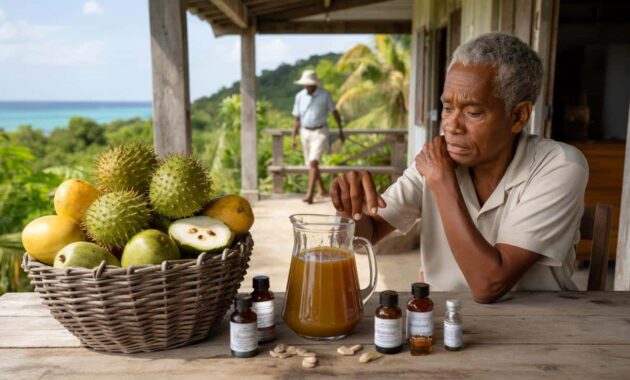
On sunny Caribbean islands, a beloved tropical fruit ritual is facing fresh scrutiny from neurologists raising unsettling questions.
For decades, certain fruits have been promoted as natural relaxants and folk remedies across the Antilles. A long-running French study now suggests that, eaten often enough, they might also quietly increase the risk of a severe, unusual form of Parkinson’s disease.
Caribbean comfort food under the microscope
In Guadeloupe, Martinique and other islands, fruits from the Annonaceae family — especially soursop (known locally as corossol), custard apple (cachiman) and sugar apple (pomme cannelle) — are part of daily life.
They are blended into juices, churned into ice creams and sorbets, steeped in herbal teas and sold as “natural” supplements meant to soothe anxiety or help with sleep.
New findings from neurologists in Guadeloupe link high, long-term consumption of these fruits to a particularly aggressive, early-onset form of Parkinson’s disease dubbed “Caribbean Parkinson’s”.
The research team at the neurology department of the University Hospital of Guadeloupe has spent more than twenty years tracking neurological disorders among local residents in the French Antilles, French Guiana and Réunion Island.
Over time, they noticed that many patients shared similar dietary habits. Heavy, regular consumers of soursop and related fruits seemed over-represented among people developing a distinctive neurodegenerative syndrome.
What is “Caribbean Parkinson’s”?
The condition identified by the team resembles Parkinson’s disease but behaves differently from the typical form seen in Europe or North America.
In some Caribbean regions, this atypical syndrome reportedly accounts for up to 70% of Parkinson-like cases, far above what specialists expected.
Classic Parkinson’s usually begins with tremors, muscle stiffness and slowness of movement, with cognitive decline appearing much later, if at all.
➡️ Neither bleach nor baking soda: this magic mix cleans your trainers and makes them look new
➡️ France And The Rafale Lose A €3.2 Billion Deal After Last‑Minute U‑Turn
➡️ The Norfolk home of the grandmother of Diana, Princess of Wales, has come to the market
➡️ Archaeologists Are Astonished: A Mosaic Emerges Linking The History Of Rome And Ancient Egypt
➡️ Experts analyse Nivea cream – and what they find may surprise you
➡️ With its 337 metres and 100,000 tonnes, the world’s largest aircraft carrier rules the oceans
➡️ In the middle of the Pacific, satellites are tracking colossal waves reaching 35 metres high
In “Caribbean Parkinson’s”, motor symptoms are often accompanied very early by:
- Memory lapses and difficulties concentrating
- Marked cognitive decline
- Behavioural changes
- Visual hallucinations or unusual perceptions
These features overlap with conditions such as dementia with Lewy bodies, complicating diagnosis and treatment. Local neurologists were struck by the pattern and began to suspect that environmental or dietary factors might play a role.
The plant toxin at the heart of the suspicion
The key suspect is a naturally occurring molecule called annonacin, found in high amounts in soursop and other Annonaceae fruits.
Annonacin is a potent neurotoxin that interferes with how brain cells produce energy, damaging neurons over time when exposure is high and chronic.
Laboratory research suggests that annonacin disrupts mitochondrial respiration — the process by which cells generate the energy needed to function. When this machinery fails, neurons become vulnerable and can die prematurely.
Researchers also report that annonacin promotes the accumulation of toxic proteins inside brain cells. These protein clumps resemble those seen in classical Parkinson’s disease, strengthening the hypothesis that repeated exposure could trigger a neurodegenerative cascade.
Why processed products may be riskier
Traditional home use of these fruits — the occasional fresh slice or seasonal dessert — is not the main concern raised by the Guadeloupe team.
The spotlight is instead on concentrated preparations:
- Industrial juices and nectars containing large amounts of fruit pulp
- Herbal teas made from soursop leaves or seeds
- Capsules and extracts marketed as “natural anti-cancer” or “stress relief” remedies
These products can deliver much higher, more frequent doses of annonacin than a simple piece of fresh fruit. In many cases, labels do not mention annonacin content, leaving consumers unaware of the quantities they are ingesting.
A long-running investigation with global echoes
The Guadeloupe study adds to a broader scientific debate about the role of environmental toxins in neurodegenerative diseases.
Mechanisms linked to annonacin toxicity closely resemble the effects of certain pesticides long suspected of increasing Parkinson’s risk.
For neurologists, this similarity is not just a technical detail. It points toward a wider picture in which multiple exposures — from food, water, air and workplace chemicals — might combine to push still-vulnerable brains over a threshold.
The team also refers to a historical case far from the Caribbean: the Pacific island of Guam. In the mid-20th century, a wave of parkinsonian and dementia-like syndromes hit the population. Years later, researchers traced a strong association to frequent consumption of products made from cycad plants, which contain neurotoxic compounds. As those food practices waned, the mysterious illnesses gradually declined.
For specialists in Guadeloupe, Guam serves as a proof of concept that dietary habits alone can shape the prevalence of complex neurological diseases across generations.
Call for caution, not a ban
Despite the alarming headline potential, the researchers are not asking governments to outlaw soursop or related fruits. These foods remain part of local culture, identity and economy.
The goal is not to stigmatise a traditional fruit, but to reduce prolonged high-dose exposure where the risk appears greatest.
Recommended actions discussed by the team include:
- Clearer labelling of juices, teas and supplements made from Annonaceae fruits
- Public health campaigns highlighting the risks of daily, heavy consumption
- Guidelines on safe frequency and portion sizes, especially for older adults
- Further toxicology studies to define exposure thresholds for annonacin
Such measures would allow people to keep occasional culinary traditions while avoiding sustained, concentrated intake that might harm the brain over decades.
Who should be most vigilant?
The concern is higher for certain groups:
| Group | Why they may face higher risk |
|---|---|
| Older adults | Ageing brains are more vulnerable to neurotoxic damage. |
| People with a family history of Parkinson’s | Genetic susceptibility could amplify the impact of environmental toxins. |
| Heavy consumers of soursop drinks or supplements | Chronic, high-level exposure to annonacin accumulates over years. |
| Residents also exposed to pesticides or other chemicals | Combined toxic hits may have additive or synergistic effects. |
How much is too much?
One of the biggest gaps is the lack of precise “safe” limits. Unlike alcohol or caffeine, there is no widely recognised threshold for annonacin intake.
Experimental work indicates that very high doses can cause neurodegeneration in animals. Translating that to everyday human consumption, and adjusting for individual differences, is far from straightforward.
For now, many neurologists recommend a precautionary approach: treat concentrated soursop products as something to enjoy rarely rather than daily, especially for people already worried about their neurological health.
What this means if you love soursop
For Caribbean families, this debate cuts close to home. Soursop juice is often associated with childhood, family gatherings and local pride. Being told that a traditional food may pose long-term risks can feel like an attack on culture itself.
Health professionals in Guadeloupe are trying to strike a careful balance: respect for heritage on one side, blunt scientific data on the other.
A practical way forward is not abstinence, but moderation plus informed choice — especially regarding industrial drinks and “natural” remedies claiming miracle benefits.
Someone who drinks a small glass of homemade soursop juice once in a while is in a different situation from someone taking high-dose soursop capsules every day for years because an advertisement promised anti-cancer effects.
Looking ahead, researchers hope better regulation and transparent labelling will help people make decisions without guilt or panic. As with many environmental factors linked to brain disease, risk tends to build quietly over long periods rather than from a single meal.
A wider conversation about food, toxins and the brain
This story also raises broader questions that go beyond a single tropical fruit.
Parkinson’s disease and related disorders appear to arise from a mix of genes, ageing and lifetime exposures to various chemicals. That mix is different in each region of the world, shaped by farming practices, industrial history and culinary customs.
From British farmland pesticides to American industrial solvents and Caribbean plant toxins, communities are now confronting how everyday environments can leave a mark on the brain. The Guadeloupe findings add another piece to that puzzle, suggesting that even cherished natural products may carry hidden neurological costs when consumed without limits over a lifetime.