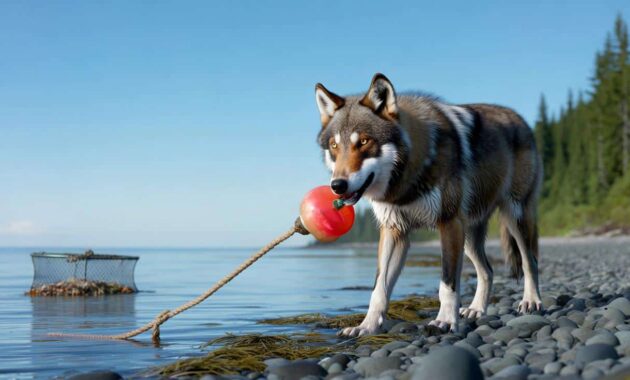
On a quiet stretch of Canada’s Pacific coast, a single trail camera captured something that upends how we judge animal minds.
What looked at first like routine footage of a coastal wolf quickly turned into a small cognitive thriller: a wild predator methodically stripping food from a human crab trap, step by step, as if it had rehearsed the scene.
A three‑minute sequence that has scientists rewatching on loop
The scene unfolds on the shores of the Haíɫzaqv (Heiltsuk) Nation territory in British Columbia, where dense forest meets cold Pacific water. In the middle of the day, a lone coastal wolf appears at the water’s edge with a bright buoy clamped in its jaws.
Instead of shaking it like a toy, the wolf adopts a precise routine. It braces its body on the pebbled shore, then begins to walk backwards, pulling steadily.
This is not a single lucky tug: the wolf repeatedly grips the rope and hauls, as if following a plan it already knows.
The buoy is attached to a rope, and that rope leads to a crab pot sitting on the seafloor. With each pull, the trap inches closer to land. Within less than three minutes, the wolf has dragged the crab trap fully onto the shore.
Then comes the most striking part. The animal does not waste time attacking the metal frame. Instead, it targets the plastic bait cup fixed inside the trap, extracts the food, eats calmly, and walks away, leaving the gear behind. The footage ends almost as abruptly as it began.
The mystery of the “vanishing” crab traps
The trap wasn’t there by chance. Local Indigenous Guardians had set up a line of crab pots as part of an ecological programme tackling invasive European green crab, a species that threatens local shellfish and eelgrass beds.
For months, some traps had been turning up empty, damaged, or had gone missing entirely. People on the coast suspected bears, sea otters, or even curious boaters. No one really considered wolves as prime suspects.
The trail camera settled the question. The video, recently analysed in the journal Ecology and Evolution by researchers Kyle A. Artelle and Paul C. Paquet, shows a wolf performing a series of tightly ordered actions that look less like trial-and-error and more like a chain of reasoning.
➡️ 12 things flight attendants notice about you the moment you board
➡️ The gendarmerie issues a warning: drivers must look at the ground before getting into their car
➡️ All You Need Is A Toilet Roll: The Gardener’s Trick That Transforms Your Plants
➡️ No bag, no foil: the magic trick to freeze bread and keep it crusty
➡️ Putting a cork in your fridge: the simple trick that fixes your biggest kitchen headache
➡️ Feeling mentally active but emotionally flat is a common psychological imbalance, experts explain
➡️ The meaning of this traffic sign that most drivers ignore – until they get a hefty fine
Researchers describe the behaviour as fast, structured and goal‑directed, suggesting the wolf was not simply gambling on random movements.
Is a wolf that pulls a rope using a tool?
The crab‑trap incident drops right into a long‑running scientific argument: what counts as “using a tool” in animals?
- Some scientists use a broad definition: any object manipulated to reach a goal could be a tool.
- Others argue for a stricter view: the object must be clearly modified or handled in a flexible, targeted way.
- Simple actions like pulling a rope are often left out of the “tool use” category.
At first glance, the wolf is only tugging on a buoy and a rope. But context matters. The bait hidden inside the trap is not visible from shore. The animal still performs a sequence that implies it understands the links between buoy, rope, trap and food.
The wolf appears to act as if: buoy leads to rope, rope leads to trap, trap holds something edible. That chain of invisible connections is precisely what many researchers look for when trying to distinguish instinct from something closer to reasoning.
Did the wolf learn this alone or from others?
Artelle and Paquet note that this might not be an isolated act. Other traps in the same area had been dragged, emptied or broken in similar ways. That pattern hints at two possibilities: either more than one wolf has figured out the trick, or the behaviour is spreading within the local population.
Wolves are highly social. They watch each other, copy behaviours and sometimes improve on them. In captivity, dingoes and domestic dogs have already shown they can learn to pull ropes, press levers or open latches to get rewards.
The Canadian footage suggests wild wolves may be capable of comparable problem‑solving, given the right conditions and enough freedom to experiment.
If one wolf in the Haíɫzaqv territory cracked the “code” of the crab traps, others may have learned by simply observing from a distance, then trying it later when alone.
Why this coastal wolf might think differently
The setting may be a big part of the story. The coastal wolves of British Columbia live in a relatively protected region, where hunting pressure is lower and human contact is more controlled than in many other parts of North America.
That matters for cognition. When animals are constantly under threat, they often prioritise avoidance and speed over curiosity. In safer landscapes, they can afford to investigate new objects, test behaviours, and refine tricks without the same level of risk.
The researchers argue that what they call “behavioural freedom” can shape how intelligence appears in the wild. When a wolf is not fleeing bullets or traps, it has time and mental space to study a strange buoy bobbing offshore and try to turn it into lunch.
| Context | Likely behaviour |
|---|---|
| High persecution, frequent disturbance | Short, cautious investigations, rapid flight, little trial‑and‑error |
| Protected, low human pressure | Longer observation, repeated attempts, inventive problem‑solving |
Rethinking how we test animal logic
The coastal wolf incident also highlights a blind spot in classical lab experiments. Many cognitive tests for animals take place in highly controlled, artificial environments with puzzles designed by humans: boxes with levers, computer screens with shapes, mazes for rodents.
Those tests are valuable, yet they capture only a fraction of what an animal can do when faced with real‑world challenges that matter to it, such as finding food in a tricky place or working around human infrastructure.
A single wild behaviour, caught by chance on camera, can sometimes say more about an animal’s mind than hours of laboratory trials.
In natural settings, the cost of failure is higher. A misjudged leap, a badly chosen route or an overconfident approach to humans can be fatal. When an animal still takes the risk to interact with a human device, and succeeds in a structured way, that behaviour deserves careful attention.
What this means for people living with wolves
For coastal communities, the clever wolf raises fairly practical questions. If a predator can systematically raid crab traps, the economic impact could grow, especially in regions where small‑scale fishing supports local families.
At the same time, the story adds weight to Indigenous accounts describing wolves as observant, adaptive beings, fully attuned to the coastline. For the Haíɫzaqv and other Nations along the Pacific, wolves are not just background wildlife; they are neighbours shaping and responding to the same seascape.
Managers now face a balancing act between protecting fisheries, controlling invasive species and acknowledging that wildlife will inevitably “hack” human devices when given a chance. Stronger lids or modified bait systems might slow the thefts, but they also risk triggering new rounds of adaptation from curious wolves and other animals.
Key terms that help make sense of the case
Several concepts often used in animal cognition research help frame what happened on that Canadian shoreline:
- Cognitive flexibility: the ability to adjust behaviour when past routines no longer work. A wolf that learns to use a buoy rather than just scavenging shoreline carcasses shows this flexibility.
- Social learning: picking up behaviours by watching others. If more coastal wolves start looting traps, scientists will be looking closely for signs of this.
- Problem‑solving: finding a new sequence of actions to reach a goal, such as linking buoy, rope and trap to access hidden food.
These terms can sound abstract, yet they describe everyday challenges for wild animals. A fox crossing a busy road at night, a crow dropping nuts on pavements, or a bear testing car doors in a campsite all show variations of the same skills.
How far could this kind of behaviour go?
Imagine a stretch of coast with dozens of traps, lines and buoys set by different fishers. If even a small number of wolves learn to exploit them, the behaviour might spread through a pack across several seasons.
Young wolves, growing up around these devices, could start treating buoys as regular food cues, just as urban foxes associate rubbish bins with meals. In a few years, “trap‑raiding” might become part of the group’s cultural knowledge – skills handed down not through genes but through observation.
That possibility raises both fascination and concern. On one hand, it shows that a predator can adjust quickly to human technology. On the other, it suggests conflict may escalate if people see wolves as competitors not only for wild prey but also for their fishing gear.
For now, the three‑minute video from British Columbia stands as a rare, vivid record of a mind at work. A single wolf, wet from the Pacific, walks up onto the stones, takes a buoy, and turns a human device against its maker – not by brute force, but by understanding how the parts fit together.