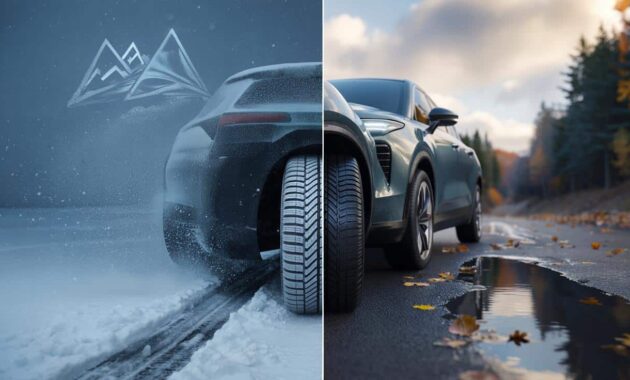
Grip, braking and confidence do—especially when the forecast keeps changing by the hour.
That’s why the tire choice question returns every autumn. Winter tires or all-season? The right call depends on how you drive, where you drive, and how often your roads see snow, slush or black ice.
What really changes when temperatures drop
Rubber chemistry decides your grip. Summer compounds stiffen below roughly 7°C (45°F). All-season stays workable longer. Winter compounds stay flexible in freezing conditions.
How tread design affects traction
Winter tires use deep sipes and aggressive blocks. Those tiny cuts bite into packed snow. They clear slush. They shorten stops on ice. All-season tread blends wet grip channels with fewer sipes, favoring a broader operating window rather than peak snow traction.
Below freezing, the right compound matters as much as tread. Stiff rubber slides. Flexible rubber grips.
Winter tires: built for frequent snow and ice
Pick winter tires if your area sees regular snow, recurring freeze-thaw cycles, or long stretches below 0°C (32°F). Independent tests often show 20–40% shorter stopping distances on snow compared with typical all-season tires at urban speeds. Steering response also improves when roads glaze over after sunset.
Strengths you feel on the road
- Faster bite off the line on packed snow.
- Shorter stops on ice and cold, wet asphalt.
- Greater stability in deep slush and on steep, untreated streets.
There are trade-offs. On warm, dry pavement, winter compounds wear faster and feel softer. That affects precision and increases noise. Plan a seasonal swap to avoid premature wear once daily highs rise.
All-season and “all-weather”: not the same thing
Many drivers lump both into one category. They shouldn’t. Standard all-season tires suit a wide range of spring-to-autumn conditions and light winter days. “All-weather” tires are a sub-category designed to carry the 3PMSF winter mountain snowflake symbol, meaning they meet a minimum snow traction benchmark.
| Tire type | Best temperature range | Snow/ice performance | Markings | Where it fits |
|---|---|---|---|---|
| Winter | Freezing and below | High on snow, better on ice | 3PMSF + often M+S | Regions with regular snow and freeze |
| All-weather | -5°C to +25°C (23–77°F) | Moderate; better than all-season | 3PMSF + M+S | Mild-to-moderate winters, occasional snow |
| All-season | 0°C to +35°C (32–95°F) | Low; light snow only | Usually M+S | Coastal or lowland areas with rare snow |
If you want one set year-round where winters are mild, look for the 3PMSF symbol. It signals winter-rated “all-weather,” not just generic all-season.
What the symbols and laws actually mean
M+S (Mud and Snow) appears on many tires, but it’s not a winter performance test. 3PMSF (Three Peak Mountain Snowflake) marks tires verified for a minimum snow traction standard. Winter tires carry 3PMSF by design. All-weather models worth the name do as well.
➡️ France edges out UK to clinch €6.7 billion deal for India’s 6th?generation fighter engine
➡️ Gut microbiome and everyday flatulence: unexpected numbers
➡️ Why your retirement dreams may be quietly sabotaged by the one ‘safe’ habit you refuse to question
➡️ Transparent biodegradable cardboard: Japan’s new weapon against plastic pollution
➡️ Exiled in the US, Surya Bonaly, 52, hits out at France: “I no longer had my place there”
➡️ Psychology says the loneliest part of getting older isn’t being alone
Rules you should know in the UK and US
- UK: No winter tire mandate. 1.6 mm is the legal minimum tread depth, but 4 mm is widely recommended for winter traction.
- US: Laws vary by state. Some mountain passes require chains or adequate winter traction during storms. Studded tires have date and state restrictions. 2/32 inch is the legal minimum tread depth in most states; aim for at least 5/32 inch for snow.
Check local chain controls and traction advisories if you cross high-altitude routes. 3PMSF tires often meet traction requirements when chains aren’t mandatory, but rules change with conditions.
How to choose based on your actual winter
Start with your postcode and your routine
- Frequent snow or morning ice? Choose winter tires.
- Mild winters with occasional flurries? Consider 3PMSF all-weather.
- Rare snow, quick gritting, mostly urban driving? Quality all-season can work, with cautious driving on cold mornings.
Think about your car, not just your climate
- EVs and hybrids: Heavier curb weight and instant torque can tax traction. Choose a tire with a higher load index and snow rating if you see winter.
- Performance cars: Ultra high performance all-season offers better cold grip than summer tires, but still trails winter tires on snow.
- AWD: Helps you go. Tires help you stop and turn. AWD does not replace winter compounds on ice.
AWD gets you moving. The right tires get you stopped.
Cost, wear and the storage question
Two sets cost more up front, but they stretch tire life because each set works only part of the year. The cost often balances over several seasons, especially if winter conditions would otherwise chew up all-season tread through spinning and sliding.
A simple back-of-the-envelope example
Say a single set of all-season tires costs $700 and lasts 40,000 miles in your climate. A set of winter tires at $650 and a set of summer or all-season tires at $700 might each last 35,000–40,000 miles because you split use. Over 80,000 miles, your cost per mile can look similar, while winter grip increases markedly. Add $80–$150 per seasonal swap if you don’t run a spare set of wheels. A second wheel set adds cost now but saves on mounting fees later.
Practical checks that boost safety fast
- Tread depth: Aim for 5/32 inch (4 mm) for snow days. Below that, snow traction drops quickly.
- Pressures: Cold shrinks air. Expect roughly 1 psi down for every 10°F drop. Top up monthly.
- Rotation: Every 5,000–8,000 miles evens out wear and preserves grip.
- 3PMSF symbol: Verify on the sidewall if you rely on one set year-round in a cold region.
When all-season makes sense, and when it doesn’t
All-season shines when roads rarely see packed snow and councils or DOT crews clear fast. Commuters in coastal cities and low-elevation suburbs often manage with a premium all-season and a cautious right foot. Add a set of chains in the boot for trips to the hills.
All-season struggles when ice lingers on shaded streets or morning black ice bites. If you’ve twice considered working from home due to road conditions last winter, you sit in winter tire territory.
Studs, chains and a quick word on braking
Studded tires help on polished ice but come with noise, dry-road trade-offs and legal limits. Modern non-studded winter tires perform strongly on mixed winter surfaces while staying legal everywhere. Chains or textile socks add insurance for steep or unplowed routes. Keep them sized to your tire and practice fitting once in dry conditions.
Extra nuance for EV drivers
Weight and instant torque can push tires past the limit sooner on slick surfaces. Look for winter or all-weather models with higher load ratings, efficient rolling resistance and robust siping. Regenerative braking also changes weight transfer, so smooth inputs matter more. Many EV-specific winter tires now balance range, noise and cold-weather grip.
Two last pieces of advice that save the day
If you regularly see snow or sub-zero mornings, go winter. If you see mostly cold rain with a few flurries, go 3PMSF all-weather.
Plan your changeover by temperature, not calendar. Swap to winter when daytime highs hold near 7°C (45°F) and back to summer or all-season when spring stays warmer. That simple timing step preserves tread life and keeps stopping distances short when the first sheen of ice arrives.
If you want to go deeper, try a mini “risk map.” Mark your weekly routes. Note shaded bridges, ungritted lanes, steep driveways and early-morning commitments. Any cluster of winter risk points shifts you toward winter tires. A clean map with rare mountain trips points toward all-weather or all-season plus a chain set.