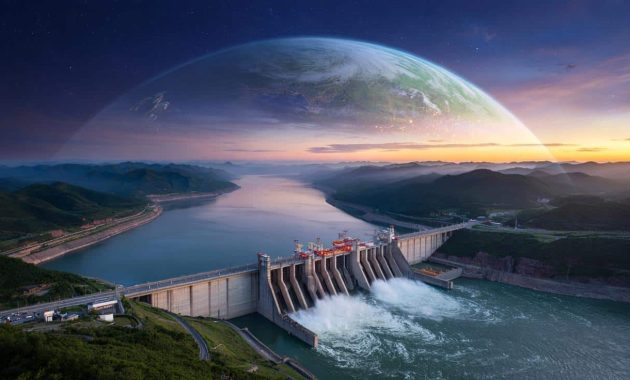
As China reshapes one of its great rivers with a hydroelectric dam of staggering proportions, researchers say the project does something else too: it nudges the way our planet spins, stretching the length of the day by a fraction of a microsecond.
China’s giant dam that moves time by a fraction
The project at the heart of this story is the Three Gorges Dam, an immense hydroelectric installation on the Yangtze River in Hubei province, central China. Built over nearly 18 years and fully operational since the early 2010s, it is widely cited as the largest hydroelectric dam on Earth in terms of installed capacity and reservoir volume.
Chinese authorities designed the dam with several goals in mind: flood control for a notoriously dangerous river, huge electricity production for an energy-hungry economy, and a strong political statement about national power and engineering prowess.
The mass of water stored behind the Three Gorges Dam is so large that it slightly changes how Earth spins on its axis.
According to France’s National Centre for Space Studies (CNES), the reservoir can hold roughly 40 cubic kilometres of water. Put differently, we are talking about around 10 trillion gallons shifted from a fast-flowing river into a vast elevated lake. That redistribution of mass is what brings NASA into the story.
Nasa’s verdict: yes, megastructures can tweak Earth’s rotation
Back in 2005, NASA researchers examined how major events and massive engineering projects can influence Earth’s rotation. The starting point was not a dam, but the devastating 2004 Sumatra-Andaman earthquake and tsunami, which literally shook the planet.
That quake rearranged huge blocks of rock in Earth’s crust. When the internal mass of the planet moves, the way it spins changes, just as a spinning top wobbles when its weight shifts. NASA scientists calculated that the 2004 event shortened the length of the day by about 2.68 microseconds.
“Any global event that involves the movement of mass affects Earth’s rotation,” explained Dr Benjamin Fong Chao of NASA’s Goddard Space Flight Center.
The same physical principle applies to human-made projects. Move enough mass high or low, closer or further from the axis of rotation, and you adjust the planet’s moment of inertia. That is a measure of how easily an object spins. A higher moment of inertia means a slower rotation.
➡️ Better Than “Mission Impossible”? This SSD Card Is Designed To Self-Destruct If Hacked
➡️ Meteorologists warn early February could expose extreme Arctic behavior unseen in decades
➡️ This is what professional organizers focus on before cleaning starts
➡️ No longer ‘experimental’: Navy to deploy drone boats this year, official says
➡️ Japan decries Chinese export restrictions that could cripple defenses
➡️ Few people know it but heating water or milk in the microwave is a bad idea
➡️ An astrophysicist calls out Elon Musk : “Even after a nuclear apocalypse, Earth would be paradise compared to Mars.”
➡️ Emotional value in beauty: how confidence trumps physical perfection
The ice skater analogy: why water placement matters
A simple way to picture all this is to think of a figure skater. When skaters pull their arms in, closer to their body, they spin faster. When they stretch their arms out, they slow down. The total spin energy stays almost the same, but its distribution changes.
Earth behaves in a similar way. Mass concentrated near the equator or at higher elevations increases the moment of inertia, which makes the daily rotation marginally slower. Mass pulled towards the centre or towards the poles speeds it up.
When the Three Gorges reservoir fills, vast amounts of water sit higher above sea level than before. NASA’s calculations suggest that this shift slightly increases Earth’s moment of inertia. The effect on time is tiny, but measurable with modern instruments.
How much does the Three Gorges Dam slow Earth’s rotation?
NASA’s team estimated that a full Three Gorges reservoir would extend the length of the day by about 0.06 microseconds. For comparison, the earthquake that unleashed the 2004 tsunami changed the day by about 2.68 microseconds.
| Event | Estimated change in day length |
|---|---|
| Three Gorges Dam filled | +0.06 microseconds |
| 2004 Sumatra earthquake | -2.68 microseconds |
A microsecond is one millionth of a second, so 0.06 microseconds is 0.00000006 seconds. No clock in your home would ever show the difference. Even an atomic clock needs long time spans to track changes that small.
The Three Gorges effect on time is real, but far too small to affect daily life or technology.
NASA’s analysis also noted a subtle shape change. By rearranging water, the dam very slightly makes Earth rounder at its middle and a touch flatter at the poles. That effect is also minuscule, detectable only through precise geophysical measurements.
Why scientists still care about such tiny changes
If nobody can feel a 0.06 microsecond stretch to the day, why bother? For geophysicists, these small perturbations act like a diagnostic tool. They help scientists understand how mass moves around the planet over time, and how sensitive our rotation is to these shifts.
Several forces and processes constantly tug at Earth’s spin:
- Large earthquakes that rearrange rock in the crust and mantle
- Melting ice sheets, which transfer water from polar regions into the oceans
- Seasonal weather patterns, moving air and water around the globe
- Human engineering projects such as dams and large-scale groundwater extraction
Each factor adds or subtracts microseconds from the day. Added together, they change the long-term behaviour of Earth’s rotation, including tiny variations known as length-of-day fluctuations.
Climate change, dams and shifting water masses
Climate change is already altering the distribution of water on the planet. As ice sheets in Greenland and Antarctica melt, water flows into the oceans, subtly changing Earth’s rotation and even its axis tilt. Studies show that mass loss from ice and glaciers has already caused the axis to drift by several centimetres per year.
Large reservoirs add another layer. They tend to concentrate water inland and, often, at higher elevations than the sea. When countries build dozens of big dams, the cumulative effect on Earth’s rotation and shape becomes more complex and worth tracking precisely.
Still, current research suggests that natural processes, especially ice melt and mantle dynamics deep under the crust, dominate the long-term picture. The Three Gorges Dam stands out as a striking example because of its sheer scale, not because it dramatically rewrites planetary physics.
What “slower days” actually mean
Earth’s rotation is not perfectly stable. It gradually slows down over millions of years as tidal forces between Earth and the Moon transfer energy. That long-term braking is why scientists occasionally add “leap seconds” to Coordinated Universal Time.
Changes induced by dams and earthquakes sit on top of that slow trend. In practice, this means timing agencies track Earth’s rotation carefully using radio telescopes and satellites. When the difference between atomic time and Earth’s rotation grows large enough, they adjust official timekeeping by a second.
The Three Gorges Dam’s contribution is so small that it does not directly trigger leap seconds. Instead, it is one tiny variable among many in the equations that keep global time in sync with the planet’s spin.
Key terms behind the headlines
Two technical ideas often come up in this discussion: moment of inertia and length of day.
Moment of inertia describes how mass is distributed relative to an axis of rotation. A dumbbell spun with weights at the ends has a high moment of inertia and rotates more slowly for the same energy than one with weights near the centre. The Three Gorges reservoir effectively shifts water away from Earth’s centre of mass, increasing that moment.
Length of day (LOD) is the precise duration of one complete rotation of the planet. On paper, it is 24 hours, but in reality it flickers by milliseconds and microseconds. Geophysicists track LOD changes to understand what is happening inside Earth and on its surface.
Future scenarios: what if we built many more “Three Gorges”?
One common question is what would happen if dozens of dams on the scale of Three Gorges were built worldwide. Based on current physics, even a large global programme of megadams would only nudge day length by a few additional microseconds.
That scale of change would still sit far below any level that would disrupt daily human activity, seasons, GPS systems or satellite operations. The more prominent concerns around such dams remain social and environmental: displaced communities, river ecosystems, sediment build-up and earthquake risks triggered by reservoir weight on faults.
What the NASA work highlights is not a new existential threat, but a striking illustration of how interconnected engineering, climate and fundamental planetary behaviour have become. A single infrastructure project on one river, in one country, now has effects that can, with enough precision, be traced all the way to the length of the day itself.
Originally posted 2026-02-17 16:09:34.