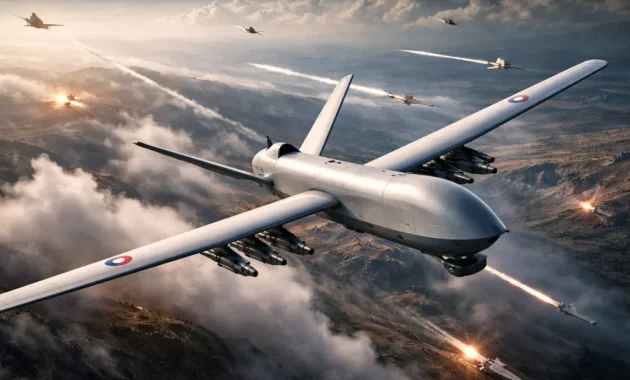
France has quietly stepped into a new era of long‑range warfare, betting on a cheap, fast kamikaze drone designed less to show off technology than to overwhelm it. Behind the scenes, defence giant MBDA and a major French carmaker are preparing to mass‑produce a weapon that could change how Europe fights.
A 500 km “one-way” drone built to die on target
MBDA’s new project carries a telling name: One Way Effector. This is not a drone that returns to base. It is built to be fired in swarms, fly hundreds of kilometres, and end its mission in an explosion.
This is France’s entry ticket into the club of nations able to launch long‑range, ground‑based precision strikes with an all‑domestic system.
The concept sits halfway between a cruise missile and a classic loitering munition. It is faster and more robust than many hobby-style drones seen in Ukraine, but far cheaper than high‑end missiles such as SCALP or Storm Shadow.
Key performance figures
According to internal figures shared around the Bourget air show, the One Way Effector is designed around a few simple, aggressive parameters.
| Parameter | Value |
| Maximum range | 500 km |
| Speed | Above 700 km/h |
| Propulsion | Compact jet engine |
| Warhead | 40 kg explosive payload |
| Employment | Massed salvo launches |
| Guidance | Autonomous or semi‑autonomous |
The drone is not stealthy and does not try to rival advanced cruise missiles in accuracy. Its role is different: it is a tool for saturation. Fired by the dozen or the hundred, it forces enemy radars and surface‑to‑air missiles to light up and react.
From Ukraine to Paris: war by numbers
The concept behind the One Way Effector is rooted in the lessons of Ukraine. Since 2022, Kyiv has repeatedly shown that relatively simple drones, used in large numbers, can damage strategic targets deep inside Russian territory.
One operation in early June 2025, dubbed “Spiderweb” by Ukrainian forces, reportedly hit several Russian air bases more than 700 km from the front line. Ukrainian drones damaged or destroyed dozens of aircraft, including Tu‑95 and Tu‑22M3 bombers and an A‑50 early‑warning plane.
The underlying lesson for Western militaries is blunt: quantity can erode quality if it is cheap and produced quickly enough.
➡️ In 2008 China was building subway stations in the middle of nowhere In 2025 we realized how naive we were
➡️ Far beyond luxury: The Qatari Royal Family has a gold escalator and a multi-billion dollar fleet of up to 12 aircraft, including Boeing 747-8 BBJ and Gulfstream G700, with values ??exceeding US$400 million.
➡️ Here Is How A Bay Leaf Can Make You Look Younger: Visible Effects In Just A Few Days
➡️ “I wasn’t inactive, yet felt stiff”: what finally explained the tension
➡️ Why constant improvement attempts can actually disrupt garden balance
➡️ 9 phrases self-centered people commonly use in everyday conversations, according to psychology
➡️ Astronomers unveil stunning new images of interstellar comet 3I ATLAS captured across several observatories
➡️ She reported her neighbor for feeding stray cats and won in court, now the whole town is asking who really crossed the line
For European planners used to relying on a small fleet of exquisite assets, this shift is uncomfortable. Expensive jets and missiles remain vital, but they increasingly need clouds of cheap systems ahead of them to soak up enemy fire.
Flooding the sky: how France plans to use it
French officers see the One Way Effector less as a sniper and more as a hammer. Its job is to turn a calm radar screen into chaos.
A typical use could look like this:
- Ground launchers fire a salvo of dozens of drones towards a defended area.
- Enemy radars detect multiple incoming tracks at high speed.
- Surface‑to‑air units start launching interceptors and repositioning assets.
- Each interception consumes expensive missiles and reveals radar locations.
- Once the air defence layout is exposed, high‑value weapons or manned aircraft strike the key sites.
Even when shot down, the drones force the opponent to expend resources and reveal positions. When one gets through, its 40‑kilogram charge is enough to damage fuel depots, radar stations or parked aircraft.
“Not a gadget”: a shift in French doctrine
MBDA chief executive Éric Béranger has framed the project as a response to “new quantitative requirements” on modern battlefields. In other words, France cannot rely only on Rafale fighters and million‑euro missiles if it wants to keep up.
The One Way Effector sits at the heart of a “swarm doctrine”. Instead of a handful of rare assets, commanders get the option of launching barrages of inexpensive, semi‑autonomous drones before committing their best platforms.
Automotive-style production: 1,000 drones a month
The truly disruptive part of the project may not be the airframe itself, but the way MBDA wants to build it. The company has teamed up with a major French car manufacturer, whose identity remains confidential, to apply automotive mass‑production methods to weapons.
The target capacity is 1,000 units a month, an output rate closer to a car plant than a traditional missile line.
To reach those numbers, MBDA is leaning on:
- Modular design, allowing rapid assembly and easier repairs on the line.
- High automation, with robotics handling repetitive tasks.
- Supply chains drawn from the civilian sector to cut costs and delivery times.
Analysts expect unit prices somewhere between €30,000 and €50,000 per drone, depending on the guidance package. For context, a SCALP cruise missile can exceed €1 million, while a single Rafale costs upward of €100 million before weapons and support.
The programme began discreetly in late 2024 and is now entering a demonstration phase. A first full‑scale test is planned before the end of the year. If trials go well, MBDA aims for serial production in 2027.
Strategic stakes for Europe
The race for loitering munitions and long‑range drones is already crowded. The US fields systems like Switchblade and the XQ‑58A Valkyrie. Iran has exported waves of Shahed drones. China is pushing a broad portfolio of armed drones and stand‑off missiles.
Europe has lagged, split between national projects and slow joint programmes. The One Way Effector offers something different: a relatively affordable, mass‑producible weapon built on European soil, with few foreign dependencies.
Yet adoption is not guaranteed. The French armed forces have traditionally favoured high‑performance, long‑life equipment. Embracing a “cheap and disposable” mindset means reshaping doctrine, training, logistics and even political messaging about how France fights.
Invisible threats, visible risks
Arms‑control experts already warn that such systems can lower the threshold for long‑range strikes. A truck‑mounted launcher firing dozens of kamikaze drones might feel less politically heavy than sending manned jets across a border.
There are also questions around proliferation. Once Europe masters low‑cost, high‑volume production, export pressures will follow. States facing internal conflicts or tense borders may want these tools. That raises issues of targeting ethics, civilian risk and long‑term regional stability.
What “loitering munition” really means
The One Way Effector sits in a broader family often described as loitering munitions. These are weapons that can fly to a general area, wait for a target, then dive in.
Unlike classic drones:
- They are not meant to return; the airframe is part of the warhead.
- Endurance can be traded for speed or cost.
- Guidance often mixes pre‑programmed routes with last‑second target selection.
In practice, that means commanders can launch an attack even if the exact target is not yet visible when the system leaves the launcher. The weapon can loiter near airbases, radar sites or fuel depots and then commit once an aircraft lands or a radar switches on.
How such drones reshape a campaign
On a hypothetical conflict’s first night, France could choose to saturate enemy air defences with several waves of One Way Effectors. The first wave would map radar activity and force the opponent to waste pricey interceptors. A second wave could focus on newly identified command posts or logistics hubs. Only once the protective umbrella thins out would Rafales and high‑end missiles move in against the hardest targets.
For smaller European states, similar systems could offer a form of “poor man’s deep strike”. They would not replace aircraft or large cruise missiles, but they could complicate the plans of a stronger neighbour, simply by threatening airbases and infrastructure hundreds of kilometres away.
At the same time, this sort of capability pushes air defence planners to look for new answers: better radar networking, cheaper interceptors, directed‑energy weapons, and more resilient base layouts. As France prepares to flood hostile skies with low‑cost threats, adversaries are already thinking about how to drain their sting.