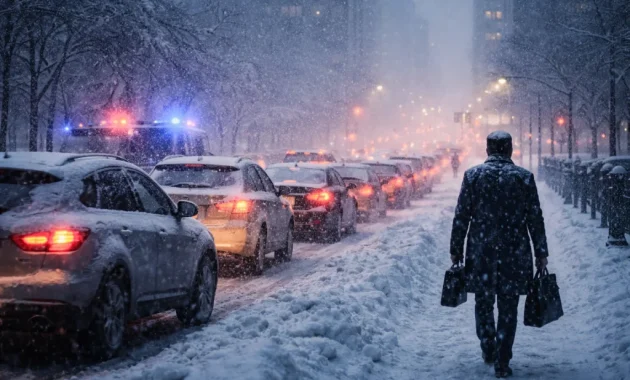
On the dashboard, the snowflake warning light blinked on just as the radio cut to the emergency bulletin. “Heavy snowfall overnight. Non-essential travel strongly discouraged. Stay home if you can,” the announcer repeated, in that calm-disaster voice that always sounds slightly out of breath. Out on the ring road, taillights were already smeared red through the first thin veil of flakes, like someone had rubbed the world with a frosted thumb.
In the same moment, phones buzzed across town. New emails. New notifications. “Reminder: All staff are expected to report to the office tomorrow.” No mention of the weather. No mention of the governor’s plea. Just the quiet steel of expectation.
On one side, police and meteorologists begging drivers not to become statistics. On the other, managers drafting performance warnings in case they do.
The storm hasn’t arrived yet. The clash already has.
Public safety says ‘stay home’, your boss says ‘get in the car’
The forecasts for tonight aren’t gentle. We’re talking a wall of snow, not a pretty postcard dusting. Meteorologists are warning of whiteout conditions, sheets of ice under fresh powder, and wind gusts strong enough to shove a car half a lane sideways. Authorities are using rare, serious words on social media and in press conferences: “life-threatening,” “treacherous,” “do not travel.”
Yet just a few miles away, in warm glass offices, some executives are pressing send on emails that read like they were written in June. “Business as usual.” “We expect operations to continue uninterrupted.” No hint of the spinning tires, the jackknifed trucks, the frantic hazard lights that tend to follow these forecasts.
The message is clear, and it’s not subtle. Your life is a variable. The meeting is not.
Take one logistics worker we’ll call James. He drives a 14-year-old sedan with worn-out snow tires and a windshield crack that spiderwebs just enough to annoy, not enough to fail inspection. Tonight, the local sheriff’s office is begging residents online to stay off the highways after 8 p.m. Snowplow crews admit they’ll be behind all night. Schools have already announced closures.
James texts his supervisor: “Roads are going to be bad. Any option to work remote or shift my hours?” The reply comes back in seconds. “We need all hands on deck. Absences may affect your performance review.” Then the corporate account posts a glossy “Safety First” graphic on LinkedIn.
He fills his tank anyway. Throws a blanket in the back seat. Sets his alarm for 4:30 a.m. And wonders which risk is bigger: the ditch or HR.
➡️ Spraying vinegar on the front door has sparked debate among cleaning enthusiasts, with fans calling it essential and skeptics labeling it another overhyped household trend
➡️ A tiny kitten found inside a taped box reaches out its paw when the lid opens and the scene leaves rescuers crying
➡️ China’s race to the sky creates a disturbing new reality exhausted couriers climbing floor after floor so office workers do not waste a minute of their precious time
➡️ 5 cylinders, 240 hp and 16,000 rpm: this engine is Europe’s last hope of keeping petrol alive
➡️ Officials confirm pension cuts for next year: and seniors are pushing back
➡️ Aluminum foil in the freezer: the simple hack winning over more households
➡️ “Beijing is preparing a nuclear aircraft carrier”: a secret reactor in Leshan could upend the global balance
➡️ Heavy snow is set to begin tonight as officials urge residents to avoid all non-essential travel emergency tone hardens
This collision between public safety and private profit isn’t rare. It simply becomes impossible to ignore on nights like this. Local officials have a clear metric: how many people get home alive. Big companies, by contrast, quietly optimize around something else: staying “operational,” hitting quarterly targets, showing resilience to investors. That’s not cartoon-villain evil, it’s structural.
*A snowstorm turns that invisible tension into something you can literally see out the windshield.* The requests from authorities are framed as moral appeals: protect paramedics, don’t block plows, don’t turn your car into a rescue mission. The demands from bosses hide behind neutral language: “attendance policy,” “business need,” “client obligations.”
Put side by side, one sounds like care. The other sounds like risk management.
How workers quietly resist unsafe “snow day” pressure
When the weather maps go purple and the emails stay cold, some workers have started drawing their own line. Not with grand gestures or viral videos. With small, stubborn decisions. Calling in “vehicle unsafe” rather than “sick.” Carpooling with the one colleague who owns a decent truck, turning a dangerous commute into a rolling support group. Shifting their start time to daylight, even if the attendance system dings them.
Others keep screenshots. A photo of the highway camera at 6 a.m. A capture of the state police warning, timestamped. A copy of the manager’s “everyone is expected in” email. Not for drama. For self‑defense if anything goes wrong and blame starts moving downhill.
These aren’t perfect solutions. They’re survival tactics in a system where staying home can cost you, and going in might cost even more.
There’s also the emotional math no one sees. Parents staring at their sleeping kids, calculating how many minutes of sliding on black ice they’re willing to trade for one more “reliable” checkmark in some HR file. Adult children wondering if their aging car — or their aging reflexes — can handle yet another “just drive slow and you’ll be fine” storm.
We’ve all been there, that moment when your gut says “this is a bad idea” and your paycheck says “do it anyway.” The guilt runs both ways. People who stay home feel like they’re letting the team down. People who go in feel like they’re letting themselves down. And the corporate line about “personal responsibility” floats over everything, like the weather itself is your private hobby.
Let’s be honest: nobody really does this every single day without it leaving a mark somewhere.
“Public officials are telling people their lives are more valuable than any appointment,” says Dr. Lila Mendoza, a labor sociologist who’s been tracking work patterns during climate events. “At the same time, many employees are hearing the opposite from their employers. That gap is where resentment grows, and where trust quietly dies.”
- Know your rights
Check your contract and local laws before the storm hits. Some regions have explicit protections around extreme weather and dangerous travel. - Document everything
Keep records of official “do not travel” advisories, company messages, and your commute conditions. That paper trail is your one calm ally if things escalate. - Ask for alternatives
Offer concrete options: remote work, shifted hours, swapping to tasks that can be done from home. Specific proposals are harder to ignore than vague discomfort. - Talk to coworkers
Informal solidarity — agreeing as a group not to drive in whiteout conditions — often speaks louder than one scared person on their own. - Plan your exit strategy
If this pattern repeats storm after storm, start quietly looking for employers whose actions match their “people first” slogans. That search is its own form of self-defense.
When the snow stops, the questions stay
By tomorrow afternoon, plows will have carved rough corridors through the drifts. The news will show kids tunneling in snowbanks like it’s a winter wonderland. Companies will post photos of “brave teams keeping the lights on” and hand out free cocoa in the break room. People will swap stories about spinouts and near-misses, shaking it off with nervous laughs.
What tends to melt slower is the memory of who was willing to gamble with whose body. That doesn’t show up on the company intranet. It shows up in the way workers stop volunteering for overtime, or stop speaking up in meetings, or quietly stop believing the word “family” when leadership uses it.
Storms like this have a way of exposing the underlying script of a workplace. When the state says “stay home” and your boss says “get in here,” that’s not just a scheduling conflict. That’s a value statement. It tells you what really counts and who is quietly considered replaceable.
Some teams will emerge from this week with a little more trust, because someone high up finally said, “Stay safe, we’ll figure the rest out.” Others will come out with a little less, because the memo never came or came with a threat attached. People remember that. Long after the salt washes off the roads.
There’s no neat answer here, no universal rule for when to turn the key and when to hang it on the hook and walk away. The storm is real. The bills are real. The power gap between the person sending the email and the person driving the car is very, very real.
What might change things, slowly, is refusing to pretend those realities don’t collide. Talking about it with coworkers. Pushing unions and local councils to treat extreme weather as a labor issue, not just a traffic problem. Calling out the gap between winter-themed corporate posts and the pressures in your inbox.
The snow will fall either way. The question is whose voice you hear in your head when you decide whether to step outside.
| Key point | Detail | Value for the reader |
|---|---|---|
| Safety vs. attendance | Authorities urge people to stay off the roads while some employers insist on physical presence | Helps you name the conflict you feel before a dangerous commute |
| Everyday resistance | Workers use small tactics like schedule shifts, carpools, and documentation | Gives you realistic ideas to protect yourself without heroic gestures |
| Long-term impact | Storm days quietly reshape trust, loyalty, and career choices | Invites you to reflect on what your employer’s behavior says about your future there |
FAQ:
- Question 1Can my employer legally force me to drive to work in dangerous snow conditions?That depends on your country, local laws, and contract, but in many places employers can require attendance unless authorities have issued specific orders. It’s worth checking labor regulations and talking to a legal aid service if you’re unsure.
- Question 2What should I say to my boss if I don’t feel safe driving?Describe the conditions factually, reference any official advisories, and propose alternatives like working remotely or shifting your hours. Keeping the conversation practical tends to work better than emotional appeals alone.
- Question 3Can I be fired for not coming in during a snowstorm?In at‑will employment systems, you can sometimes be dismissed for attendance issues, even during bad weather, unless specific protections apply. This is why knowing your rights locally — and documenting the conditions — matters so much.
- Question 4How do I handle the guilt of staying home when coworkers are going in?Remind yourself that you’re the only person who lives in your body and drives your car. Talk honestly with trusted colleagues; you’re often not the only one feeling torn, just the only one saying it out loud.
- Question 5What signs show that my company really prioritizes safety in storms?Look for early, clear communication that aligns with public advisories, flexible options, no punishment for staying home, and leaders who model the same rules they set. Policies on paper matter less than patterns in practice.
Originally posted 2026-02-14 17:47:26.