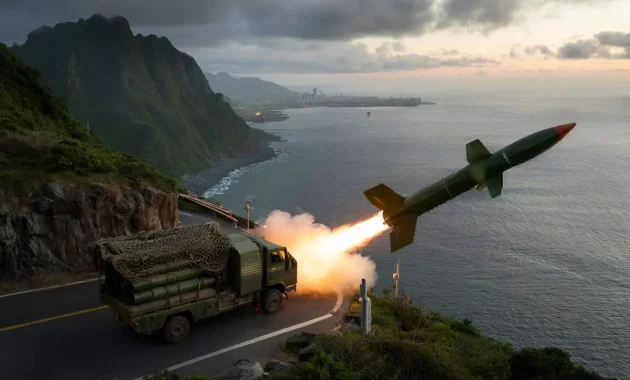
For years, Taiwan’s most secretive missile system, the HF-2E cruise missile, remained a closely guarded military secret. Rarely seen outside the island’s military bases, this formidable land-attack weapon was a silent deterrent, its existence barely acknowledged in public. But as tensions escalate between Taiwan and China, the HF-2E has emerged from the shadows, signaling Taipei’s growing resolve to strike deep into the Chinese mainland if provoked.
The sight of these missiles rolling down Taiwan’s remote eastern highways is a rare and unsettling one for local residents. Once confined to classified facilities, the HF-2E’s public appearance underscores the island’s determination to bolster its asymmetric defense capabilities in the face of China’s increasingly aggressive military posturing.
The HF-2E’s emergence comes at a critical juncture, as China ramps up its military exercises and airspace incursions around Taiwan, raising fears of a potential conflict. This homegrown cruise missile, capable of hitting targets hundreds of kilometers away, represents a significant step in Taiwan’s strategy to deter and, if necessary, retaliate against any Chinese aggression.

A Home-Grown Equivalent to the Tomahawk
The HF-2E, or Hsiung Feng II Extended, is a Taiwanese-developed cruise missile that bears a striking resemblance to the American-made Tomahawk. Like its American counterpart, the HF-2E is a long-range, highly accurate land-attack missile designed to strike targets deep within enemy territory.
Boasting a range of up to 1,000 kilometers, the HF-2E can deliver a conventional warhead with pinpoint precision, making it a formidable deterrent against China’s military capabilities. Its ability to evade radar and strike from unexpected angles adds to its strategic value, as Taiwan seeks to level the playing field against its much larger neighbor.
The missile’s quiet emergence in recent months underscores Taiwan’s growing confidence in its homegrown defense industry. While the island has long relied on foreign military hardware, the HF-2E represents a significant leap forward in its ability to develop and field its own advanced weaponry.

An Asymmetric Deterrence Strategy
The HF-2E’s public debut is part of a broader shift in Taiwan’s defense strategy, which increasingly focuses on asymmetric capabilities to deter and counter China’s military might. By developing weapons like the HF-2E, Taipei aims to create a more level playing field, denying China the ability to overwhelm the island with sheer numbers and firepower.
This asymmetric approach is designed to make any potential Chinese invasion or attack prohibitively costly, forcing Beijing to think twice before launching a full-scale assault. The HF-2E’s ability to strike deep within China’s territory is a clear message that Taiwan is willing and able to retaliate in kind if provoked.
Experts believe that this strategy, combined with Taiwan’s investments in other advanced military technologies, such as drones and cyber defense, could significantly complicate China’s military calculus and deter aggression in the long run.

Signaling in the Shadow of Chinese Drills
The HF-2E’s emergence onto Taiwan’s public roads comes at a time of heightened tensions, with China conducting a series of large-scale military exercises and airspace incursions around the island. These drills, which have included the simulated blockade of Taiwan’s ports and the rehearsal of amphibious landings, have raised concerns about Beijing’s intentions.
By showcasing the HF-2E, Taiwan is sending a clear message to China and the international community: that it is willing and able to defend itself against any potential aggression. The missile’s public display is a tangible demonstration of the island’s growing military capabilities and its determination to protect its sovereignty.
Analysts suggest that this move is also intended to deter China from further escalating the situation, as any attack on Taiwan could now potentially result in retaliation deep within the Chinese mainland. The HF-2E’s emergence, therefore, represents a strategic shift in Taiwan’s approach to cross-strait relations, one that seeks to create a more stable and balanced deterrence.

Key Terms and What They Actually Mean
| Term | Explanation |
|---|---|
| HF-2E Cruise Missile | A long-range, highly accurate land-attack missile developed by Taiwan, with a range of up to 1,000 kilometers. It is capable of striking targets deep within the Chinese mainland. |
| Asymmetric Deterrence | A defense strategy that focuses on developing specialized capabilities to counter a larger, more powerful adversary, such as China. This approach aims to make any potential invasion or attack prohibitively costly for the aggressor. |
| Chinese Military Drills | Large-scale military exercises conducted by China around Taiwan, including the simulation of blockades, amphibious landings, and other scenarios that raise concerns about potential aggression against the island. |
The emergence of Taiwan’s HF-2E cruise missile is a significant development in the ongoing tensions between the island and China. As the military balance in the region continues to shift, the public display of this powerful weapon signals Taiwan’s growing determination to defend its sovereignty and deter any potential Chinese aggression.
“The HF-2E represents a significant step in Taiwan’s asymmetric defense strategy. By developing long-range, precision-strike capabilities, the island is creating a credible deterrent against China’s military might.”
– Dr. Tsung-Ling Lee, defense analyst at the Institute for National Defense and Security Research
“Taiwan’s willingness to publicly showcase the HF-2E is a clear message to Beijing that the island is no longer willing to be a passive target. This move could significantly complicate China’s military calculus and raise the stakes of any potential conflict.”
– Dr. Shirley Kan, senior fellow at the Institute for Taiwan-American Studies

“The emergence of the HF-2E is a testament to Taiwan’s growing confidence in its own defense capabilities. It represents a shift away from reliance on foreign military hardware and towards the development of indigenous weapons systems.”
– Dr. Wu Rong-i, professor of strategic studies at National Chengchi University
As tensions continue to simmer, the appearance of the HF-2E on Taiwan’s roads serves as a stark reminder of the island’s determination to defend itself. The missile’s long reach and precision strike capabilities could significantly alter the military balance in the region, potentially deterring China from pursuing overt aggression. However, the risks of escalation and unintended consequences remain high, underscoring the delicate nature of the cross-strait situation.
Possible Scenarios if Tensions Boil Over
Should tensions between Taiwan and China escalate into open conflict, the HF-2E could play a crucial role in the island’s defense strategy. Experts suggest that the missile could be used to target key Chinese military and infrastructure assets, potentially disrupting the mainland’s ability to launch a successful invasion or sustained military operations.

However, the deployment of the HF-2E would also raise the stakes of any potential conflict, potentially triggering a dangerous escalatory spiral. China would likely see the missile’s use as a direct threat to its national security, potentially prompting a harsh retaliatory response that could further destabilize the region.
In a more optimistic scenario, the mere existence of the HF-2E could serve as a strong deterrent, convincing China to avoid any overt military action against Taiwan. By demonstrating its ability to strike deep into the mainland, the island may be able to discourage Beijing from pursuing a full-scale invasion, potentially preserving a fragile status quo.
Risks, Escalatory Chains, and Regional Impact
| Risk | Potential Impact |
|---|---|
| Escalation of Tensions | The deployment or use of the HF-2E could provoke a strong military response from China, leading to a dangerous escalatory chain that could destabilize the region and increase the risk of open conflict. |
| Miscalculation and Unintended Consequences | The complex nature of cross-strait relations and the high stakes involved could lead to miscalculations by either side, potentially triggering unintended consequences and further escalation. |
| Regional Instability and Economic Disruption | A conflict between Taiwan and China would have far-reaching implications for the broader Asia-Pacific region, potentially disrupting trade, supply chains, and regional security arrangements. |
The emergence of Taiwan’s HF-2E cruise missile is a significant development in the ongoing tensions between the island and China. While the missile represents a powerful deterrent and a symbol of Taiwan’s growing military capabilities, its deployment also carries significant risks and the potential for further escalation.

As the military balance in the region continues to shift, the HF-2E’s public appearance serves as a stark reminder of the delicate and volatile nature of cross-strait relations. Both Taiwan and China must exercise caution and restraint to avoid a dangerous escalatory chain that could have far-reaching consequences for the entire Asia-Pacific region.
FAQ
What is the range of the HF-2E cruise missile?
The HF-2E has a range of up to 1,000 kilometers, allowing it to strike targets deep within the Chinese mainland.
How does the HF-2E differ from the American-made Tomahawk cruise missile?
While the HF-2E shares some similarities with the Tomahawk, such as its long-range and land-attack capabilities, it is a Taiwanese-developed weapon system that has been specifically designed to meet the island’s defense needs.

Why is Taiwan’s development of the HF-2E considered an “asymmetric deterrence” strategy?
Taiwan’s focus on developing specialized capabilities like the HF-2E, rather than trying to match China’s overall military might, is part of an asymmetric deterrence strategy. This approach aims to make any potential invasion or attack prohibitively costly for the aggressor, even if they have a larger and more powerful military.
How could the deployment of the HF-2E affect the military balance between Taiwan and China?
The HF-2E’s ability to strike deep within the Chinese mainland could significantly complicate Beijing’s military calculus, potentially deterring it from pursuing overt aggression against Taiwan. However, it also raises the stakes of any potential conflict and could trigger a dangerous escalatory spiral.
What are the potential risks and consequences of Taiwan using the HF-2E in a conflict with China?
The use of the HF-2E could provoke a harsh military response from China, leading to a dangerous escalation of tensions and the possibility of a broader regional conflict. There are also concerns about miscalculation and unintended consequences that could further destabilize the region.
How might the HF-2E’s emergence affect Taiwan’s relations with the international community?
Taiwan’s public display of the HF-2E could be seen as a signal of the island’s growing assertiveness and determination to defend its sovereignty. This could bolster Taiwan’s international standing and support, but it could also heighten tensions with China and complicate the island’s diplomatic relations.
What are the potential economic impacts of a conflict between Taiwan and China involving the HF-2E?
A conflict between Taiwan and China would have far-reaching economic consequences, potentially disrupting global supply chains, trade, and financial markets. The regional instability and uncertainty could also lead to significant economic disruption and slowdown.
How does the HF-2E’s emergence fit into Taiwan’s broader defense strategy?
The HF-2E is part of Taiwan’s shift towards an asymmetric defense strategy, which focuses on developing specialized capabilities to counter China’s military superiority. This approach aims to make any potential invasion or attack on the island prohibitively costly for the aggressor.
Originally posted 2026-02-07 08:42:22.