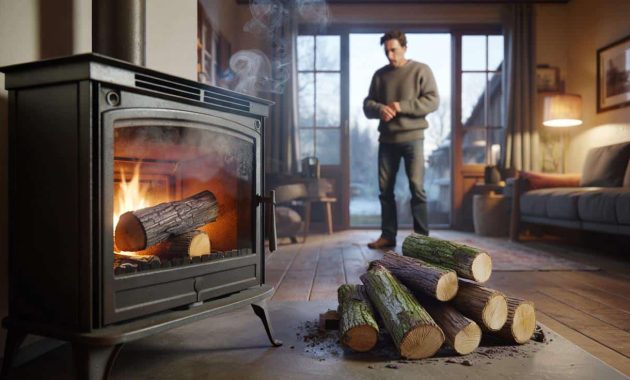
The first cold snap arrived on a Tuesday. Not the pretty kind with postcard snow, but that damp cold that slips under doors and into bones. Marc went down to his backyard shed feeling quietly proud: he’d stacked those logs in April, covered them, left them “to dry”. Winter was sorted, or so he thought.
He opened the shed, grabbed an armful, and already something felt off. The wood was oddly heavy, almost sticky under the fingers. On the first match, the log hissed instead of crackled. On the second, a thin ribbon of smoke crawled into the living room, set off the detector, and nothing caught. The “carefully stored” firewood just smoldered, blackened and steamed.
He stared at the useless pile and had the same thought many of us would have: nobody ever explained the simple things that actually matter.
When stored firewood turns into a cold, smoky disaster
There’s a particular kind of frustration in standing in front of a full woodpile, only to discover it’s practically worthless. You’ve done the “responsible” thing. You ordered or cut your logs early, stacked them in a corner, covered them, and mentally ticked off “heating” on your winter checklist. Then the first real fire of the season exposes a detail nobody spelled out: wood can be stored for months and still be completely unburnable.
Instead of flame, you get hissing, thick smoke, a stubborn black log that refuses to catch. The firebox fogs up, the glass door turns brown, the chimney groans. It feels like the wood is mocking you.
For a lot of people, the story starts the same way. They bought a big load of logs in late summer from a “friend of a friend” who said it was “dry enough”. Or they cut trees in their garden in spring, split a few rounds, then left the rest in big chunky pieces under a tarp. Months go by. Nobody checks moisture. Nobody talks about air circulation or wood species.
When winter hits, that “bargain” pile reveals its secret: the heart of the logs is still soaked. The bark is greenish. Some pieces are spotted with soft white mold. The outer layer has crusted over, fooling the eye. Inside, it’s like a wet sponge.
Here’s the plain truth: storing firewood is less about time and more about how that time is used. If air can’t move around the logs, the moisture stays trapped. If the wood is stacked directly on the ground, it sucks up dampness from below. If you throw a plastic sheet over the whole pile like a giant lid, you basically build a steam room for your logs.
Wet or semi-wet wood doesn’t just burn badly. It clogs chimneys with creosote, wastes energy, and fills your living room with smoke instead of heat. What looks like “bad luck” is usually just a chain of small, very human mistakes nobody warned you about in time.
The right way to store wood so it actually burns
Good firewood starts with one simple priority: let the wood breathe. That means stacking it on something raised – pallets, blocks, old bricks – so air flows underneath. The logs should be split to a size that suits your stove, then stacked in rows with gaps between them, not stuffed in a heap. Think of it less like building a wall and more like weaving a kind of wooden lattice.
➡️ Albert Einstein predicted it and Mars has now confirmed it: time flows differently on the Red Planet, forcing future missions to adapt
➡️ Is it better to turn the heating on and off or leave it on low ?
➡️ People who feel pressure to stay emotionally available often forget to recover
➡️ This invasive and deadly fish species in the Mediterranean is deeply worrying experts
➡️ Why being intentional with time creates more freedom
➡️ A breakthrough kitchen device is being hailed as the invention that could finally replace the microwave for good
➡️ 7 rare qualities that make a woman unforgettable, according to psychology
➡️ Retirement upheaval in the village: how one ‘harmless’ land loan to a cash-strapped beekeeper triggered an unexpected agricultural tax bill, fractured lifelong friendships, and forced everyone to choose between blaming a greedy state or a gullible pensioner who should have known better
Cover the top of the pile to protect it from rain and snow, but leave the sides open. A simple sloping roof, a piece of corrugated metal, even an old wooden board works better than wrapping the whole thing in tarpaulin. The aim is always the same: shelter from above, airflow from below and the sides.
A common mistake is trusting your eye instead of a simple tool. Wood that “looks dry” can still hold 25–30% moisture, which means smoke, not flame. A small moisture meter, the kind you find in DIY stores, costs the price of a pizza and tells the truth: under 20% is the goal for decent burning.
Another trap: storing wood too close to walls or fences. When the pile is pressed tight against a surface, air can’t move properly. The side facing the wall stays humid for months. Add a few rainy weeks, and the bottom layer becomes a kind of compost starter instead of a fuel reserve. We’ve all been there, that moment when you pull out the first log and it crumbles in your hand.
“Everyone told me ‘buy early, it has to dry’, but no one mentioned that if you stack it wrong, you lose half your load,” admits Claire, who lives in an old stone house in the countryside. “I thought time was enough. Turns out, time plus bad storage just makes expensive mulch.”
- Elevate the pile
Use pallets, blocks or rails to keep logs off damp ground. - Split before storing
Smaller pieces dry faster than thick rounds. - Protect only the top
Let the sides open, avoid wrapping the whole pile. - Leave breathing space
Keep a small gap between the wood and any wall or fence. - Rotate your stock
Burn the oldest wood first, start a new pile separately.
From wasted logs to a quiet, reliable heat
There’s something oddly humbling about realizing that “just stacking wood” is actually a small craft. Once you get past the embarrassment of the first winter disaster, a kind of quiet satisfaction appears. You start to notice wood species, the sound a dry log makes when you knock two pieces together, the way a well-stacked pile looks almost like architecture.
*Storing firewood turns from a chore into a low-tech skill that directly changes how your winter feels.* Less smoke, more flame. Less stress, more of that slow comfort of watching real fire do its job.
People who’ve lived through a season of useless, damp wood often become unexpectedly evangelical about proper storage. They’ll show you where they now put their pallets, how they orient the pile to catch the prevailing wind, which tarp they cut in half so the sides stay open. They share their mistakes with a mixture of pride and self-mockery.
And you notice something else: this is one of those domestic details that rarely makes it into manuals or school lessons. It travels by stories, by neighbors, by a passing tip at a barbecue when someone points at your chaotic stack and gently says, “You might want to change that before winter.”
Let’s be honest: nobody really does this every single day. Nobody stands in front of their woodpile with a notebook, logging humidity rates and wind direction. What people do, though, is learn from the season that went wrong. From the fire that wouldn’t start when guests were arriving. From the chimney sweep shaking his head at the amount of soot.
Those almost-forgotten frustrations end up shaping the next year’s habits. A bit more air here. A better cover there. A moisture meter in the shed. Small corrections that add up to one simple, very tangible result when the cold returns: you strike a match, and instead of hissing, the wood catches, glows, and finally does what it was meant to do.
| Key point | Detail | Value for the reader |
|---|---|---|
| Raise and ventilate the pile | Use pallets or blocks, leave gaps and distance from walls | Reduces moisture, limits mold, improves combustion |
| Protect from above, not all around | Cover only the top, keep sides open to wind | Prevents “steam room” effect and heavy, unusable logs |
| Check dryness, not just time | Use a moisture meter and burn under 20% humidity | More heat, less smoke, safer chimney and better comfort |
FAQ:
- Question 1How long does firewood need to dry before it’s ready to burn?
- Question 2Can I store my woodpile under a full plastic tarp?
- Question 3What are the signs that my logs are still too wet?
- Question 4Do I really need a moisture meter, or is visual inspection enough?
- Question 5Is it bad to store firewood directly in the basement or garage?