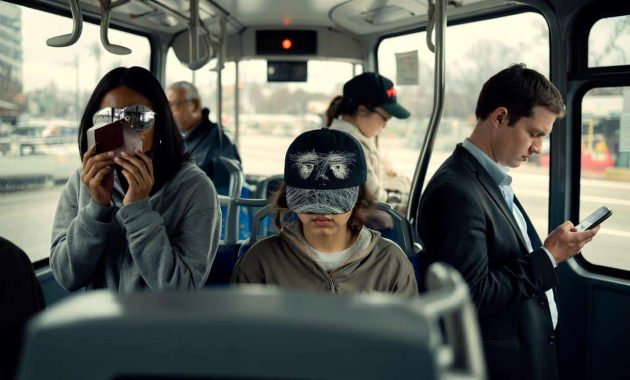
On a gray Tuesday morning in Jackson, Mississippi, the bus station cameras started blinking a little faster. Commuters shuffled through the turnstiles, coffee in one hand, phone in the other, passing under a new row of black domes screwed into the ceiling. No sign, no announcement, just a different kind of gaze soaking up every face that moved. The drivers had heard the rumor. The regulars had too. “They’re scanning us now,” whispered a college kid in a faded hoodie, eyes flicking up at the lens.
By the end of the week, those same cameras were staring at something they hadn’t expected at all: people’s refusal to play along.
The machines learned faces.
The city learned masks.
The day the buses started watching back
Jackson is not the first place you’d expect to quietly roll out facial recognition on public transport. It’s a mid-sized Southern city where the buses run late, everyone knows the driver’s first name, and the biggest daily annoyance is the heat baking the metal seats. Yet that’s exactly where a small pilot project started: new cameras at transit hubs and on a handful of busy bus lines, connected to software trained to flag “persons of interest.”
Most riders didn’t spot the change right away. Some noticed sharper lenses, odd little flashes of red, small black boxes welded to the ceiling. Others only found out when screenshots started circulating on local Facebook groups: a city PowerPoint slide bragging about “real-time facial analytics” in public transit.
The backlash didn’t arrive in the streets at first. It arrived in group chats. A law student posted a blurry photo of a new camera in the downtown transfer station. A city worker quietly leaked that tests were running on a handful of buses that served low-income neighborhoods. Then a local activist put it into one blunt sentence on X: “They turned our commute into a police lineup.”
Within days, riders were sharing threads about how the system worked. They dug up vendor brochures, accuracy rates, bias studies. One viral post compared the cameras to “a boss clocking your face every time you leave the house.” Underneath, someone wrote: “Fine. Let’s give them nothing to clock.”
That’s where the real story started: with the quiet, improvised creativity of people who just didn’t want their face in another database. Riders began experimenting. Sunglasses on cloudy days. Baseball caps pulled low. Haircuts reshaped to confuse the software. A few went further and printed out weird “adversarial” patterns they found online, supposed to scramble facial recognition.
The transit system had been sold a high-tech safety net. On the ground, it met something messier and more human: mistrust, humor, stubbornness. The more the city tried to normalize the cameras, the more inventive riders became at dodging their gaze. That cat‑and‑mouse game is shaping a new kind of daily resistance, one bus ride at a time.
How people quietly hacked the gaze of the city
The first workaround was almost embarrassingly simple: oversized masks and sunglasses. Not the thin surgical masks most people wore in the pandemic years, but thick black cloth masks that hid half the face, paired with reflective shades you’d expect at the beach, not on the number 12 bus to the mall. Drivers started joking about “the poker table crowd” stepping on board.
Then came hats. Hoodies. Scarves on warm days, wrapped a bit too high. A teenage rider posted a selfie on TikTok under the bus camera, face almost completely obscured, captioned: “If you want my data, bring dinner first.” That video did more to spread anti-surveillance habits than any rights group brochure could.
➡️ If your body feels tired without strain, this might explain it
➡️ Should we really feed robins this 3p kitchen staple tonight: gardeners clash over new advice
➡️ “I assumed budgeting meant restriction, until I tried this approach”
➡️ Goodbye Footprint Marks on Sandals: The Simple Trick That Makes Them Look Brand New
➡️ Meteorologists warn early February atmospheric signals point to a dangerous Arctic anomaly
➡️ Psychologists explain why some people fear being misunderstood more than being judged
➡️ “I stopped forcing productivity” and my garden balanced itself
Not all the tactics were about covering up. Some were about confusion. A small art collective in Jackson began designing printable patterns meant to “jam” facial recognition by tricking the algorithm into seeing dozens of fake eyes and noses. They uploaded them for free, with simple instructions: tape this to your hat, your hoodie, your backpack. Within a week, a few riders showed up with caps patterned in warped grayscale faces, like low-budget cyberpunk fashion.
One mother told a local reporter she’d started teaching her teenage daughter “bus outfits” — clothes and accessories that made her look different enough each day to avoid easy tracking. “It’s a little game for us now,” she said. “But underneath, it’s not a game at all.”
Behind the scenes, the tech struggled. Facial recognition systems rely on clear, consistent features: eyes, nose, mouth, jawline. Public transport throws everything at them: motion blur, low light, cheap cameras, people turning away at the last second. Add masks, hats, and intentional distortion, and the error rates spike. Independent researchers who later reviewed similar pilots in other cities found big drops in accuracy when just a portion of faces was covered, especially for women and people of color.
That’s the plain truth sentence the sales pitch rarely includes: artificial intelligence looks unstoppable in clean lab demos, but it limps in the wild when people simply refuse to cooperate. *A system built on seeing everything clearly starts to wobble the moment the crowd learns how to become a little cloudy.*
What this “everyday resistance” actually looks like
One of the most effective gestures locals adopted was astonishingly low-tech: looking down. Riders began timing their ticket scan or tap at the moment they passed under the camera, letting the brim of a cap or the angle of a phone obscure their features. Some walked a bit faster under the lens, blurring their image just enough. A few would wait until another person stepped in front of them, using their body as a natural shield.
These are not James Bond moves. They’re tiny, almost invisible adjustments. But stacked across hundreds of riders, hundreds of bus rides, they chip away at the clean data stream the system craves.
Of course, not everyone has the time or energy to game a surveillance camera every morning. People rush for transfers, juggle kids, answer work emails standing up. Privacy can feel abstract when you just want to sit down before your stop. We’ve all been there, that moment when the day is already heavy and a blinking red light above your head is just one more thing you’d rather not think about.
Let’s be honest: nobody really does this every single day. Some days you walk onto the bus barefaced and tired, and the camera gets what it wants. That doesn’t erase the power of those other days when you do something, even small, to say: I see you, too.
Alongside improvised tricks, another kind of response grew: a shared language of refusal. Local organizers started leaving leaflets at bus stops explaining basic digital rights and how to challenge surveillance policies at city hall. At a packed community meeting, one transit advocate put it bluntly:
“Public transport is supposed to be the most democratic space in the city. When you add facial recognition, you’re quietly telling some people their face is a risk factor just for showing up.”
From that meeting came a short list that spread online and on paper, scribbled, reprinted, imperfect but practical:
- Wear a cap or hoodie on camera-heavy routes if you can.
- Use printed patterns or stickers on hats and masks to confuse auto-detection.
- Talk to your driver and fellow riders about the cameras; break the silence.
- Ask your city for transparency reports: who sees the data, for how long, and why.
- Support local groups challenging or monitoring surveillance tech in transit.
These steps don’t magically erase the system. They do something else: they make it social, visible, discussable.
When the commute becomes a quiet referendum
In Jackson, the facial recognition pilot hasn’t disappeared. It has stalled, sputtered, been “reviewed” and “reassessed” as city officials face growing questions about cost, bias, and legality. The cameras are still there on some routes. So are the riders who tilt their heads away, wrap scarves a little higher, or print out one more weird pattern for their backpack.
What’s happening on those buses touches something bigger than one city. Similar pilots are being pitched to transit systems from Los Angeles to smaller Midwestern towns, often with the same promises: modern, efficient, secure. Yet every deployment runs into the same stubborn reality: people do not like being treated as walking barcodes on their way to work.
There’s no single right way to respond. Some will push for laws that ban or strictly limit facial recognition in public spaces. Others will keep playing cat-and-mouse with the cameras, adjusting how they dress and move. Some will shrug and ride on. That mix of reactions is messy, very human, and exactly what high-tech systems are bad at predicting.
For anyone who rides buses, trains, or subways, the story out of Jackson is less about one city’s policy twist and more like a mirror. How much of yourself are you willing to hand over, automatically, just for the right to move? Where do you draw the line between safety and scrutiny? This debate won’t be settled in a courtroom alone. It’s being written every morning at 7:42 a.m., under a small black dome above the turnstile, by whoever walks past and decides what face — or which mask — they want the system to see.
| Key point | Detail | Value for the reader |
|---|---|---|
| Everyday resistance works | Simple acts like hats, masks, and looking down can disrupt facial recognition accuracy | Shows that small, accessible gestures can meaningfully protect privacy |
| Public transport is a frontline | Bus and train systems are becoming quiet test beds for new surveillance tools | Helps readers see their commute as a space where rights are being negotiated |
| Collective action matters | Community organizing, transparency demands, and shared tactics pressure cities to rethink pilots | Gives readers concrete ways to move beyond fear and into informed action |
FAQ:
- Question 1Does facial recognition on buses actually work if people wear masks and hats?
- Question 2Is it legal for a US city to use facial recognition in public transport?
- Question 3Can I refuse to be scanned when I ride a bus or train?
- Question 4What are simple things I can do on my commute to protect my privacy?
- Question 5How can I find out if my city is testing facial recognition in transit?