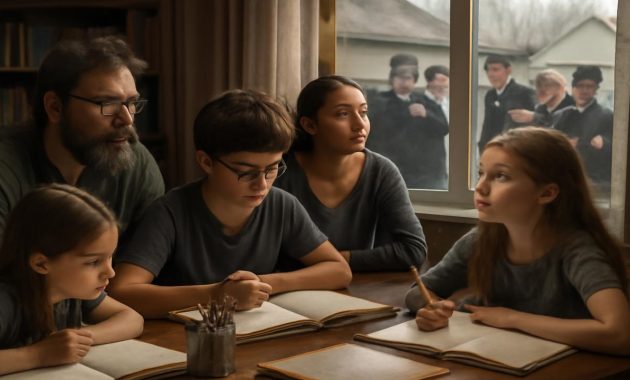

The first time twelve-year-old Lily realized she didn’t quite belong, she was standing in the fluorescent glow of a church basement, holding a paper plate of store-brand cookies and trying not to stare at the other girls’ matching skirts. The youth pastor had just asked everyone to write down “three things the world is getting wrong.” Around her, pens scratched confidently: “public schools,” “movies,” “social media.” Lily, homeschooled since kindergarten in a tightly knit conservative community, stared at her blank index card and thought, uncomfortably, I don’t think it’s that simple.
The Quiet Rebellion at the Kitchen Table
Homeschooling, in communities like Lily’s, is often framed as a kind of shelter—four walls and a roof built of curriculum choices, carefully chosen friends, and a firm belief that the world outside is dangerous, morally slippery, or simply wrong. It’s a place where parents can filter books, facts, and ideas like water through a trusted pitcher, so only the “pure” stuff gets through.
But at the kitchen table—under the hum of the fridge and the smell of reheated coffee—something unexpected can happen. The world, despite everyone’s best intentions, sneaks in through dog-eared library books, documentary clips, nature walks, and the unanswerable questions that come out of a child’s mouth right when the spaghetti timer goes off.
Lily’s mother, a former elementary school teacher with a fierce protective streak, had pulled her out of public kindergarten when a classmate called her “weird” for not knowing the latest pop song. “At home,” her mother said to friends, “I can make sure she’s taught truth, not trends.” She built a careful universe: Christian-based science textbooks, history lessons from a “biblical worldview,” and co-op days with other like-minded families. There were modest dresses, family movie nights, and a running joke that “we do things the old-fashioned way.”
But there were also long afternoons where Lily was left alone with a pile of books and a curious mind. Her mom trusted her, within limits, to roam the local library shelves, because “she’s a good kid.” Lily devoured novels, field guides, astronomy books, and eventually, without fanfare, a slightly outdated book on world religions. She started asking questions over dinner: “Why do some people read the same Bible and say different things?” “How old is the Earth really?” “If people in other countries believe different things, does that mean they’re all wrong?”
Her parents did their best to keep up. But each answer seemed to unspool into more questions. That’s the trouble with teaching a child to think things through—even if you give them a narrow path to walk, they eventually notice the forest all around.
The Strange Gift of Time and Thought
One of the least talked-about side effects of homeschooling, especially in insular conservative circles, is the surplus of time to think. Public school students, shuttled from class to class and conditioned by bells and hall passes, develop other skills: social navigation, group dynamics, the art of fitting in. Homeschooled kids, for better or worse, spend a lot of time inside their own heads.
Noisy classrooms are traded for quiet kitchens. Group projects morph into solitary experiments. Instead of being surrounded by thirty other kids who can gently (or brutally) correct an offbeat idea, a homeschooled child can nurse it for a long time in private. That can be a breeding ground for wild imagination, deep curiosity—and sometimes, dissident thought.
Parents in conservative communities often choose homeschooling so they can pass on their faith, their politics, and their sense of right and wrong without interference. But in doing so, they sometimes also pass on—whether they mean to or not—the tools of independent thinking: reading widely, connecting ideas, asking for evidence, wrestling with moral dilemmas. And if you give a child those tools, you don’t always get to decide what they build.
Ironically, the effort to control inputs—cutting out “bad influences,” limiting peer contact, curating media—can magnify the impact of any new idea that does slip through. That one thoughtful librarian recommendation, that one science video, that one news article a teen scrolls past on a cousin’s phone at Thanksgiving can land like a meteor in a smaller world.
Lily still remembers the first time she read about climate change in a book that didn’t dismiss it as a hoax. It was in the children’s science section, with soft watercolor illustrations of polar bears and graphs she didn’t fully understand. The book didn’t feel evil. It felt…sad. And real. When she brought it home, her mother frowned but didn’t take it away. “Just remember,” she said, “not everything you read out there is true.”
But the seed was planted. A few weeks later, Lily was at a homeschool co-op class on “Creation Science” where the instructor cheerfully insisted that the Earth was only a few thousand years old. Lily thought of those graphs. She looked at the fossil pictures. Something in her pulled taut. Both of these things can’t be true, she realized. So which one was lying?
When “Our Kind of People” Isn’t Your Kind
In conservative homeschooling communities, belonging can feel like a warm quilt—safe, thick, and comforting—but it’s stitched together with invisible rules. Everyone knows who “our kind of people” are. They go to the right churches, vote the right way, believe the right things about gender, marriage, and “the culture.” To be accepted, kids learn to repeat the lines, even if they don’t believe all of them.
At first, Lily played along. At youth nights and co-op park days, she laughed when the other teens mocked “public school kids” for being “brainwashed” and “lost.” She nodded when someone said that feminism was destroying families. She kept her questions to herself, locking them away behind polite smiles, because that’s what you do when you’re the pastor’s daughter’s best friend and everyone assumes you’re “a good influence.”
But the more she learned—through books, through quiet online searches, through overlapping circles of thought—the more she felt the gap widen between the girl everyone thought she was and the person taking shape in her own mind. She started to feel like a double agent in her own life, fluent in two native languages: the careful, guarded vocabulary of her community, and the rough, questioning voice of her thoughts.
That’s the hidden tension for many homeschooled kids raised on strong ideologies: they are marinated in certainty but given enough time and solitude to pick at its edges. And once you tug at one loose thread, the whole garment can begin to unravel in slow motion.
Parents often imagine a straight line: We raise them this way → they become like us → they raise their kids this way. But a quieter story plays out in countless households: We raise them this way → they notice the gaps → they read between the lines → they love us but can’t stay inside the story.
It’s not always dramatic. Sometimes it’s subtle: a child who no longer nods on cue, who hesitates before repeating a talking point, who asks, “But what if they’re not actually evil, just different?” In a community that defines itself partly by who it stands against, that kind of nuance can feel like treason.
Raising Freer Thinkers, Making Future Outsiders
Homeschooling in conservative communities doesn’t guarantee stronger free thinkers—but it often creates a very particular kind of outsider, even before the child realizes it. When you don’t spend your childhood learning the unwritten rules of cafeteria tables and school hallways, you develop a slightly slanted view of the world. You watch from the outside a lot. That can turn into loneliness—or into clarity.
Many homeschoolers grow up deeply empathetic, used to interacting mostly with adults or younger siblings, more comfortable in long conversations than in quick social banter. They can be devastatingly good at self-directed work, at following their curiosity down long rabbit holes. These are ideal conditions for incubating people who question assumptions, invent new paths, and challenge established norms.
But in a conservative enclave that values cohesion and doctrinal purity, questioning is often a liability, not an asset. The child who wrestles with evolution, LGBTQ+ rights, systemic racism, or different faith traditions is not simply “exploring ideas”—they are, in the community’s eyes, flirting with disaster. They threaten the unity that homeschooling was supposed to preserve.
Look closely, and you’ll find a pattern of young adults who grew up like Lily did and then, often painfully, slipped away. Some come out as queer in communities where that’s seen as rebellion or sin. Some quietly deconstruct their childhood faith. Some become the first in their circle to attend a secular college or move to a big city. They send shockwaves back through the tight-knit networks that raised them, proof that control has limits.
There is a particular rivalry of emotions that many of these parents feel: pride in their child’s intelligence and strength, fear of the ideas they’re embracing, grief for the future they’d imagined, and sometimes an unspoken sense of betrayal. “We did everything right,” they say, “and look what happened.”
From the outside, though, another interpretation emerges: You taught them to care about truth, to ask hard questions, to stand apart from the crowd… and they did exactly that, just not in the direction you planned.
The Unintended Curriculum
Alongside math and grammar and the founding fathers, homeschooled kids absorb another syllabus—the hidden curriculum of their family culture. They watch how their parents talk about people who are different. They notice what’s mocked, what’s feared, and what’s never mentioned at all. But they also watch how their parents handle tension, argument, and doubt.
Some conservative homeschooling parents run their homes like fortresses: no contradicting books, no unsupervised media, no conversations that tilt too far from the line. In those homes, kids may become skilled at secrecy or complete mental compartmentalization. Others, like Lily’s mother, walk a more complicated path: they’re firm in their beliefs but they answer as many questions as they can, they allow a little slack in the rope, maybe hoping that truth will prove itself if given the chance.
That slack is where many freer thinkers are born.
Consider a simplified picture of what many such homes actually teach, beyond the official curriculum:
| What Parents Intend to Teach | What Children Often Also Learn |
|---|---|
| Our beliefs are the final truth. | Beliefs matter enough to examine and question deeply. |
| The outside world is dangerous. | The outside world is complex—and I want to understand it myself. |
| Authority deserves respect. | Authority should be tested against evidence and conscience. |
| We don’t follow the crowd. | Standing apart is normal; I can survive being different. |
| Our community is “the good side.” | Every group believes it’s right; maybe goodness is bigger than one camp. |
The “bad news” for some parents in conservative communities is that homeschooling can amplify these unintended lessons. A child marinating in a single worldview, but also steeped in independence, is uniquely positioned to see through cracks and inconsistencies. And once they see, they can’t unsee.
For kids like Lily, this awareness doesn’t come with a triumphant soundtrack. It often arrives with a quiet ache. They love their families. They understand why their parents made the choices they did. They’re grateful for the time, the care, the attention. And yet, they feel themselves drifting from the harbor that sheltered them, heading toward a wider sea their parents warned them about.
The Cost of Stepping Outside the Circle
By sixteen, Lily had mastered the art of internal translation. In co-op debates, when other teens recited lines about “liberal brainwashing,” she thought of the thoughtful college professor in an online lecture she’d watched, explaining systemic inequality. In church, when someone prayed for “those confused about their gender,” she remembered a forum post from a homeschooled kid like her who came out as transgender and wrote, “I’m not confused. I’m terrified.”
Eventually, the gap between her inner world and her outer performance became unbearable. One evening, after a heated family discussion about a news story, she did the unthinkable: she said out loud that she didn’t agree. Not just on a minor point—but on the entire way “us versus them” was being framed.
The room went very still.
The next weeks were a blur of strained conversations. Her parents, blindsided, cycled through panic (“Who influenced you?”), anger (“After everything we’ve done for you…”), bargaining (“You can question, but don’t go too far”), and grief. Her mother cried in the laundry room, blaming herself for every “compromising” book she’d allowed. Her father forwarded long articles about “kids falling away.”
In their community, word spread in a quiet, coded way. Invitations shifted. A mom at co-op asked Lily gently if she was “going through a rebellious phase.” One family banned their daughter from texting her. Overnight, she went from trusted “good example” to potential bad influence.
This is the part of the story that divides opinion. Some will say: this is the natural, necessary friction of a child growing up and apart; all families go through some version of it. Others argue: no, this is what happens when rigid ideology meets the human impulse to think and feel freely. Still others see tragedy in every direction: parents losing the future they envisioned, children losing the home where they felt safe—each side convinced the other has drifted away from what is right.
But for the child emerging as a freer thinker, the cost is unmistakable. They may gain intellectual and moral autonomy, but they often lose uncomplicated belonging. They learn first-hand that the price of being honest in some circles is stepping outside them.
What If We Named the Tension Honestly?
Imagine if, instead of pretending homeschooling could produce perfectly compliant replicas of their own convictions, conservative parents named the risk out loud from the beginning:
“We’re teaching you what we believe is true and good. We hope you’ll hold onto it. But we also know we’re giving you tools to think for yourself. And that means you may not end up exactly where we are. That scares us—and we love you enough to face that anyway.”
What if homeschool co-ops made room for kids who question, instead of quietly exiling them? What if churches embraced the doubters with the same warmth they give the prodigals who come home—recognizing that staying and struggling honestly is its own kind of bravery?
This isn’t about abandoning convictions or pretending that deep differences don’t matter. It’s about accepting that control and love are not the same thing, and that children are not projects. Homeschooling can be a rich, beautiful way to raise a child—full of field trips on Tuesday mornings, long read-alouds on rainy days, and the freedom to learn at their own pace. But it can’t be a guarantee against divergence.
The more honest we are about that, the less devastating it might feel when a homeschooled teenager looks around their carefully built world and whispers, “I think I’m different.”
Some of those kids will leave their communities entirely. Some will hang on at the margins, learning to translate between worlds, returning home for holidays with a suitcase full of books their parents don’t quite understand. Some will stay inside and try to gently widen the circle from within. Many will become bridges—people who can see both the tenderness and the harm in the world that raised them, who can speak to insiders and outsiders in their own dialects.
For conservative parents, that might be the most unsettling outcome of all: not a child who openly fights them, but one who quietly insists that the world is too complex for the old lines to hold. A child whose conscience was sharpened at the very kitchen table where they memorized Bible verses—and who now uses that conscience to challenge the boundaries of the tribe.
That’s the paradox at the heart of this story: in trying to raise faithful followers, some parents are actually raising prophets without meaning to—kids who stand a little outside, squinting at the horizon, unafraid to name what they see. Freer thinkers. Future outcasts. Or, depending on who’s telling the story, the first of a new kind of insider.
Frequently Asked Questions
Does homeschooling in conservative communities always create freer thinkers?
No. Some homes are so tightly controlled that questioning is punished or shut down early, and children learn to suppress doubt rather than explore it. Others may simply internalize the worldview around them without much friction. The point isn’t that homeschooling always produces independent thinkers, but that its structure often creates the conditions for deeper reflection—and that can sometimes challenge the very ideology that shaped it.
Is it wrong for parents to want to pass on their beliefs through homeschooling?
Wanting to share deeply held values with your children is natural, whether you homeschool or not. The ethical tension appears when passing on beliefs becomes synonymous with controlling access to information or punishing honest questioning. Many families find a middle ground where they are open about their convictions but also make space for their children to explore, disagree, and grow.
Are homeschooled kids in conservative communities more likely to become social outcasts?
They’re more likely to feel like outsiders in at least one direction. Some feel out of place among peers in the broader world because they missed common cultural experiences. Others—especially those who change their beliefs or identity—can become outsiders in their original communities. Whether that becomes a lasting wound or a source of resilience depends on support, empathy, and the possibility of building new circles of belonging.
What can parents do to support children who start questioning shared beliefs?
They can listen more than they lecture, separate love from agreement, and be transparent about their own uncertainties and limits. Saying, “I don’t see it that way, but I want to understand how you do,” keeps the relational door open. It can also help to invite trusted, thoughtful adults into the conversation—people who won’t panic or shame the child for asking hard questions.
Can conservative homeschooling and open-ended critical thinking coexist?
They can, but it requires intention. Parents need to accept that genuine critical thinking might lead their children to different conclusions. That means valuing integrity over ideological sameness, and curiosity over comfort. Some families discover that when they loosen their grip on outcomes, they gain something harder to quantify but deeply important: a relationship strong enough to survive disagreement.

Originally posted 2026-02-13 01:38:10.