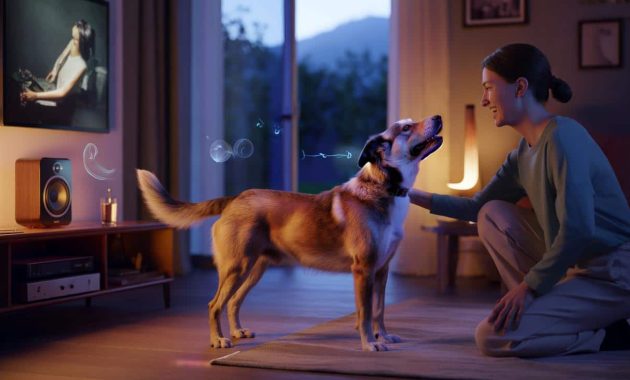
The first time my dog howled at music, I froze with my hand on the volume button. I was cleaning the kitchen, a soul playlist humming in the background, when suddenly, a haunting melody rose from the corner. My dog, a loyal mutt named Buddy, had joined in, his mournful howl echoing through the room.
I couldn’t help but chuckle at the unexpected duet, but it also got me wondering: why do dogs howl when they hear music? Is it a sign of distress, or is there something more profound happening?
As it turns out, the answer lies in the deep, ancient connection between canines and music – a bond that stretches back thousands of years.
The Evolutionary Link Between Dogs and Music
Howling is a natural behavior in dogs, one that has been honed over millennia through evolution. In the wild, wolves and other canids use howling to communicate over long distances, marking territory, and coordinating pack activities.
But when domesticated dogs hear certain types of music, particularly those with sustained, low-frequency notes, they instinctively respond with their own vocal contributions. This, according to experts, is not a sign of distress, but rather a deep-seated biological inclination to join in with the sonic landscape.
Dr. Alexandra Horowitz, a leading expert on dog cognition and behavior, explains that the tendency to “sing along” with music is a vestige of the dogs’ evolutionary past. “Dogs are highly attuned to the sounds of their environment, and music that mimics the cadence and timbre of natural wolf howls triggers a primal response,” she says.
The Science Behind the Howl
Researchers have found that dogs’ auditory systems are particularly sensitive to low-frequency sounds, which is why they often respond to music with deep, resonant tones. This sensitivity likely evolved to help canids detect the calls of pack members and potential predators over long distances.
When dogs hear these types of sounds, their brains process them as a form of vocal communication, triggering the urge to join in. “It’s almost as if the dog is saying, ‘Hey, I hear you, and I want to respond,’” says Dr. Horowitz.
Interestingly, not all dogs will howl in response to music. Some may simply perk up their ears or show other signs of interest, while others may remain indifferent. This variation, experts say, is likely due to individual differences in personality, experience, and even breed characteristics.
The Emotional Connection Between Dogs and Music
Beyond the scientific explanations, there may also be an emotional component to a dog’s musical howling. Some researchers believe that the act of “singing along” with music can be a way for dogs to express a range of feelings, from joy and excitement to longing and nostalgia.
Dr. Clive Wynne, a professor of psychology and expert on animal behavior, suggests that the howling response may be a form of emotional contagion, where the dog picks up on the emotional cues inherent in the music and responds in kind.
“When a dog hears a haunting melody or a soaring symphony, it may trigger an emotional resonance that the dog expresses through their own vocal cues,” says Dr. Wynne. “It’s a way for them to connect with the music on a deeper level and share in the emotional experience.”
Fostering a Musical Bond with Your Dog
If your dog is a budding musical virtuoso, you can use this behavior to strengthen the bond between you. Try playing different types of music and observe how your dog reacts – some may prefer the plaintive wail of a violin, while others may be drawn to the rhythmic beats of a drum.
You can even experiment with making music together, using simple instruments like a harmonica or a ukulele. Dr. Horowitz suggests that this collaborative musical experience can help deepen the emotional connection between a dog and their human companion.
“When you make music with your dog, you’re engaging in a form of shared experience that taps into their primal instincts and emotional responses,” she says. “It’s a way to communicate and connect on a level that goes beyond words.”
Embracing the Canine Chorus
So the next time your dog starts to howl along with your favorite tunes, don’t be alarmed – it’s just their way of joining the musical conversation. Embrace the canine chorus and enjoy the unique bond that you share with your furry friend through the power of sound.
After all, as the old saying goes, “A dog’s howl is music to the soul.”
| Reason for Howling | Explanation |
|---|---|
| Evolutionary Instinct | Dogs’ auditory systems are sensitive to low-frequency sounds, triggering a primal response to join in with the “pack” (the music). |
| Emotional Connection | Howling may be a way for dogs to express a range of emotions, from joy to nostalgia, in response to the emotional cues in the music. |
| Strengthening the Bond | Engaging in shared musical experiences can help deepen the emotional connection between a dog and their human companion. |
“When a dog hears a haunting melody or a soaring symphony, it may trigger an emotional resonance that the dog expresses through their own vocal cues. It’s a way for them to connect with the music on a deeper level and share in the emotional experience.”
– Dr. Clive Wynne, Professor of Psychology and Animal Behavior Expert
“Dogs are highly attuned to the sounds of their environment, and music that mimics the cadence and timbre of natural wolf howls triggers a primal response.”
– Dr. Alexandra Horowitz, Expert on Dog Cognition and Behavior
“When you make music with your dog, you’re engaging in a form of shared experience that taps into their primal instincts and emotional responses. It’s a way to communicate and connect on a level that goes beyond words.”
– Dr. Alexandra Horowitz, Expert on Dog Cognition and Behavior
Music has the power to connect us across species, bridging the gap between the human and the canine worlds. So the next time your dog joins in with a musical howl, don’t just shush them – embrace the moment and let the canine chorus ring out.
After all, in the end, a dog’s howl is truly music to the soul.
Why do dogs howl when they hear music?
Dogs howl in response to music due to a deep, evolutionary connection between canines and certain types of sounds. Their auditory systems are particularly sensitive to low-frequency tones, which trigger a primal response to join in and “sing along” with the music.
Is it a sign of distress?
No, dog howling in response to music is not a sign of distress. It is a natural behavior that stems from the dogs’ evolutionary past, where howling was used to communicate over long distances and coordinate pack activities.
Can dogs and humans make music together?
Yes, engaging in shared musical experiences can help deepen the emotional bond between dogs and their human companions. Things like playing simple instruments or even just singing or humming together can help dogs feel more connected to their owners.
What types of music do dogs tend to respond to?
Dogs are often drawn to music with low-frequency, sustained tones that mimic the cadence and timbre of natural wolf howls. This triggers their primal instinct to join in and respond vocally.
Is the howling response the same across all dogs?
No, not all dogs will howl in response to music. Some may simply perk up their ears or show other signs of interest, while others may remain indifferent. This variation is likely due to individual differences in personality, experience, and even breed characteristics.
How can I encourage my dog’s musical talents?
You can experiment with playing different types of music and observe how your dog reacts. Try engaging in shared musical experiences, such as using simple instruments or even just singing and humming together, to deepen the emotional connection.
What does my dog’s howling say about them?
A dog’s howling response to music can be a way for them to express a range of emotions, from joy and excitement to longing and nostalgia. It’s a form of emotional contagion, where the dog picks up on the emotional cues in the music and responds in kind.
Is there any scientific evidence for the dog-music connection?
Yes, researchers have found that dogs’ auditory systems are particularly sensitive to low-frequency sounds, which is why they often respond to music with deep, resonant tones. This sensitivity likely evolved to help canids detect the calls of pack members and potential predators over long distances.
Originally posted 2026-02-10 11:58:55.