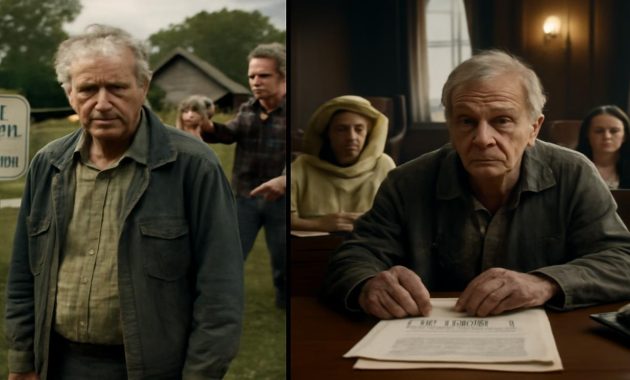

The bees arrived at dawn, humming like a distant engine as the sun slid over the cul‑de‑sac roofs. By 8 a.m., the neighborhood group chat was already on fire. Someone had spotted the white pickup, the wooden boxes, the smoker puffing little clouds. Someone else had zoomed in and, with the forensic intensity usually reserved for true crime podcasts, announced: “He’s getting an ag exemption. This is tax fraud with honey.”
The day the hives showed up
The retired couple at the end of the street had always been background characters in the neighborhood story. Their lawn was neat, their Christmas lights mild and tasteful. They waved at dog walkers. They were, by all visible measures, boring in the most comforting way.
Then, one spring, the For Sale sign that everyone half expected never showed up. Instead, six pale wooden beehives did.
The air filled with that faint electrical buzz that you can feel in your teeth if you stand close enough. The smell of warm wax and dust and clover began to drift across their fenced yard. From the sidewalk, all you could really see were boxes on stands and the beekeeper in a white suit, moving slowly like a lunar astronaut.
But what people really noticed wasn’t the bees. It was the rumor.
“He’s getting his property taxes cut in half,” someone said.
“No, more than that,” another neighbor replied. “My cousin did this. Calls it ‘agriculture.’ He pays less than I do on my two-bedroom. For bees!”
The couple’s quiet decision to “help out” a local beekeeper had, somehow, become a kind of moral crime in the court of cul‑de‑sac opinion. Was it generosity toward a struggling beekeeper and pollinators—or a sophisticated way to dodge paying their fair share?
The strange marriage of bees and tax codes
Hidden inside the dry, eye‑glazing language of many state tax codes is a surprisingly poetic idea: if you use your land to grow things or raise animals—if you farm, in some tangible, productive way—the government will recognize that as a public benefit and tax you less.
So far, so reasonable. Until someone asks the obvious question: what counts as “farming”?
In parts of the country, lawmakers gradually widened the definition. Orchards. Vineyards. Cattle. Goats. And then, at some point, quietly, bees. Beehives, in many jurisdictions, qualify as “agricultural use.” A few boxes of bees on your acreage, managed by someone who knows what they’re doing, can transform your land on paper from “residential property” to “agricultural land.”
That change is worth thousands, sometimes tens of thousands, of dollars a year. And, crucially, the landowner does not need to become a beekeeper. They can simply “host” the hives. The beekeeper supplies the bees, equipment, and labor. The landowner supplies the land—and qualifies for a substantial tax break.
On glossy pamphlets and beekeeper websites, the arrangement is framed as a win-win-win: bees get habitat, beekeepers get space in a world of shrinking forage, landowners get lower taxes. What could be more wholesome?
Ask the neighbors across the street.
“Helping out” or gaming the system?
From the sidewalk, the setup can look suspiciously like a legal loophole with a halo on it. To the neighbor whose property taxes keep inching upward, that halo is blinding.
They see a retired couple on fixed income who once complained about rising taxes over coffee now hosting racks of beehives just past the fence line. They hear the words “ag exemption” whispered in the driveway. They remember reading that not all those bucolic “ranches” off the highway actually grow very much of anything, but still pay nearly nothing in property taxes.
There’s a particular discomfort in watching someone appear to benefit from public services—schools, roads, firetrucks—with a smaller contribution, especially when the mechanism looks like a technicality. A few boxes, a few buzzing insects, and suddenly your property isn’t “residential” anymore? Really?
“If that’s farming,” a neighbor mutters, “my tomato plant is agribusiness.”
Yet, on the other side of the fence, the beekeeper will tell you a different story: hauling heavy boxes in 100‑degree heat, treating mites, losing colonies to pesticides sprayed two miles away, scrabbling to find clean, pesticide‑light forage in a landscape paved and sprayed into sterility. To that beekeeper, access to scattered parcels of private land is survival, not a loophole.
Somewhere in between, the tax code sits like an opaque referee—until a case finally goes to court and the quiet arrangement of bees-for-breaks is dragged into fluorescent-lit clarity.
The court case that made everyone squirm
In a now‑notorious ruling that spread through beekeeping forums and neighborhood groups alike, a judge was asked to decide whether a property owner’s “bee operation” qualified them for an agricultural tax break—or whether it was essentially a costume party for their tax bill.
The scene in court was more beige than dramatic: stacks of documents, aerial photos, expert testimony. But what was at stake went beyond one property. The ruling peeled back the polite story we tell about “helping out” and forced a hard look at intention, scale, and sincerity.
The landowner’s attorney talked about environmental stewardship, declining bee populations, and the noble tradition of small-scale agriculture. They described the soothing hum of bees, the educational opportunities for schoolkids, the honey shared with neighbors.
The county’s attorney brought spreadsheets.
They presented years of tax records, showing huge drops in property taxes after a handful of hives appeared. They asked how many colonies were kept, how long they’d been present, how much honey was sold, where it was sold, whether records of sales existed. They pointed out that the “farm” had no sign, no website, no recurring customers, no clear profit motive. They raised the question few like to speak aloud:
“Is this genuinely agricultural production… or is it the performance of agriculture to unlock a lower tax rate?”
The judge’s written opinion shied away from moralizing and stuck, as courts do, to definitions and evidence: Was there continuous, bona fide agricultural use? Was there a business, or just a gesture?
The uncomfortable truth that opinion exposed was this: many arrangements dressed up as “helping a beekeeper” are, in practice, driven primarily—sometimes almost entirely—by the landowner’s desire to reduce taxes.
When kindness wears a calculator
It’s not that landowners don’t like bees. Many genuinely do. They walk out on warm evenings and watch the last foragers strafe the clover. They tell friends, with a soft kind of pride, “We’re helping the pollinators.” They might even buy a coffee table book on bees and leave it out where guests can see.
But the first conversation with the beekeeper usually doesn’t start with, “How can I support your livelihood?” It starts with, “Can this qualify me for ag?”
In the court case, email chains surfaced. The landowner’s questions were precise: How many hives are required? How many years until my valuation changes? What paperwork do I need? Can we keep it minimal so the neighbors don’t complain?
Nowhere in that thread were questions about honey yields, local forage, or pollination benefits. The bees were not the beneficiaries of the arrangement. They were the justification.
The judge didn’t call it fraud—because legally, it wasn’t. The statutes were vague, and the land technically met the letter of the law. But in parsing the facts, the ruling highlighted an ethical gap wide enough to drive that white pickup through.
What many neighbors feel, but struggle to articulate, is that there’s a difference between living with less because you’re part of a working landscape and simply wearing the outfit of that landscape to pay less than the people next door.
The quiet economics of “hobby agriculture”
Out in the real countryside, the tax system was originally designed to stabilize something fragile: the razor‑thin margins of farms that actually produce food or fiber. Droughts, pests, global markets—none of it cares that you still owe property tax each year. Lower valuations were meant as a kind of societal buffer: keep the land in production, and we’ll make it a little easier to hold on.
But the world changed. Suburbs spread their fingers into former pastureland. Wealth accumulated in retirement accounts and stock portfolios. Suddenly, you had software engineers with “cattle ranches” consisting of three longhorns and a mailbox, and retirees with “apiaries” that functioned mainly as shields for their tax bill.
The law, slow to adjust, created an odd category: hobby agriculture with major‑league financial perks.
Consider a simplified comparison:
| Scenario | Residential Lot | Same Lot with Bee “Ag Use” |
|---|---|---|
| Assessed Value | $500,000 (market) | $50,000 (ag rate) |
| Annual Property Tax (example rate 2%) | $10,000 | $1,000 |
| Beehives Hosted | 0 | 6–10 |
| Net Savings to Landowner | – | ≈ $9,000/year |
Those numbers vary wildly by state and county, but the ratio is often similar. A relatively small, symbolic level of agriculture unlocks a very real, very non‑symbolic financial reward.
To be clear: the beekeeper doesn’t see that $9,000. They may receive a small annual payment or simply free placement of their hives in exchange for providing the “ag use.” The lion’s share of benefit stays with the landowner, who now pays dramatically less than the schoolteacher a few doors down with no such acreage to “convert.”
Is it illegal? No—most of the time it’s perfectly within the written law. Is it equitable? That depends on whether you think public systems should reward gestures or genuine, measurable production.
The neighbor’s eye view
Through the slats of a fence, the system looks even stranger.
On one side: a family juggling daycare payments, student loans, and a property tax bill that feels like a slow leak in the hull. On the other: a pair of retirees whose biggest visible sacrifice seems to be tolerating a few more insects in the lavender.
They see the handyman’s truck parked routinely at the “bee house.” They watch the beekeeper’s visits with mild curiosity. There is no farm stand, no tractors, no evidence of commerce. There are, perhaps, jars of honey handed out at Christmas. There are no receipts.
But next July, when the county’s valuation notices arrive, one bill is a third of the other. Same fire coverage. Same roads. Same school district. Wildly different contributions.
So the neighbor does what modern humans do with uneasy feelings: they text about it.
“It’s a scam,” someone writes. “Tax fraud disguised as kindness.”
The words are emotionally accurate, even if legally sloppy. This isn’t fraud, exactly. It’s a mirror held up to a tax system that tried to protect working land and instead created a stage where anyone with just enough money and the right phone number can play farmer on paper.
Where does real stewardship begin?
Some defenders of bee‑based exemptions argue that any land not covered in concrete is a win. That bees are in crisis, that every hive matters, that pollinators don’t care why the flowers were planted or how heartfelt the motive.
There’s truth there. Bees—native and managed—are under pressure from pesticides, habitat loss, pests, and climate extremes. A yard that once held only thirsty turf grass now hosting clover, wildflowers, and a line of hives is, in a narrow ecological sense, better than before.
But when courts get involved, they don’t weigh ecological vibes. They weigh evidence: production records, management plans, income, scale, continuity. And their rulings reveal something simpler and colder than the poetry about pollinators: the system was never designed to reward people for “being nice to nature.” It was designed to keep working land in production.
Real stewardship is rarely tidy. It looks like spreadsheets of hive losses, invoices for feed and equipment, contracts with landowners, logbooks of honey harvests and mite treatments. It’s the nighttime worry when a hard freeze hits during bloom. It’s not just the Instagram shot of amber honey against the sunset.
A landowner who partners with a beekeeper in a way that genuinely supports that work—pays a fair fee, plants forage, accepts stings and swarms and the occasional dead‑out—might still qualify for the tax break. But the tax break is then attached to an actual agricultural process, not just a cosmetic arrangement.
The court case laid this bare: the law doesn’t ask whether you love bees. It asks whether you’re actually using your land for agriculture in a continuous, substantial way. Everything else—kindness, aesthetics, vibes—is extra.
Redrawing the line between loophole and livelihood
None of this is purely theoretical anymore. As rulings accumulate, counties and appraisal districts have started tightening definitions. Minimum hive numbers rise. Documentation requirements grow teeth. Inspectors show up not just to confirm the presence of boxes, but to ask harder questions about management and production.
Landowners and beekeepers who built their arrangements on the thinnest possible technical compliance suddenly find themselves on shakier ground. What once felt like a clever, quiet hack now looks, under legal light, like a risk.
Some respond by doubling down—adding more hives, formalizing agreements, tracking honey sales. Others quietly remove the boxes once the math no longer works in their favor. The trucks stop visiting. The bees disappear. The story retreats back into the numbers of the tax rolls.
And the neighbors? They keep watching, keep wondering how many of the “little farms” around them are really farms at all.
So what does an honest arrangement look like?
If you zoom out from the particular court case and the particular cul‑de‑sac, a sharper, more practical question appears: Is there a way to lend land to beekeepers that feels like stewardship rather than strategy?
There is, but it requires a shift in starting point.
Instead of asking, “How many hives do I need to cut my taxes?” a landowner might first ask, “What does a beekeeper actually need to keep bees healthy here?” That answer might include:
- Diverse forage: not just a monoculture of clover, but seasons of bloom—trees, shrubs, wildflowers.
- Reduced pesticide use: cooperation with neighbors to avoid spraying at peak foraging times.
- Long‑term access: stability so the beekeeper doesn’t lose their investment in building up colonies.
- Fair terms: written agreements that respect both parties, rather than handshake deals built on tax panic.
If, after that, the land also qualifies for an agricultural valuation, the financial benefit becomes a side effect of real ecological and economic activity, not the engine disguised as generosity.
This doesn’t resolve the deeper structural question—whether tax systems should be this easily reshaped by beehives in the first place. But it does offer a more honest path for those who genuinely want to help.
Because beneath the legal arguments and the neighborhood gossip lies a simpler tension: when we say we’re “helping out,” we should be clear—both to others and to ourselves—who we’re really helping.
FAQs
Is hosting beehives for a tax break actually illegal?
In most places, it’s not illegal if the arrangement meets the specific legal requirements for agricultural use. The issue isn’t usually criminal fraud; it’s whether the land truly qualifies under the law. If it doesn’t, and the owner knowingly misrepresents the use, then it can cross into fraud.
How do tax authorities decide if beehives qualify as “agricultural use”?
They typically look at factors like the number of colonies, continuity over several years, whether there is real management and production, and if the operation resembles a business rather than a token setup. Some places have explicit minimum hive counts and documentation rules.
Do bees really need this kind of land access?
Managed honey bees benefit from pesticide‑light, forage‑rich spaces, and scattered small parcels can help beekeepers. But the ecological value varies widely. A few hives on a lawn with limited flowers help less than a thoughtfully planted, pesticide‑conscious property.
Why are neighbors so upset if it’s technically legal?
Because the outcomes feel unfair. Two households use the same public services, but the one with a minimal “ag use” setup may pay dramatically less. The mismatch between the legal definition of agriculture and the visible reality creates resentment.
Can I support beekeepers without getting into tax gray areas?
Yes. You can lease land at a fair rate, plant pollinator‑friendly habitat, reduce chemical use, and sign clear agreements that don’t hinge on changing your property tax status. You can support local beekeepers by buying their honey and services, regardless of how your land is classified.
