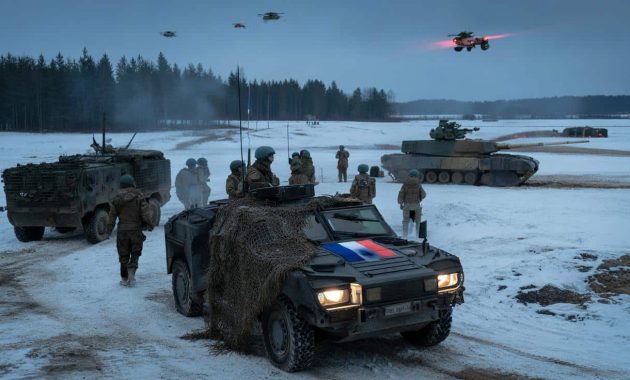
Far from Paris, in NATO’s eastern front-line states, France has quietly put its new-generation land combat unit through a brutal four‑day test that says a lot about where Europe’s next big fight could unfold.
French SGTIA passes its first major test in Estonia
Early December 2025, more than 600 French and British soldiers gathered in northern Estonia for exercise SCORPION PANZER, part of NATO’s enhanced Forward Presence mission.
A British headquarters led the multinational battlegroup. The French contribution centred on a full-strength sous-groupement tactique interarmes, or SGTIA, designed specifically for high-intensity combat in coalition operations.
France used SCORPION PANZER as a first full-scale proof that its new generation combined-arms unit can fight, manoeuvre and survive on NATO’s most exposed flank.
Running for four days in sub-zero temperatures, the exercise went far beyond simple drills. It simulated the full rhythm of a modern ground war: rapid deployment, offensive thrusts, defensive attrition and a final counter-attack in trenches reminiscent of Ukraine.
From toolbox to frontline: what a GTIA and SGTIA really are
The French Army sees the SGTIA as the sharp end of a bigger tool: the groupement tactique interarmes (GTIA), or combined-arms tactical group.
A GTIA starts with a core regiment, usually infantry or armoured cavalry, then adds artillery, engineers, signals and logistics tailored to the mission. Everything falls under one commander, with a single plan and tempo.
- GTIA: a modular, mission-tailored battlegroup mixing infantry, tanks, artillery, engineers and support.
- SGTIA: a lighter, more agile slice of that battlegroup, built for close combat and rapid manoeuvre.
These structures were battle-tested in Afghanistan and the Sahel. In Estonia, the French SGTIA embodies the latest evolution of this approach: compact, autonomous, heavily networked and built from day one to plug into NATO frameworks led by allies like the UK or US.
A unit designed for contact
The SGTIA involved in SCORPION PANZER deployed new-generation GRIFFON armoured vehicles, infantry, engineers and supporting assets. Its size and design allow it to hold a sector, launch local attacks or reinforce allied positions at short notice.
➡️ Say goodbye to gray hair with this 2 ingredient homemade dye
For NATO planners, this kind of plug‑and‑play French unit is one of the pieces needed to build a credible land defence from the Baltic to the Black Sea.
Phase one: rapid deployment and offensive push
The exercise opened with what every crisis in Eastern Europe would demand: speed. French and British elements deployed rapidly into Estonian woodland, grabbed forward positions and issued orders under tight time pressure.
The operational command post came online as units rotated through exposed forward lines. The tempo left little room for hesitation, forcing staff and troops to work with incomplete information.
Armed with intel from infiltrated reconnaissance teams, the Franco-British battlegroup shifted from posture to punch. Tanks and mechanised infantry attacked a mock enemy, neutralising armoured vehicles and seizing trench networks.
Drones were the real game-changer: they spotted enemy movements, marked targets and simulated strikes in real time, turning the sky into a second battlefield.
Both sides in the scenario had comparable technology, including UAVs, which forced the French SGTIA to think about concealment, electronic signatures and how long a vehicle can stay still before it is “found”.
Phase two: holding the line under pressure
The second phase flipped the script. After attacking, the battlegroup had to hold.
On tight, wooded ground that punished both tracks and wheels, the mission shifted to denial: slow the enemy, force them into kill zones, bleed their advance. British WARRIOR infantry fighting vehicles and French GRIFFONs moved troops and combat engineers close to the front.
They dug in, fortified positions and rigged likely approach routes with simulated obstacles and mines. The goal was no longer gains in kilometres, but forcing the opponent to pay in time and assets for every metre.
Where interoperability gets real
This was the phase planners cared about most. Coordinating artillery and direct fire across languages and doctrines is harder than drawing arrows on a map.
French and British troops had to share targeting data, request support and rotate units using procedures that both sides understood instantly. Radio brevity codes, map references, even the way a platoon leader describes terrain had to line up.
SCORPION PANZER did not just test hardware resilience; it measured whether French and British soldiers could instinctively fight as one under stress.
Final act: a joint assault on enemy trenches
The closing stage was a counter-attack meant to clear entrenched positions.
Mixed groups of French and British infantry climbed into WARRIOR vehicles, backed by CHALLENGER 2 tanks. They advanced to the edge of enemy trench systems and dismounted side by side for the final assault.
Here, interoperability stopped being a buzzword. Sections blended across national lines. Fire and movement drills, hand signals, casualty evacuation procedures — all had to match, or the attack would stall.
For French officers, this live-fire style scenario was a first real confirmation that their SGTIA structure can slot smoothly under a British-led command in high-tempo operations.
One piece of NATO’s wider Eastern shield
France has taken part in NATO’s enhanced Forward Presence in the Baltic states since 2017. In Estonia, it serves under a UK framework nation battlegroup, which also includes Estonian and other allied troops.
After Russia’s full-scale invasion of Ukraine in 2022, Paris increased its Eastern deployments and shifted from symbolic presence to credible blocking force. Around 300 French soldiers now operate in Estonia with modern vehicles and combined-arms capabilities.
SCORPION PANZER fits into a broader pattern: NATO has quietly grown from small battlegroups to brigade-level forces along its eastern flank.
Snapshot of NATO forces in Eastern Europe, 2025
| Host country | Framework | Framework nation | Estimated NATO troops | Main contributors | Key capabilities |
| Estonia | eFP | UK | ~1,200 | UK, France, Denmark, Estonia | Mechanised infantry, CHALLENGER 2 tanks, artillery, drones |
| Latvia | eFP | Canada | ~1,700 | Canada, Spain, Italy, Poland, Latvia | Infantry, light armour, air defence |
| Lithuania | eFP | Germany | ~1,600 | Germany, Netherlands, Norway, Czechia | Heavy armour, artillery, logistics |
| Poland | Expanded eFP | US | 10,000+ | US, UK, Romania, Croatia | US armoured brigade, aviation, missile defence |
| Romania | eFP → brigade | France | ~5,000 | France, Belgium, Spain, Luxembourg | Leclerc tanks, CAESAR artillery, TIGER/NH90 helicopters |
Roughly 40,000 NATO troops are now either forward-based or ready for rapid deployment to the eastern flank. Stocks of ammunition and heavy equipment are prepositioned, and standing command chains are in place to avoid last-minute improvisation.
Why Estonia matters for Paris, London and Moscow
For London, leading the Estonian battlegroup underlines its post-Brexit role as a hard-power European player in NATO.
For Paris, exercises like SCORPION PANZER send a dual message. On one hand, France shows it is not just a Mediterranean or Sahel power, but ready to commit heavy forces from the Baltic to the Black Sea. On the other, it proves its SCORPION land modernisation programme — new vehicles, networks and doctrine — is maturing in real conditions.
For Moscow, watching from across the border, the signal is blunt: any attempt to test NATO’s treaty promise in the Baltics would meet not just local troops, but integrated brigades able to manoeuvre and counter-attack quickly.
Key terms and what they actually mean on the ground
Several acronyms hide big changes in how European defence now works:
- eFP (enhanced Forward Presence): NATO’s permanent, multinational units stationed in the Baltics and parts of Eastern Europe as a visible deterrent.
- Framework nation: the country that provides the core headquarters and main forces for a given NATO battlegroup or brigade.
- Nation-cadre: the state that leads a multinational formation, shaping its doctrine, training rhythm and deployments.
France is framework nation in Romania, fielding Leclerc tanks, CAESAR guns and a joint headquarters. In Estonia, it accepts a different role: a powerful but subordinate combined-arms brick under UK command.
Future scenarios and what this training hints at
Military planners watching SCORPION PANZER are less interested in today’s drill than in tomorrow’s crisis. In a real conflict, a French SGTIA in Estonia could, for example:
- Reinforce a threatened sector with armoured infantry while British tanks deliver long-range fire.
- Conduct night raids on enemy artillery positions using drones for spotting and navigation.
- Hold a critical village or road junction until a larger NATO brigade arrives.
The risks are clear. Operating under constant drone surveillance shortens reaction times. Any mistake in coordination between allies could lead to friendly fire or missed opportunities. And sustaining such units over weeks would require robust logistics through vulnerable Baltic routes.
Yet the benefits of this kind of integration are hard to ignore. Each repetition builds shared reflexes, from how a French gunner interprets a British fire mission, to how an Estonian officer briefs terrain to both. SCORPION PANZER shows that France is no longer just signalling commitment to NATO’s east; it is training to fight there, for real, alongside the UK and other allies.
Originally posted 2026-02-11 19:19:30.