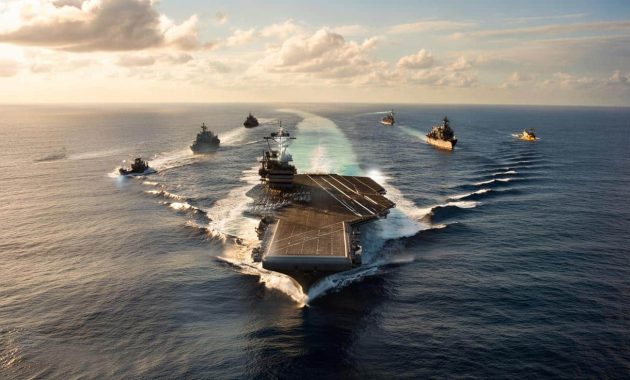
The Atlantic looks calm from 15 decks up, like a sheet of brushed metal. On the island of a U.S. aircraft carrier, the wind claws at your jacket, the deck hums under your boots, and the horizon is just an endless, stubborn line. Down below, 5,000 people live in a floating city that doesn’t feel like it’s moving at all. And yet, somewhere on a chart in Combat, a thin pencil mark crawls toward Europe.
Somebody asks the question out loud, half joke, half real curiosity: “So… how long would it actually take us to cross this whole thing?”
Nobody gives the same answer. That’s when you realize: the journey of a carrier isn’t just about speed. It’s about everything that can’t be seen from the flight deck.
So, how fast can a 100,000-ton giant really go?
If you Google the speed of a Nimitz or Ford-class carrier, you’ll usually find something like “30+ knots.” That mysterious little plus sign hides a lot. Official numbers are intentionally vague, partly for operational security, partly because conditions change everything.
Translating that into something closer to daily life: 30 knots is roughly 34–35 mph (about 55–56 km/h). So on paper, a modern U.S. carrier cruising across the Atlantic at a steady clip could cover roughly 700 nautical miles a day.
On a clean, straight line, New York to the English Channel is about 3,000 nautical miles. Do the back-of-the-envelope math, and you land on a surprising answer.
Imagine the ship leaving Norfolk, Virginia at first light. The pier slowly shrinks, cell signals fade, and the coastline smudges into a gray smudge on the horizon. Day one: still hugging the East Coast, working through shipping lanes. Day two: deeper blue water, fewer lights at night, the sky getting bigger. Day three: you’re fully in the open Atlantic, and the world has turned into steel, sky, and sea.
On a pure speed-run profile, a carrier group could cross the Atlantic in about 4–6 days. That’s a sprint, pushed hard, with priority on getting to the other side fast. Some transatlantic repositioning cruises have run on similar timelines, especially when a carrier had to reach the Mediterranean in a hurry.
But life at sea rarely stays as clean as the math on a whiteboard.
Real crossings factor in weather, escort ships, fuel for the escorts, training schedules, and even political signaling. A carrier almost never travels alone; it moves with a carrier strike group, which usually includes cruisers, destroyers, and often a supply ship. That means the formation’s speed is limited by the slowest hull and the mission profile.
➡️ The subtle reason familiar places make people less motivated
➡️ How spending awareness improves even without detailed tracking
➡️ Salaries in this career increase steadily rather than dramatically
➡️ New arrest: The sad downward spiral of Visham Ramdoo
➡️ Swiss Government Ordered a $117 Million Private Jet Only to Realize the Runway Was Too Short
➡️ 4 phrases to end a conversation intelligently
➡️ Experts say a common morning routine may quietly shape long-term motivation levels
➡️ An ‘ingenious’ Ukrainian idea so good China patented it for its next high?tech battle tank
Rough seas, North Atlantic storms, or heavy flight operations can all force the group to adjust speed. Sometimes the goal isn’t to arrive fast, but to spend time in specific training areas, run exercises, or coordinate with allied navies. So while the theoretical answer might be “about five days,” the lived reality is often closer to 7–10 days door to door.
The plain truth: a carrier crosses the Atlantic at the speed of strategy, not at the speed of engines.
Why the Atlantic crossing is never just straight-line sailing
If you picture the navigation route on a screen, it’s not a straight pencil line from America to Europe. It looks more like a gentle arc, bending north. That’s the great circle route: the shortest path between two points on a sphere. Pilots use it, big ships use it, and it quietly shaves hours off a crossing.
On top of that, navigators constantly watch currents, sea states, and wind. The Gulf Stream can help or hinder; winter swells can slow the group down. Every watch, someone is tweaking the plan by a knot here, a course correction there.
A good navigator treats the Atlantic less like a highway and more like a living thing that needs to be read.
We’ve all been there, that moment when a plan looks simple on paper and then reality laughs. On one deployment, a carrier group leaving the U.S. East Coast was “scheduled” to hit the Strait of Gibraltar in just over a week. The schedule said one thing; the ocean said something else.
First came a North Atlantic low, rolling deep swells across the carrier’s bow. Flight operations had to pause, escort ships took heavier motion, and speed dropped to keep everyone safe. Then came a multi-day exercise with NATO partners, intentionally slowing transit to work through complex drills.
By the time the ship saw the hazy silhouette of Europe, that neat line on the PowerPoint slide had stretched several days longer.
There’s also the human factor. A carrier is a city that needs sleeping, eating, maintenance, and training. Crossing the Atlantic is prime time for qualifying new pilots, running man-overboard drills, testing radar, or doing seemingly tiny checks that keep a nuclear-powered behemoth alive. Every time the air wing flies, the ship’s speed and course may shift to create the right wind-over-deck.
Then there’s diplomacy. Sailing a bit closer to certain coastlines, joining up with an allied frigate, or deliberately taking a visible route can send messages that never show up in public schedules. A carrier is a political statement as much as a warship.
So when you ask “how long does it take to cross?”, the real answer is braided tightly with what the ship is meant to say just by being there.
How to mentally picture a carrier’s Atlantic crossing time
One simple mental trick helps: think in ranges, not exact numbers. Instead of hunting for “the” answer, hold two ideas in your head. First, the pure performance window: around 4–6 days for a fast, focused transit at high speed. Second, the mission window: 7–10 days for a typical, real-world crossing with training and operations.
Start with the distance (about 3,000 nautical miles), then divide by average speed. At 25 knots, you’re at 5 days. At 20 knots, you’re closer to 6–7 days. That’s really all the math you need to keep a rough sense of scale.
*Once you do that, an aircraft carrier suddenly feels a lot less like a lumbering dinosaur and a lot more like a marathon runner choosing their pace on purpose.*
Lots of people get tripped up by comparing carriers to cruise ships. Cruise liners sometimes boast higher top speeds and can do transatlantic crossings in 5–7 days as well, which sounds similar. The difference is that cruise ships are built to move passengers fast and smooth, not to run jet operations or escort destroyers.
Another common mistake is imagining the carrier pinned at “top speed” the whole way. Real ships don’t sprint non-stop; that burns fuel for escorts, stresses machinery, and leaves little margin to react. Let’s be honest: nobody really runs anything at max settings for days in a row unless they absolutely have to.
If a news story mentions “a carrier rushing toward a crisis,” remember there’s still a lot of patient, methodical sailing under that dramatic headline.
“People imagine carriers charging across the ocean like race cars,” a former U.S. Navy officer told me. “In reality, it feels more like living in a town that just happens to have a horizon that moves.”
- Ballpark crossing time – Around 4–6 days flat-out, 7–10 days in typical conditions – Gives you a realistic range without obsessing over secretive exact speeds.
- Route and weather effects – Great circle routes, storms, and currents nudge timing up or down – Helps you understand why no two crossings feel exactly the same.
- Mission over speed – Training, diplomacy, and flight ops steer the schedule – Shows why carriers sail at the pace of strategy, not just engineering.
- Comparison with civilian ships – Carriers can match or beat many liners on speed, but not on comfort – Grounds the myth of “slow old warships” in real-world numbers.
- Life on board during transit – Drills, watches, maintenance, and movies in cramped lounges – Lets you picture the crossing as a lived week, not just a line on a map.
What an Atlantic crossing really means for the people on board
Ask sailors about crossing the Atlantic and they rarely answer in knots. They talk in mid-watches, in cups of coffee, in the number of sunsets watched from the sponsons. Time stretches oddly at sea. One day the ocean feels like a wall. The next, the ship jumps forward on the chart and you suddenly realize you’re closer to a different continent than the one you left.
For some, that first crossing is a rite of passage. You get your “blue nose” ceremonies for crossing the Arctic Circle, your “shellback” stories for the Equator, your hazy memory of the first time you saw Europe rising out of the morning mist.
Those experiences don’t care if the transit took five days or nine. They live in moments, not in speed logs.
The next time you read that a carrier has “entered the Atlantic” on its way to a crisis, you can picture what that really looks like. Somewhere on the bridge, a navigator is quietly updating a position report. Down below, someone is arguing over whose turn it is to do the trash run. On the flight deck, a petty officer squints at the sky and judges if the crosswind will play nice.
Between the coasts, there’s an enormous stretch of blue that most of us only ever see from 35,000 feet. For the people aboard a carrier, that stretch is a working week filled with drills, worries, little joys, and the low constant thrum of nuclear power pushing steel forward.
The question “how long does it take?” turns out to be less about days and more about what those days are used for. That might be the most quietly fascinating part of all.
| Key point | Detail | Value for the reader |
|---|---|---|
| Typical crossing time | Roughly 4–6 days at high speed, 7–10 days for real-world missions | Gives a concrete, shareable answer that still respects operational nuance |
| Factors that change timing | Weather, escort ships, training, political signaling, and routing | Helps you read between the lines when you see carrier movements in the news |
| Human experience on board | Life feels like a floating city gradually sliding across a moving map | Transforms abstract numbers into a vivid mental picture of the journey |
FAQ:
- Question 1How many days does it usually take an aircraft carrier to cross the Atlantic?
- Question 2Are aircraft carriers faster than cruise ships on transatlantic routes?
- Question 3Do carriers ever travel at their absolute top speed the whole way?
- Question 4Can an aircraft carrier cross the Atlantic without refueling?
- Question 5What happens on board during a long Atlantic transit?