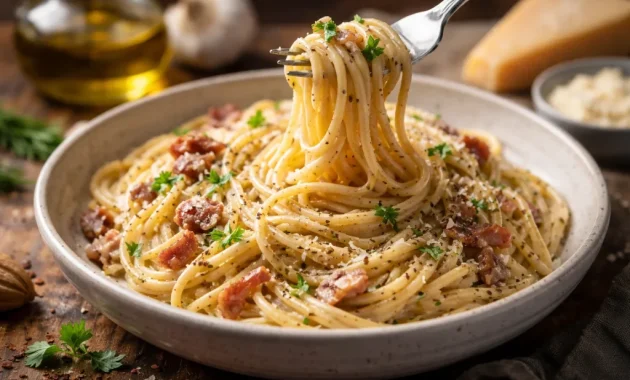
The night I ruined pasta for eight people, someone actually clapped. Not the good kind of clapping. The slow, polite “well, we tried” applause you give a child at a school recital. The pot had boiled over twice, the sauce was gluey, and my friend’s Italian boyfriend stared at my dish like it had personally offended his ancestors. I’d followed the recipe “exactly”. I’d done what the blog said. And yet the spaghetti on those plates tasted like wet cardboard wearing tomato perfume.
That disaster is the reason I cook pasta the way I do now. No complicated tricks. No intimidating Italian nonna in my head, judging from the doorway. Just a few hard lessons burned into my memory, one overcooked noodle at a time.
Because once you learn pasta the hard way, you never go back to cooking it on autopilot.
The night everything went wrong with a simple pot of pasta
The recipe that broke me was supposed to be foolproof: “Best One-Pot Creamy Pasta, Ready in 15 Minutes.”
The photos were glossy, the comments full of hearts and exclamation marks. I invited friends, bought the good parmesan, lit a candle I absolutely did not need.
Then I dumped everything into one pan like the instructions said. Pasta, water, cream, stock cube, garlic, all boiling together in a foamy chaos that smelled great… for the first five minutes.
By minute twelve, the bottom had burned. By minute fifteen, the top was still undercooked. The sauce was thick in a way that whispered “hospital food”. And yet I’d done everything the recipe told me to.
One of my friends, who usually eats anything, quietly left half his bowl. Another one tried to rescue it with chili flakes. My spoon literally stood up in the pot on its own, like that famous test with thick hot chocolate.
Later that night, I sat on the floor with my laptop and searched things like “why does my pasta always suck?” and “why does restaurant pasta taste better than mine?” That’s when I stumbled on a video of a Roman chef yelling (lovingly) at tourists who broke their spaghetti before cooking it.
He explained starch, timing, heat, salt, as if he was breaking a curse. It felt dramatic, but he wasn’t wrong. I realized the problem wasn’t me being cursed in the kitchen. The problem was the way I’d been taught to think about “easy” cooking.
The hard truth hit me: throwing everything into one pot is great for dishes like soup or stew, not for noodles that live and die in seconds. I’d treated pasta like rice or potatoes, something slow and forgiving. It isn’t. Pasta lives in this narrow window between “too hard” and “too soft”, and inside that window, magic happens.
➡️ Japan enters hypersonic missile defense era with mass production of Improved Type 03 Chu-SAM Kai
➡️ Released into the forest by his owners, this squirrel returns every morning to the window to play with his best canine friend
➡️ The new Chinese fighter jet pushes the known limits of naval aviation
➡️ Gray hair is outdated this controversial 2 ingredient recipe makes you look years younger
➡️ Abdominal fat after 60 : the easiest, most effective exercise you’re not doing
➡️ Why flexible budgets work better than strict ones for most people
➡️ Riyadh Lines Up 330 MQ-9B And Gambit Drones
➡️ T-7 Red Hawk jet trainer offer to United Kingdom includes local assembly
From that night on, I stopped believing in miracle one-pan recipes that promise less washing up and more “creamy perfection” with zero effort. Let’s be honest: nobody really does this every single day.
I started treating pasta the way you treat a good conversation. Present, attentive, not scrolling your phone while it bubbles away alone. That small mental shift changed everything I put on a plate.
The simple method I now follow every single time
These days, my “never again” rule is simple: the pasta cooks in one pot, the sauce in another, and they only meet at the end like a well-timed date. I salt the water until it tastes like a clean, mild sea. Not a swamp, not a shot of brine. Just alive.
I bring it to a real boil, not a lazy simmer. Then the pasta goes in, whole, without breaking. I stir in the beginning so it doesn’t stick, then I let it move on its own.
The trick that changed everything? I stop cooking the pasta a minute or two before the packet says. I move it, still a little firm, straight into the pan where the sauce is quietly waiting. They finish together, sharing heat and starch and flavor instead of sulking in separate corners.
The second part of the ritual is the sauce. While the water heats, I start with something small in a pan: a clove of garlic in olive oil, a bit of onion, a handful of chopped tomato, or a spoonful of butter and black pepper. Nothing fancy, just honest flavors.
I add a ladle of that starchy pasta water and let it reduce until it looks glossy instead of watery. This is the moment most of us rush, because we’re hungry and our phones keep lighting up on the counter. *This is also the moment that makes the difference between “decent” and “why does this taste like a restaurant?”*
When the pasta slides into that pan, it doesn’t drown. It coats, it clings, it absorbs. A handful of grated cheese off the heat, a little toss, a taste for salt. And that’s it. No magic, no secret ingredient. Just a few patient minutes.
I’ve learned the main enemy in all this isn’t lack of skill. It’s panic. The panic that hits when the pasta is almost done, the sauce looks wrong, and suddenly you’re dumping in more cream, more cheese, more whatever-jar-you-find in the cupboard.
That’s when sauces split, pasta overcooks in the pot, and everything tastes heavier than it should. We’ve all been there, that moment when your “quick dinner” starts to feel like a small emergency.
Now, when that panic creeps up, I repeat a tiny rule in my head: heat down, water up. Lower the flame, add a spoon of pasta water, breathe. Most sauces can be rescued with those two simple moves. Burned bottoms and mushy noodles are harder to forgive.
“Pasta is simple, but it is not lazy,” an old chef once told me in a tiny Roman trattoria. “You do little things well, at the right moment. That’s all. And that is everything.”
Sometimes I think about that sentence as I cook on a regular Tuesday with laundry drying on a chair and emails still open on my laptop. My routine now comes down to a few non-negotiables I wish I’d learned sooner:
- Salt the water early, and taste it before the pasta goes in.
- Cook the pasta a touch under, then finish it in the sauce.
- Keep a mug of pasta water aside for emergencies and creaminess.
- Mix pasta and sauce for at least a minute on the heat, don’t just pour sauce on top.
- Grate hard cheese fresh if you can, and add it off the heat.
None of this is trendy. None of it looks dramatic on TikTok. Yet this is the quiet backbone of every bowl that makes people go back for seconds without asking what’s “in it”.
The recipe that stays with you long after the plates are empty
When I say I never make pasta differently now, I don’t mean every sauce is the same. Some nights it’s just garlic, chili, and oil. Other days, there’s a slow-cooked ragù that has been murmuring on the stove for hours. The constant isn’t the ingredient list. It’s the way the pasta and sauce meet, the respect for timing, the refusal to drown everything in shortcuts.
What I learned the hard way is that the smallest choices, repeated quietly, change how people remember a meal. Not the brand of olive oil. Not the type of trendy cheese. Just the fact that the pasta is alive in the sauce instead of floating under it.
Maybe your “hard way” story isn’t about burning a one-pot dish like I did. Maybe it’s serving undercooked penne to your kids, or apologizing for the third time in a month because your “creamy” sauce turned grainy again. There’s always that one dinner that makes you say: okay, something has to change.
From that point on, cooking stops being about copying viral recipes and starts being about understanding a few plain truths your hands can remember. You salt the water with more confidence. You taste earlier. You trust yourself a little more with the heat.
And suddenly, on some random evening, someone at your table says, “This is really good pasta.” Not fancy. Not dramatic. Just really good. That’s the sentence that stays with you.
| Key point | Detail | Value for the reader |
|---|---|---|
| Cook pasta and sauce separately | Boil pasta in salted water, prepare sauce in a pan, then finish them together | Better texture and flavor, closer to restaurant quality at home |
| Use pasta water like an ingredient | Reserve starchy water to adjust thickness and help sauce cling | Creamier sauces without needing extra cream or butter |
| Control timing, not trends | Undercook slightly, avoid panic, adjust heat and liquid calmly | More reliable results, fewer kitchen disasters and wasted meals |
FAQ:
- Question 1Do I really need to salt the water that much for pasta?
- Answer 1Yes, because the pasta absorbs that seasoning from the inside. The goal isn’t super salty water, just water that tastes pleasantly seasoned, like a light broth.
- Question 2Can I still use one-pot pasta recipes sometimes?
- Answer 2You can, especially for very simple weekday dinners, but expect a different texture. For your “impress people” meals, the two-pot method is far more reliable.
- Question 3What if I don’t have fresh parmesan or pecorino?
- Answer 3Use whatever hard cheese you have and grate it finely. Pre-grated bags work in a pinch, but they won’t melt as smoothly because of added anti-caking agents.
- Question 4How do I stop my pasta from sticking together?
- Answer 4Stir in the first minute or two, keep the water properly boiling, and don’t let cooked pasta sit in a colander. Move it straight into the sauce while it’s still hot.
- Question 5My sauce always turns too thick or too thin. What can I do?
- Answer 5Keep a cup of pasta water next to you. If it’s too thick, add a splash and toss. If it’s too thin, cook it a bit longer on low heat and let the starch do its job.