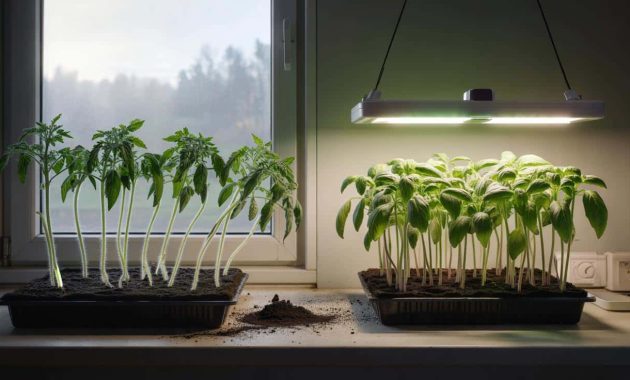
The first time your tomato seedlings topple over, it feels almost personal. Yesterday they were standing proud on the windowsill, tiny soldiers in a row. Today they’re lying flat, stems like overcooked spaghetti, leaves stuck to the soil as if they’ve given up on life. You touch one and it bends with zero resistance, that heartbreaking “snap” waiting to happen.
You water less. You water more. You whisper encouragement, you move the tray away from the radiator. Nothing changes.
Some gardeners blame the compost, some blame the seeds. Yet the silent culprit is usually shining right above them.
The real reason your seedlings stretch and collapse
If your seedlings grow tall, thin, and then fall over, they’re not “weak”. They’re desperate. That long, pale, thread-like look has a name: legginess. It almost always points to one thing — not enough light or the wrong kind of light.
From the plant’s point of view, the logic is simple. Light means life, so they stretch toward it as fast as they can. They sacrifice thickness of stem and strong roots in a frantic race upward. It looks like growth, but it’s closer to panic.
Picture a tray of basil babies on a kitchen table. The nearest window faces north, the sky is white, and the days are still short. After a week, the seedlings are twice as tall as the label photo. Sounds good, until you look closely.
The stems are thin as sewing thread, leaning hard toward the glass. When you turn the tray around, they tilt the other way by the next afternoon. That’s your clue. They’re not growing up. They’re reaching out.
Plants read light a bit like we read a room. They sense brightness, direction, and even color. When light is weak or too far away, seedlings kick in an elongation response, stretching cell walls to chase the source.
Under strong, close light, they don’t need to move much. They stay compact, with thicker stems and darker leaves. Under dim light, the message is: “Climb or die.” So they grow tall fast, but the tissue is soft and fragile. One watering or a gentle breeze is all it takes to send them crashing down.
How to fix the light mistake that ruins young plants
The most effective way to stop seedlings from stretching is brutally simple: give them stronger, closer light from day one. That usually means bringing in a grow light, not just hoping a window will be enough.
➡️ Those who become more likeable and respected with age have often dropped these 8 outdated habits
➡️ Engineers slowed land subsidence by pumping water into empty oil fields for decades
➡️ “I was budgeting carefully and still losing $2,200 a year”
➡️ Your Poop Schedule Says a Lot About Your Overall Health, Suggests Study : ScienceAlert
➡️ “I feel uneasy with silence”: psychology explains the exposure effect
A basic LED grow bar 10–15 cm above the leaves transforms the scene. Stems stay chunky, leaves stack tightly, and growth is slower but sturdier. You’re not just growing height. You’re building structure.
This is where many home gardeners get tripped up. The seed packet says “sow indoors” and your brain says “windowsill, obviously”. Then the days turn grey, the glass filters half the light, and eight hours of weak daylight just doesn’t cut it.
You do what most of us do at first: you slide the tray closer to the glass, maybe onto a radiator shelf, and hope. Let’s be honest: nobody really measures light levels with a meter every single day. Yet seedlings react to every tiny change, and they’re merciless about showing the result.
“The day I stopped trusting my windowsill and bought a cheap grow light was the day my seedlings stopped dying,” confessed a market gardener I met, laughing at her own stubbornness.
- Lower the lightPlace grow lights 10–20 cm above the seedlings, adjusting as they grow so the distance stays more or less constant.
- Stretch the “day” to 14–16 hoursUse a timer so the plants get long, steady light, then a clear dark period at night.
- Rotate or fan your seedlingsTurn trays daily or run a small fan to encourage sturdier stems that don’t flop at the first gust.
- Use the brightest window you haveSouth or southwest-facing is best, with no thick curtains or deep overhangs blocking the sky.
- If they’re already leggy, pot them deeperTransplant and bury part of the stem (especially with tomatoes) so they can form extra roots and recover some strength.
Light as a quiet partner in every seedling’s story
Once you see light as a partner rather than a backdrop, seed starting stops feeling like a gamble. You begin to notice how the room changes during the day, how that “bright” corner actually sits in shadow after 3 p.m. You catch the slight lean of stems toward the window and read it as a message, not a failure.
We’ve all been there, that moment when you’re tempted to blame your “black thumb” for another tray of fallen sprouts. Yet most of the time, the fault isn’t in your hands at all. It’s in the invisible numbers of lux, lumens, and hours that your seedlings quietly live by.
The next time you sow, you might still line up pots on the windowsill. You might still use whatever lamp you already own. The difference is that you’ll watch those first few days with a sharper eye. Are the stems thickening or stretching? Are leaves rich green or washed-out?
*Seeds don’t ask for perfection, just consistency.* A simple light on a timer, a tray turned once a day, a slightly deeper transplant — these are small habits that quietly stack in your favor. One season later, you’re the person handing neighbors strong, dark green starts and shrugging like it’s no big deal, even though you secretly know you cracked the code.
| Key point | Detail | Value for the reader |
|---|---|---|
| Light intensity matters | Weak or distant light triggers leggy, floppy seedlings | Helps diagnose the real cause of stretched plants |
| Light distance is crucial | Grow lights 10–20 cm above seedlings keep growth compact | Gives a clear, practical setup to prevent collapse |
| Simple fixes work | Longer light periods, rotation, deeper potting set seedlings back on track | Shows that lost-looking plants can often be saved |
FAQ:
- Why are my seedlings tall, thin, and falling over?They’re probably not getting enough strong, direct light, so they stretch rapidly toward the nearest source and end up weak and floppy.
- Can leggy seedlings be saved?Often yes: pot them deeper, move them under stronger light, and reduce temperature slightly to slow height growth and thicken stems.
- Is a sunny window enough for seedlings?Sometimes, but many homes don’t get the intensity or duration young plants need, especially early in the season or with north-facing windows.
- What kind of grow light should I buy?An LED grow light with a full spectrum or “daylight” white around 4,000–6,500 K works well; focus more on brightness and coverage than on fancy marketing claims.
- How many hours of light do seedlings need?Most vegetables do best with 14–16 hours of light and 8–10 hours of darkness each day to build strong, stocky growth.