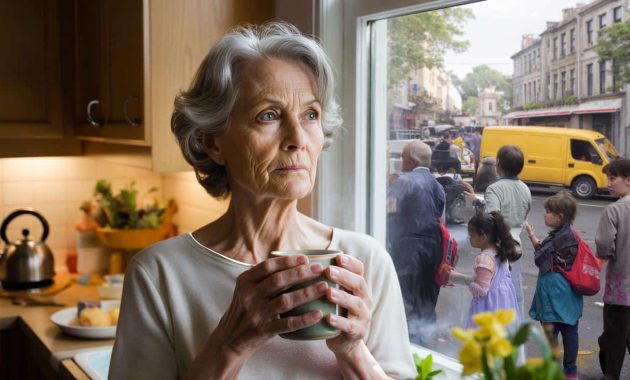
The morning she realised something had changed, the kettle had already boiled twice.
Outside, the street was noisy and slightly frantic: delivery vans, kids dragging school bags, someone arguing on the phone.
Inside, at 68, she stood in the kitchen, hands around her mug, and noticed a strange calm sitting in her chest like a quiet cat.
No rush.
No need to prove anything.
No urge to fix the whole world before lunchtime.
Then came the second feeling.
A small stab of guilt, almost shame.
“Am I becoming lazy? Am I… giving up?”
We don’t often talk about that quiet shift that arrives with age.
The one that feels like peace from the inside and looks suspiciously like apathy from the outside.
Or at least, that’s the fear.
When calm feels like you’re letting life pass by
There’s a strange pressure on people over 65 to either be endlessly “active seniors” or to disappear politely into the background.
If you’re not running marathons, learning Japanese, and starting a YouTube channel, you almost feel like you’re failing at retirement.
So when a deeper calm shows up – fewer emotional storms, less need to argue, more afternoons where “nothing special” happens – it can feel unsettling.
The world shouts “stay engaged!” while your body whispers “slow down, breathe”.
Some mornings you wake up and realise you’re genuinely okay with doing less.
And that’s when the quiet question appears: is this wisdom… or is this me checking out of life?
Take Paul, 72, who spent 40 years running a small plumbing business.
His phone never stopped ringing, his van was his second home, and he used to fall asleep in front of the TV with invoices on his lap.
After he retired, the first year was all action: trips, DIY projects, saying yes to every family request.
Then, gradually, the pace dropped.
He stopped volunteering at the sports club.
He didn’t reorganise the garage “properly”.
He started saying, “No, I’m staying in today, I like the quiet.”
His daughter looked worried.
“Dad, you’re always home now. You’re not… depressed, are you?”
He wasn’t.
For the first time since he was 20, he was simply not rushing anywhere.
And he found himself feeling serene – and strangely guilty for enjoying it.
➡️ You’re Feeding Rats Without Realising It: How To Stop Rodents Raiding Your Bird Seed
➡️ The world’s longest underwater high-speed train is in progress, set to link two continents beneath the sea
➡️ Die psychologischen Vorteile, handschriftliche Notizen für bestimmte Arten von Informationen beizubehalten
➡️ “We normalized the abnormal”: the climate signal experts say should alarm us
➡️ Biological threat: France announces world‑first antidote to ricin
➡️ China’s electric cars could soon power homes and reshape who really controls the energy grid
➡️ Psychology explains why emotional reactions can linger long after events end
➡️ Starlink Unveils Mobile Satellite Internet: No Setup, No New Phone Needed
Part of the confusion comes from how our culture worships productivity.
From school onward, we’re measured by what we produce, achieve, fix, earn.
So when output drops, many people over 65 think something must be wrong.
Less noise feels like less worth.
Yet what’s really happening is often a shift from “doing” to “being”.
The nervous system doesn’t want constant adrenaline anymore.
The mind has seen enough arguments to know which ones are pointless.
The heart finally understands that not every fight is yours to fight.
Peace can look like saying no.
It can sound like silence in a house that used to echo with obligation.
And that silence can be rich, not empty.
Learning to trust the new rhythm (without slipping into numbness)
One simple way to tell peace from apathy is to scan your day for small sparks.
Not fireworks, not grand passions – tiny moments where you still feel a gentle “yes” inside.
It might be the way you still care what your grandson is going through.
Or how you notice the light on the neighbour’s roses.
Or the fact that you still like picking the ripest tomato at the market.
Try this: for a week, write down one moment a day when you felt even slightly moved, curious, amused, or touched.
If there are sparks, there is life.
Calm with sparks is peace.
Emptiness with no colour at all needs attention.
The biggest trap? Believing that if you’re not busy, you’re “doing nothing”.
That’s the guilt talking, not reality.
You can be sitting in an armchair and still be deeply alive.
Thinking about your childhood street.
Replaying that song you loved at 30.
Feeling thankful that your knees hurt less today than last week.
What often hurts is the comparison.
To your younger self.
To your friends who post hiking photos.
To the image of the “ideal” retiree who never rests.
Let’s be honest: nobody really lives up to that image every single day.
The mind gets tired.
The body rebels.
And that’s not failure, that’s biology.
At 69, Marianne told me, “I used to cry if I stayed home on a sunny Saturday. Now I sit on the balcony, watch the neighbours rush around, and feel strangely kind towards them. I remember being them. I don’t miss it. I thought that meant I’d lost myself. I slowly realised I’d just changed gears.”
- Check your body, not just your calendarIf you wake with a bit of energy, eat reasonably, sleep okay, and still find small pleasures, you’re likely peaceful, not apathetic.
- Watch for real warning signsIf you stop washing, stop answering the phone, lose interest in food, or feel that nothing matters at all, that’s not calm, that’s a red flag. That deserves support, not self-judgment.
- Keep one or two “anchors” in your weekA phone call every Tuesday, a walk with a neighbour, a crossword ritual. These small, repeated acts are like stakes in the ground. They keep calm from sliding into disconnection.
- Avoid the “all or nothing” trap