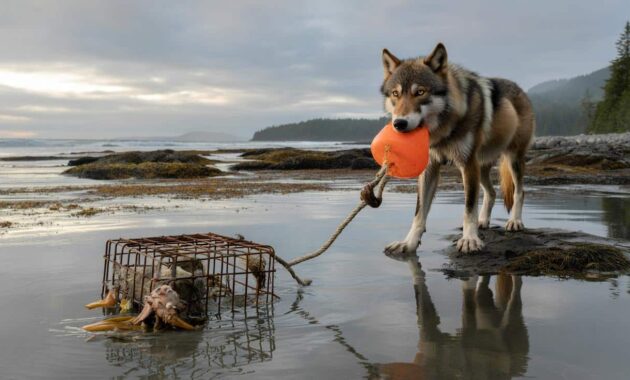
The brief scene, captured by an automatic camera in British Columbia, has since sparked a fresh argument among scientists about what wolves really understand, how they learn, and where instinct stops and problem-solving begins.
A wolf, a buoy and a missing crab trap
The incident unfolded on the shores of the Haíɫzaqv Nation territory, on Canada’s Pacific coast. Local Indigenous Guardians had been running an ecological programme to curb invasive European green crabs. For months, they had been placing baited crab traps along the intertidal zone.
Then the traps started going missing. Others were dragged out of position, turned over or mysteriously emptied. Some looked chewed or damaged. People speculated. Was it bears? Seals? Otters? Perhaps even human theft?
A motion-activated camera set up near one line of gear finally provided a clear answer.
In less than three minutes, a wild wolf calmly located a fishing buoy, pulled in the attached rope, hauled a submerged crab trap to shore, opened the bait cup and ate the contents.
The sequence, described in the journal Ecology and Evolution by researchers Kyle A. Artelle and Paul C. Paquet, shows the animal moving with deliberate, almost methodical gestures. This was not a random tug or a playful interaction with floating debris.
Step-by-step problem solving
The footage shows the wolf coming out of the water with the buoy already in its mouth. It then begins to back away from the surf, tugging steadily. As the rope tightens, the trap rises from the seabed and bumps along the rocky bottom until it reaches the shore.
Once the gear is beached, the wolf paws at it, identifies the plastic bait container, and manages to get to the food inside. After eating, it walks away, leaving the damaged trap behind.
- The bait was not visible from shore.
- The wolf had to connect buoy, rope and hidden trap as one system.
- The sequence required several distinct actions in the correct order.
For the scientists, this chain of behaviour hints at more than simple curiosity. It suggests the wolf understood that pulling on one part of the device would move another, out-of-sight part holding food.
➡️ Not Crosswords or Chess: The Best Memory-Boosting Activity for Over-65s
➡️ Day Will Turn To Night With The Longest Total Solar Eclipse Of The Century
➡️ Chimpanzees drink alcohol every day – and it could say a lot about us
➡️ I used vinegar to clean my iron: it hissed, smoked, and then worked perfectly again
➡️ I changed how I decide what to clean and saved hours every month
➡️ Seniors Applaud New EU Directive Ensuring Lifetime Renewal of Driving Licences After Seventy
What this tells us about wolf intelligence
For decades, biologists have argued about what counts as “tool use” in animals and how to measure animal reasoning. Some definitions are broad: any use of an object to reach a goal can qualify. Others are stricter and require the animal to actively modify or manipulate an object in a flexible, goal-directed way.
The wolf’s behaviour sits in a grey area between classic tool use and complex problem-solving, forcing researchers to rethink old categories.
Pulling a rope might sound simple. Yet in this case, the wolf did more than yank on a convenient handle. The trap was underwater and out of sight. The bait was hidden in a plastic cup. The wolf still performed a coherent sequence that matched the hidden structure of the fishing gear.
Artelle and Paquet point out that this demands some level of mental representation. The animal had to treat the buoy as part of a larger, unseen system and act as if it “knew” that food sat at the other end.
Learning, imitation and wolf culture
This might not be an isolated quirk. While reviewing other traps along the coast, the team and local Guardians found more signs of gear tampering that matched what the camera showed. Several traps had clearly been moved, emptied or broken in similar ways.
That raises a strong possibility: at least one wolf may have figured out how the setup works, and others might have copied the technique within their pack.
Researchers suspect that wolves, like many social animals, may share new foraging tricks through observation, turning individual insights into group traditions.
Captive canids support this idea. Dingoes in research centres, as well as domestic dogs, have learned to open gates, operate latches or pull strings to get food, sometimes after watching another animal do it once.
In the wild, such behaviours are much harder to document. Few wolves are filmed closely and repeatedly enough to reveal learning over time. The Haíɫzaqv coastal group might be one of the rare cases where cameras, conservation work and a curious predator intersected.
Why this coastal habitat may foster clever behaviour
The Haíɫzaqv wolves live in a relatively protected area. The territory is managed with a focus on conservation, and the animals face less persecution and hunting pressure than many inland wolf populations.
Artelle and Paquet argue that this calmer environment could matter for cognition. An animal that is not constantly avoiding humans or gunshots has more time and mental space to investigate new objects and situations.
Freedom to experiment, they suggest, might be a quiet but powerful driver of animal intelligence.
In high-risk landscapes, wolves that approach human-made objects often pay with their lives. That selects against curiosity. On this Pacific coast, the cost of inspecting a floating buoy is much lower, and the potential reward – a free meal – is obvious.
Rethinking “wild” behaviour
The episode challenges a common stereotype: that wild animals simply react to stimuli with rigid, pre-programmed instincts. Here, a wolf engages with a very recent human invention, in a way that fits its hidden mechanical logic.
Scientists have seen similar moments in other species: New Caledonian crows bending hooks from wire, octopuses carrying coconut shells as portable shelters, or bears rolling rocks to access food. The Canadian wolf adds a large carnivore to this growing list of animals that can handle human artefacts as if they were puzzles.
Key concepts behind the case
For readers unfamiliar with the jargon, a few terms help frame what happened on that beach.
| Term | What it means in this context |
|---|---|
| Tool use | An animal uses or manipulates an external object as a means to achieve a goal, often involving food. |
| Causal reasoning | Recognising that one action produces a specific outcome, such as pulling a rope to move a hidden trap. |
| Social learning | New behaviour spreads because other animals watch and imitate the first innovator. |
Whether the wolf counts as a “tool user” will keep scientists busy at conferences for a while. The more practical point is that it displayed causal reasoning and flexible foraging, which are strong signs of cognitive sophistication.
What this means for future wolf–human encounters
This sort of interaction has practical consequences. Fishing communities and conservation teams along coasts where wolves roam may need to rethink gear design. If wolves can pull up traps, they may also interfere with nets, longlines or other devices that create similar cues.
There are trade-offs to weigh:
- More secure gear might reduce wildlife interference, but can add cost for fishers.
- Leaving food-rich traps unchecked for long periods can encourage animals to treat them as regular feeding stations.
- Non-lethal deterrents might protect both equipment and predators from risky interactions.
In the longer term, researchers are considering experiments that stay within ethical limits: for example, staged setups with safe, removable objects that test whether multiple wolves in an area show the same rope-pulling pattern or if only a few gifted individuals do.
For wildlife managers, the case adds weight to a growing view that behaviour is not fixed. Predators can adjust rapidly to novel human devices. That flexibility can either ease coexistence or increase conflict, depending on how people respond.
For anyone walking a Pacific beach, the idea that a passing wolf might read a buoy and rope as a kind of open invitation to dinner feels slightly unsettling – and a quiet reminder that our gadgets are becoming part of animal mental life too.