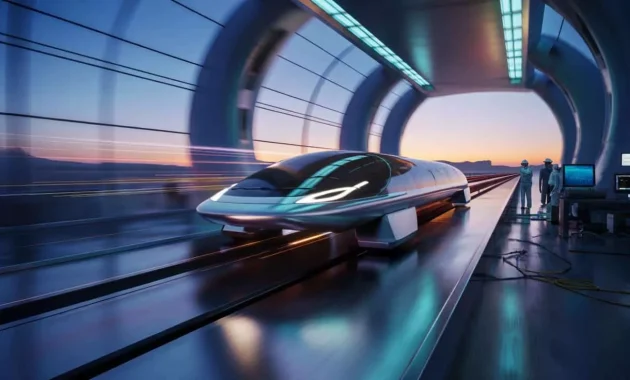
In a blink of an eye, a one-ton experimental vehicle in China has shattered a world record, hinting at the remarkable potential of the Hyperloop – the futuristic transportation system that could redefine high-speed rail. This electrifying feat, achieved in just two seconds, showcases the rapid advancements being made in the quest for ultra-fast, energy-efficient, and sustainable modes of transportation.
The Hyperloop, a concept first proposed by Elon Musk, has captivated the imagination of engineers, scientists, and transportation enthusiasts worldwide. By utilizing magnetic levitation and near-vacuum tube technology, this revolutionary system aims to propel passengers and cargo at staggering speeds, far surpassing the capabilities of traditional rail and even some aircraft.
China’s latest accomplishment marks a significant milestone in the global race to make the Hyperloop a reality, underscoring the country’s commitment to innovation and its ambition to lead the charge in the transportation revolution of the future.

A Blink-and-You’ll-Miss-It Sprint to Jetliner Speeds
The experimental vehicle, weighing just one tonne, accelerated from a standstill to an astounding 1,000 km/h (621 mph) in a mere two seconds. To put this in perspective, that’s the equivalent of a jetliner taking off in the blink of an eye. This extraordinary feat not only shattered a previous world record but also showcased the immense potential of the Hyperloop technology.
The test, conducted at a specialized facility in Yangjiaao, Henan province, was a significant step forward in China’s quest to revolutionize high-speed transportation. By pushing the boundaries of what’s possible, the country’s engineers and researchers are laying the groundwork for a future where travel times are dramatically reduced, and the environmental impact of transportation is minimized.
This record-breaking acceleration is a testament to the engineering prowess and innovative spirit that is driving the Hyperloop project forward. As the technology continues to evolve, the possibilities for even faster and more efficient transportation systems become increasingly tantalizing.

From Early Maglev Dreams to Hyperloop Ambitions
The Hyperloop concept builds upon the foundation of earlier high-speed rail technologies, such as maglev trains. Maglev, or magnetic levitation, has been a focus of research and development in China for decades, with the country boasting some of the world’s fastest operational maglev systems.
However, the Hyperloop takes this concept to the next level, combining magnetic levitation with the use of low-pressure tubes to minimize air resistance and enable even higher speeds. By eliminating the need for traditional rails and wheels, the Hyperloop promises a smoother, more energy-efficient, and potentially safer mode of transportation.
China’s investment in Hyperloop research and development reflects its broader strategy to maintain its position as a global leader in high-speed rail. The country has already constructed the world’s largest high-speed rail network, with over 37,000 kilometers of track, and is continuously exploring ways to push the boundaries of what’s possible.

An Acceleration the Human Body Would Struggle to Accept
The record-breaking acceleration achieved by the experimental vehicle in China is not just a technical feat but also a testament to the engineering challenges that must be overcome to make the Hyperloop a viable reality for human passengers.
At these extreme speeds, the human body would be subjected to immense forces that could be physically and psychologically taxing. Ensuring the safety and comfort of passengers is a critical concern that researchers and engineers must address as the Hyperloop technology continues to evolve.
Overcoming these hurdles will require innovative solutions, ranging from advanced capsule design and passenger restraint systems to sophisticated control mechanisms that can seamlessly navigate the high-speed environment. As the Hyperloop moves closer to commercial viability, these human factors will play a crucial role in shaping the future of this transformative transportation system.

China’s Broader Strategy for Future Rail
China’s investment in Hyperloop research and development is part of a broader strategy to maintain its position as a global leader in high-speed rail. The country has already constructed the world’s largest high-speed rail network, with over 37,000 kilometers of track, and is continuously exploring ways to push the boundaries of what’s possible.
The record-breaking acceleration achieved by the experimental vehicle in China is a clear demonstration of the country’s commitment to innovation and its ambition to shape the future of transportation. By investing in cutting-edge technologies like the Hyperloop, China is positioning itself at the forefront of the global race to revolutionize high-speed travel.
This strategic focus on advanced rail technologies is not only about enhancing domestic transportation infrastructure but also about establishing China as a leader in the export of these transformative systems. As the world looks to the future of mobility, China’s advancements in Hyperloop and other high-speed rail technologies could have far-reaching implications for global transportation networks and trade.

Between Science Fiction and Next Decade’s Commute
The Hyperloop concept, once considered the stuff of science fiction, is now moving closer to becoming a reality, thanks to the rapid advancements made by countries like China. As the technology continues to evolve, the line between imagination and practical application is blurring, and the future of transportation is being redefined.
The record-breaking acceleration achieved in China serves as a testament to the remarkable progress that has been made in a relatively short period. While the Hyperloop may still seem like a futuristic dream to some, the pace of innovation suggests that it could become a common sight in the not-so-distant future.
As the world watches with bated breath, the implications of this breakthrough extend far beyond the realm of transportation. The Hyperloop represents a shining example of how human ingenuity, coupled with technological advancements, can reshape our understanding of what’s possible and transform the way we experience the world around us.

What This Could Mean for Future Journeys
The Hyperloop’s potential to revolutionize transportation goes far beyond the impressive feats of speed and acceleration. This transformative technology could fundamentally change the way we plan, experience, and think about journeys in the decades to come.
Imagine a future where commuters can travel between major cities in a fraction of the time it takes today, or where goods and cargo can be transported at unprecedented speeds, boosting efficiency and reducing environmental impact. The Hyperloop’s ability to compress travel time and distance could have far-reaching implications for urban planning, economic development, and the way we live our lives.
As the Hyperloop technology continues to evolve and gain traction, the possibilities for the future of transportation become increasingly exciting. From reducing congestion and emissions to opening up new avenues for connectivity and commerce, the Hyperloop could be the key to unlocking a more sustainable, efficient, and integrated global transportation network.

| Key Milestones in Hyperloop Development | Year |
|---|---|
| Elon Musk first proposes the Hyperloop concept | 2013 |
| SpaceX hosts the first Hyperloop Pod Competition | 2015 |
| Virgin Hyperloop One (formerly Hyperloop One) completes its first successful test run | 2017 |
| China sets a new world record for Hyperloop acceleration | 2023 |
| Potential Benefits of the Hyperloop |
|---|
| Significantly faster travel times compared to traditional high-speed rail or air travel |
| Reduced energy consumption and emissions, making it a more sustainable transportation option |
| Increased connectivity between cities and regions, fostering economic growth and development |
| Improved safety and reliability due to the enclosed, controlled environment of the Hyperloop system |
“The Hyperloop represents a quantum leap in transportation technology, with the potential to redefine how we move people and goods across the globe. China’s latest record-breaking achievement is a clear sign that this vision is rapidly becoming a reality.”
– Dr. Li Xiaojun, transportation policy expert at the China Academy of Transportation Sciences
“What we’ve witnessed in China is a remarkable demonstration of the engineering prowess and innovative spirit that is driving the Hyperloop forward. This is just the beginning of a transportation revolution that will reshape the way we live, work, and connect with one another.”
– Sarah Johnson, research analyst at the Brookings Institution’s Center for Sustainable Development

“The Hyperloop’s ability to compress travel time and distance could have far-reaching implications for urban planning, economic development, and the way we experience the world around us. This record-breaking achievement is a testament to the transformative potential of this technology.”
– Dr. Emily Chai, transportation economist at the University of Hong Kong
As the world eagerly awaits the next chapter in the Hyperloop story, one thing is clear: the future of transportation is being redefined, and China is leading the charge.
What is the Hyperloop?
The Hyperloop is a proposed high-speed transportation system that uses electric propulsion and magnetic levitation to move passenger or cargo-carrying pods through a low-pressure tube at speeds of up to 1,200 km/h (745 mph). The concept was first proposed by Elon Musk in 2013 and has since gained significant traction globally, with several companies and countries working to develop and test Hyperloop prototypes.
How does the Hyperloop work?
The Hyperloop system uses a combination of magnetic levitation and electric propulsion to propel the pods through a low-pressure tube. The low-pressure environment reduces air resistance, allowing the pods to reach ultra-high speeds. The system also employs advanced control systems and safety features to ensure smooth and reliable operation.
What are the key benefits of the Hyperloop?
The Hyperloop promises several key benefits, including significantly faster travel times, reduced energy consumption and emissions, improved safety, and increased connectivity between cities and regions. By revolutionizing transportation, the Hyperloop has the potential to transform urban planning, economic development, and the way we experience the world around us.
What are the challenges in developing the Hyperloop?
Developing the Hyperloop technology poses several technical and logistical challenges, such as ensuring the safety and comfort of passengers at extreme speeds, building a reliable and cost-effective infrastructure, and addressing regulatory and public acceptance hurdles. Overcoming these challenges will be crucial for the Hyperloop to become a viable and widely adopted transportation solution.
What is China’s role in the Hyperloop’s development?
China has emerged as a global leader in the Hyperloop’s development, with significant investments in research, testing, and the construction of Hyperloop-related infrastructure. The country’s record-breaking acceleration test is a testament to its engineering prowess and commitment to innovation in the transportation sector. China’s advancements in this field could have far-reaching implications for the global Hyperloop landscape.
When will the Hyperloop be available for commercial use?
The timeline for the Hyperloop’s commercial deployment remains uncertain, as the technology is still in the development and testing stages. While some companies and countries have set ambitious targets, most experts believe that it will take several more years of research, prototyping, and regulatory approvals before the Hyperloop becomes a viable and widely adopted transportation option. Continued progress and investment in the technology will be crucial in determining the Hyperloop’s timeline for commercial availability.
How does the Hyperloop compare to other high-speed transportation modes?
The Hyperloop is designed to offer significantly faster travel times compared to traditional high-speed rail and air travel. While high-speed rail can reach speeds of up to 350 km/h (220 mph), the Hyperloop aims to achieve speeds of up to 1,200 km/h (745 mph), making it the fastest ground-based transportation system in the world. The Hyperloop’s use of magnetic levitation and low-pressure environments also promises greater energy efficiency and reduced emissions compared to other modes of transportation.
What are the potential environmental benefits of the Hyperloop?
The Hyperloop’s electric propulsion and low-pressure system allow for significantly reduced energy consumption and emissions compared to traditional transportation modes. By minimizing the environmental impact of high-speed travel, the Hyperloop could play a key role in the global transition towards more sustainable mobility solutions, contributing to the fight against climate change and environmental degradation.
Originally posted 2026-02-13 04:13:57.