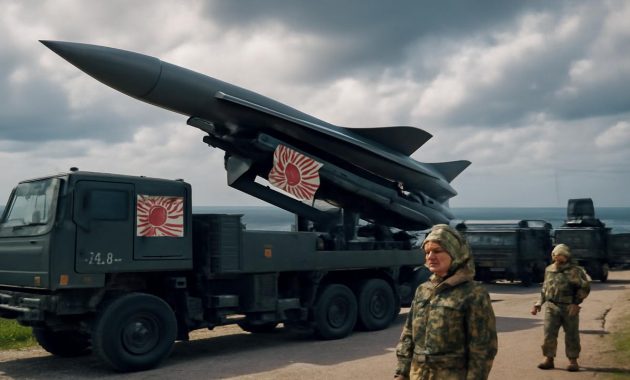

The sea is quiet until it isn’t. On a gray morning off Japan’s southern coast, swells lift and fall with the patience of centuries, rolling in from the vast Pacific. Fishing boats move slowly on the horizon, small white flecks against blue steel water. Nothing about this scene suggests the future of warfare—until you imagine a single bright streak tearing through the sky at more than 6,000 kilometers per hour, skimming low over those waves, invisible to the naked eye and almost impossible to stop. Somewhere on a launch pad tucked into the rugged coastline, Japan’s new hypersonic missile waits, silent and sleek, like an arrow nocked but not yet loosed.
The Sound of Speed You’ll Never Hear
If you were standing on the shore when a hypersonic missile launches, you might hear the roar a moment later, a low, violent thunder slipping through the salt air. But by the time the sound reaches you, the missile would already be racing far downrange—across a hundred kilometers of ocean in the time it takes to draw a deep breath.
Hypersonic is not just a buzzword. It’s a threshold: five times the speed of sound, or faster. Japan’s in-development hypersonic anti-ship and land-attack missile is designed to cruise beyond that—past Mach 5, pushing into Mach 6 and above, more than 6,000 km/h. At those speeds, air doesn’t behave like air anymore. It compresses, burns, claws at metal. Temperatures spike to the point that the missile’s skin must be engineered to survive its own passage.
What Japan is quietly building is not just a weapon; it’s a message. A line drawn across the maps in defense ministries from Beijing to Washington. As tensions rise in the Western Pacific, this arrow in Japan’s quiver is meant to speak a very specific language: Not here. Not easily.
China’s Shadow Across Japan’s Blue Frontier
To understand why Japan is investing in something so lethal, so fast, you have to start not with steel and fuel but with geography. Pull up a map of East Asia and let your eyes drift to the chain of islands arcing from the southern tip of Kyushu down toward Taiwan. This is the Nansei or Ryukyu island chain—remote, wind-battered, and strategically priceless.
These islands are Japan’s outer skin facing China. Dotted between them lie fishing grounds, undersea cables, air routes, and the disputed Senkaku Islands—tiny, uninhabited islets that might look like meaningless rocks in a turquoise sea, but sit at the heart of a simmering confrontation. Japan administers them; China claims them; so does Taiwan. Every few weeks, Chinese Coast Guard or military vessels push into waters Japan considers its own. Japanese patrol ships shadow them. Radios crackle. No one fires. No one leaves. The standoff marinates in tension.
Beyond those islands, another specter looms: Taiwan. If China ever tries to seize it by force, the skies and seas around Japan’s southwest islands will become contested space. Japanese planners know this. They can feel the map tightening—like a belt cinched notch by notch—as China builds ships, submarines, and missiles at a pace that feels less like an arms race and more like an assembly line.
For most of the postwar era, Japan’s Self-Defense Forces were designed to repel a limited invasion, operating under a pacifist constitution written in the shadow of Hiroshima and Nagasaki. Firepower was kept modest, ranges short, ambitions defensive. But in the 2020s, that posture is bending under new realities. When Chinese warships sail ever closer to Japanese waters and fighter jets cut across the East China Sea, Japan reads the same message over and over: deterrence today cannot look like it did yesterday.
A Missile Made to Guard an Island Chain
Enter the hypersonic missile. In Tokyo’s calculus, this weapon is meant to be a guardian of straits and narrows, a silent sentry guarding the approaches to Japan’s scattered islands. It’s being developed in several phases, with prototypes already taking shape in wind tunnels and test ranges, their designs tuned to ride a razor-thin line between speed, range, and accuracy.
This missile is not meant to cross oceans and smash capital cities. Its mission is far more intimate: to stare down ships and bases that might threaten Japan’s periphery. Picture a future crisis in the East China Sea. Warships edge too close. Amphibious forces maneuver. Satellites, drones, and patrol planes report a rising tide of movement. From hardened shelters on Japan’s islands, launchers roll out. The hypersonic missiles inside are slotted into their rails, sensors awakened, guidance systems humming.
Once fired, the missile sprints forward, boosting into the high atmosphere or skimming low over the sea—depending on its configuration—before bending its path like a pitcher’s vicious curveball. Unlike many traditional ballistic missiles that trace a predictable arc, hypersonic glide vehicles can jink, dip, and weave on their way to the target. That maneuverability, combined with extreme speed, is what keeps generals up at night.
Japan is betting heavily that this combination will give any commander thinking of pushing into its near-seas a cold pause. Hypersonic missiles are not cheap or simple. They demand advanced materials, top-tier electronics, and exquisite coordination between radar networks, satellites, and command centers. But in an era where one ship can hold hundreds of lives and billions of dollars in hardware, a handful of missiles that can credibly threaten those ships becomes a powerful insurance policy.
Riding the Edge of the Atmosphere
The science behind this edge-of-the-envelope weaponry unfolds in places far from the sea—inside wind tunnels humming with compressed air, in clean rooms where technicians in white suits adjust circuits under bright, shadowless lights. In these laboratories, Japanese engineers are obsessing over problems that only arise when you try to shove an object through air at several kilometers per second.
At 6,000 km/h and beyond, friction turns the leading edges of a missile into a crucible. Air molecules slam into the surface so fast they break apart, ionizing and building a sheath of plasma around the vehicle. That shell can blind radio communications and warp the very sensors meant to guide the weapon. It’s like trying to see clearly through a windshield that you’re simultaneously melting and electrifying.
This is where Japanese precision engineering—the same culture that produces bullet trains timed to the second and microchips etched by the billions—finds a new arena. Heat-resistant composites, clever nose cone geometries, software that predicts and corrects for the chaos of hypersonic airflow: all of it has to work together, perfectly, at the worst possible conditions.
For most people, “6,000 km/h” is just a number. To make it real, imagine this: the distance from Tokyo to Shanghai is about 1,800 kilometers. At hypersonic speeds, that’s a trip measured not in hours, but in minutes. Below is a simple comparison that puts the sheer velocity in perspective:
| Mode | Typical Speed | Time for 1,000 km |
|---|---|---|
| Commercial Airliner | 900 km/h | ~1 hour 7 minutes |
| High-Speed Train | 300 km/h | ~3 hours 20 minutes |
| Subsonic Cruise Missile | 850 km/h | ~1 hour 10 minutes |
| Hypersonic Missile (Mach 5+) | 6,000+ km/h | ~10 minutes |
That compression of time is what makes defenses difficult. Radar operators have minutes, not hours, to detect, track, and attempt interception. A warship’s crew must move from calm to crisis almost instantly. In that sudden squeeze of time, mistakes multiply and options shrink.
A Quiet Revolution in a Pacifist Country
For a country that has written into its constitution a renunciation of war as a sovereign right, building a missile that could outrun the sound of its own launch might seem like a contradiction. But Japan’s defense landscape has been shifting gradually, like tectonic plates grinding beneath the surface.
Over the past decade, Tokyo has relaxed long-standing prohibitions on arms exports, expanded defense budgets, and deepened its security alliance with the United States and like-minded partners. The phrase “counter-strike capability” has entered the national security vocabulary, signaling a willingness not only to absorb a blow but to hit back at an adversary’s bases and launch sites if necessary.
All of this is framed carefully, almost ritualistically, as still fundamentally defensive. Japan is not talking about conquering territory or projecting power across continents. It is talking about ensuring that its own islands—and the sea lanes and skies that sustain them—do not become chess squares for someone else’s ambitions.
In this context, the hypersonic missile takes on an almost paradoxical role: a weapon built to avoid being used. Its job is to sit in the mind of any strategist in Beijing who is sketching out how a move in the East China Sea or against Taiwan might play out. It whispers into their calculations: Your ships will not be safe. Your bases might be in reach. The cost will be higher than you like.
China’s Ambition, Japan’s Answer
China’s ambitions in the Western Pacific are as vast as the waters themselves. Its navy is now the world’s largest by number of ships. Its coast guard vessels are bigger, heavier, more numerous. Its rocket force is stacked with ballistic and cruise missiles that can reach deep into the Pacific, challenging not only Japan but also the presence of the United States.
Hypersonic weapons are no stranger to Chinese laboratories either. Beijing has tested its own systems, showcased them in parades, and folded them into the broader concept of “anti-access/area denial”—a strategy aimed at making it too costly for foreign militaries to operate near China’s shores or in contested areas.
Japan, watching this arc, is doing something quietly radical: appropriating the same toolset for its own version of denial. Call it a mirror strategy. Where China wants to push others away from the first island chain, Japan wants to keep China from flowing through it unchecked.
In this, Tokyo is not alone. The United States, Australia, and others are investing in similar capabilities. But Japan’s decision carries a particular weight, precisely because of its postwar identity. The island nation that once devastated Asia and then swore off war is now, carefully, deliberately, placing hypersonic arrows in its quiver. Not to reclaim empire, but to ensure that someone else’s empire does not roll right up to its shores.
Life Under the Flight Path
Amid all this strategic chess, there are people living under the hypothetical paths those missiles might someday trace. On a small island in Okinawa Prefecture, an old fisherman repairs his nets, fingers stiff from decades of salt and sun. He has watched the sea change—fish migrating, typhoons intensifying, government ships and foreign vessels multiplying across his horizon.
He has also watched the mainland’s decisions wash up on his shore. New radar installations sprout on hilltops. Military trucks rumble past sugarcane fields. Land once used for grazing or festivals finds itself fenced off, earmarked for ammunition depots or launch sites. Local town halls host meetings where residents argue, sometimes fiercely, about what it means to be the first line of defense—and the first line of risk.
Many in these communities know that if conflict ever comes, it will come to them first. They stand at the seam between great powers, between China’s expanding reach and Japan’s determination to draw a line. For them, the hypersonic missile is not an abstraction of speed and plasma but a real machine that might be stored in a hillside within walking distance of their homes.
Yet there is also a quieter understanding: without credible defenses, their islands could become stepping stones for someone else’s plan. In the delicate, often uncomfortable balance of fear and protection, Japan’s new missiles are both shield and shadow.
Deterrence in an Age of Uncertainty
Deterrence is a strange creature. It works best when it remains invisible. Success looks like nothing happening: no shots fired, no invasions launched, no warships sunk. Yet achieving this uneasy calm requires visible, unmistakable preparations—radars, ships, aircraft, missiles—arrayed for all to see.
Japan’s hypersonic project fits this logic. Its very existence is meant to be known, even if the exact performance and deployment details remain classified. The idea is to plant one more doubt in the mind of any planner dreaming of a fast, decisive move in the region.
Will it work? No one can say with certainty. Military technology has a way of sparking counter-technology in a spiraling dance: new sensors, better interceptors, more advanced decoys and jammers. For every spear, a shield is forged; for every shield, a sharper spear. Hypersonic missiles might today feel like the ultimate arrow, but history suggests their edge will someday be blunted.
What they do right now, though, is change the mental map. They stretch the radius of what Japan can protect. They shorten the reaction times that an adversary can count on. They signal—to China, to allies, to Japan’s own citizens—that the era of quiet reliance on others’ strength is fading. The country is, in its own way, rolling out heavy artillery in the domain of speed and sky.
Somewhere in a Japanese coastal facility, an engineer stands next to a prototype vehicle, hand resting on a fuselage that looks more like a sci-fi glider than a traditional missile. It is oddly beautiful in its own way: curves calculated to tame supersonic turbulence, surfaces coated to survive the inferno of flight. It is a culmination of equations and policies, of fear and resolve.
Outside, the sea keeps rolling against the shore, as it has long before hypersonic speeds were even imaginable and will continue long after today’s cutting-edge weapons become museum pieces. Between the slow rhythm of waves and the sudden violence of technology, Japan is trying to carve out a space where it can live, trade, and argue in peace—even as the tools it builds to secure that peace grow faster, sharper, more fearsome.
And in the skies that arch over those quiet islands, there is now the possibility of something else: a streak of man-made lightning, too swift to hear, carrying with it not only explosive power, but a message drawn in shockwaves and fire—this is as far as you go.
FAQ
What is a hypersonic missile?
A hypersonic missile is a weapon that travels at speeds of Mach 5 or higher—at least five times the speed of sound. Many hypersonic systems can also maneuver during flight, making them much harder to track and intercept than traditional ballistic or cruise missiles.
How fast is 6,000 km/h in practical terms?
At 6,000 km/h, a missile could travel 1,000 kilometers in around 10 minutes. That is several times faster than a commercial airliner and drastically reduces the time defenders have to detect and respond to an attack.
Why is Japan developing hypersonic missiles?
Japan is developing hypersonic missiles to strengthen its deterrence and defensive capabilities in response to China’s growing military presence and missile forces, especially around the East China Sea, the Nansei island chain, and the broader Western Pacific.
Are these missiles offensive or defensive weapons?
Technically, any missile can be used offensively, but Japan frames its hypersonic program as a defensive and deterrent measure. The focus is on protecting remote islands, sea lanes, and bases by threatening ships and facilities that might be used in an attack on Japan.
Can current missile defenses reliably stop hypersonic weapons?
Existing missile defense systems were largely designed to counter ballistic or slower cruise missiles. Hypersonic weapons, with their extreme speed and maneuverability, present a major challenge, and many countries are now racing to develop new sensors and interceptors specifically to deal with them.
How does this affect tensions with China?
Japan’s hypersonic missile program adds another layer to the region’s arms buildup. Beijing is likely to see it as a counter to Chinese power projection, while Tokyo views it as necessary to prevent coercion or surprise attacks. It may heighten tensions in the short term while aiming to stabilize them through stronger deterrence.
When will Japan’s hypersonic missiles be operational?
Japan is developing its hypersonic capabilities in stages over the coming years. While exact timelines and specifications are classified and subject to change, Tokyo’s defense plans envision initial operational capabilities emerging within this decade, with more advanced versions following after further testing and refinement.

Originally posted 2026-02-12 08:43:58.