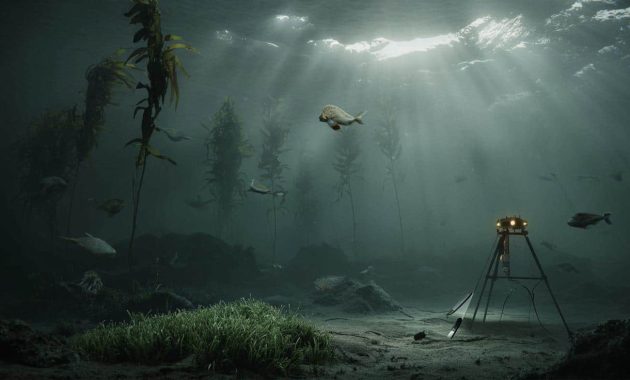
Off the world’s coasts, something strange keeps switching off the lights underwater, leaving seafloors in an eerie, drawn-out night.
Researchers now say these sudden underwater blackouts are not random flukes, but a recurring phenomenon that can be tracked, compared, and increasingly predicted — and they may be quietly reshaping coastal marine life.
What are marine darkwaves?
Scientists have given these underwater blackouts a name: marine darkwaves. They are short, intense periods when the amount of light reaching the seafloor collapses, sometimes to almost zero.
Marine darkwaves are like underwater eclipses that can last days, weeks, or even months, shutting down life that depends on light.
They happen when water becomes so murky that sunlight simply cannot break through. That murk can come from several sources:
- Heavy sediment washed in from rivers and coastal erosion
- Blooms of microscopic algae spreading through the water
- Pulses of organic material, such as decaying plants and soil, after storms or floods
- Plumes of ash and debris following wildfires or landslides
These episodes are different from ordinary cloudy days beneath the surface. A marine darkwave is defined by a sharp, unusual drop in seafloor light, going well beyond normal seasonal changes or day‑to‑day fluctuations.
Why cutting the lights hits marine life so hard
Sunlight fuels nearly everything in shallow coastal seas. Photosynthetic organisms — kelp, seaweeds, seagrass meadows, and corals — rely on light to produce energy and oxygen. When the light vanishes, their physiology and growth can stall in a matter of hours.
Researchers involved in the new work say even brief episodes can hurt. If low light continues for several days in a row, whole habitats may be pushed into stress zones.
Darkwaves can stop photosynthesis in kelp forests and seagrass beds, disrupting the base of coastal food webs.
The effects spread quickly up the chain. When underwater plants and algae struggle, the animals that depend on them — from snails and sea urchins to fish, seabirds, and marine mammals — lose food and shelter. Dark conditions can also change behaviour: some fish switch to night-time patterns in the middle of the day, predators may hunt differently, and plankton communities can reorganise.
➡️ How bananas can stay fresh and yellow for up to two weeks when stored with one simple household item
➡️ The most effective treatment for osteoarthritis isn’t a pill or surgery
➡️ After dumping tons of sand into the ocean for 12 years, China has created brand-new islands
➡️ 700+ years of global consumption: Japan discovers a mega rare-earth deposit
➡️ Netflix: one of the greatest action-adventure films ever, you have only 2 days left to watch it
➡️ Royal family acquire Oxfordshire farmland with major plans accaparement controversé
➡️ Webb Telescope Spots “Impossible” Atmosphere Around Ancient Super-Earth
➡️ Physicists Crack a New Code To Explore Dark Matter’s Hidden Life
Kelp forests, seagrass beds and corals at risk
The habitats most exposed to darkwaves tend to be the ones we already rely on heavily for fisheries, tourism, and coastal protection:
| Habitat | Key dependency on light | Potential darkwave impact |
|---|---|---|
| Kelp forests | Fast growth, high primary production | Reduced growth, weakened holdfasts, loss of shelter for fish |
| Seagrass meadows | Rooted plants need light to maintain leaves and roots | Leaf die‑off, erosion of seabed, decline in nursery habitat |
| Coral communities | Symbiotic algae within corals photosynthesise | Energy loss, reduced calcification, greater disease vulnerability |
For coastal managers trying to protect these ecosystems, a darkwave can undo months or years of slow recovery after a previous disturbance, such as a heatwave or storm.
How scientists are tracking the blackouts
Until recently, there was no shared method to describe or compare these events. One team’s “light loss event” might be another’s “temporary turbidity spike”. That made it hard to judge their severity or understand global patterns.
An international group of researchers has now created a formal framework for identifying marine darkwaves. Their work, published in the journal Communications Earth & Environment, combines direct light measurements from sensors on the seabed with satellite estimates of water clarity.
The new framework treats darkwaves much like meteorologists treat storms — as definable events with a start, peak and end.
Decades of coastal data
To build the framework, the team drew on long-term records from several coasts:
- 16 years of seafloor light readings from the Santa Barbara Coastal Long Term Ecological Research site in California
- 10 years of measurements from coastal sites in New Zealand’s Hauraki Gulf and the Firth of Thames
- 21 years of satellite-based estimates of light at the seabed along New Zealand’s East Cape
These datasets revealed between 25 and 80 darkwave events along the East Cape alone since 2002. Some lasted only a few days. Others stretched beyond two months, with sunlight at the bottom almost entirely blocked. Many coincided with major storms and large weather systems, including Cyclone Gabrielle.
Storms, climate change and “compound” ocean shocks
Marine darkwaves do not act in isolation. They tend to stack on top of other stresses that coastal seas are already coping with.
Darkwaves now sit alongside marine heatwaves, acidification and low-oxygen events as another short, sharp stressor hitting the oceans.
Heavy rainfall linked to stronger storm systems can flush more sediment and organic matter into coastal waters. Bigger fires on land can send ash and soil racing into the sea during the next downpour. Warmer water can boost algae blooms that cloud the surface. That means climate change is likely to alter not just how often darkwaves occur, but also how intense they become.
These layers of stress can interact. A kelp forest weakened by high temperatures may be less able to cope with weeks of darkness. Seagrass recovering from heat or pollution may be pushed past a tipping point by a badly timed darkwave.
A new tool for coastal decision-makers
By giving darkwaves a clear definition and metric, scientists are hoping to turn them into something coastal communities can plan for. The framework can be folded into wider ocean monitoring systems that already track marine heatwaves, acidification, and low oxygen.
Resource managers could eventually receive alerts when a darkwave is brewing or in progress. That opens the door to temporary restrictions on fishing, dredging, or construction, or to timing restoration work to avoid peak stress periods.
In California, researchers at UC Santa Barbara plan to use the long-term light records from the Santa Barbara Coastal LTER to map which kelp forests are most exposed. They are also examining how sediment from wildfires and mudslides changes water clarity and affects underwater light levels along the coast.
Key terms and how they work together
Several concepts sit at the heart of this research and often get mixed up, so they are worth separating:
- Underwater light availability – the amount of sunlight that actually reaches the seafloor, not just the sea surface.
- Water clarity – how far light can travel through the water before it is scattered or absorbed by particles and plankton.
- Turbidity – a measure of how cloudy the water is; high turbidity typically means low clarity.
- Marine darkwave – a distinct period when seafloor light drops well below normal, often driven by a spike in turbidity.
In practice, a storm or flood increases turbidity, which reduces water clarity, which then cuts underwater light. When that reduction is sharp and unusual enough, scientists label it a darkwave.
What darkwaves could mean for coasts in the future
Looking ahead, researchers are starting to model different scenarios. One concern is that coastal development and deforestation will send more sediment into rivers, making darkwaves more frequent and longer. Another is that a warming ocean will encourage more intense algal blooms that further block the sun.
On the positive side, better data and forecasting could help local communities adapt. Restoring wetlands and riparian vegetation, for instance, can trap sediment before it reaches the sea. Carefully placed marine protected areas might give vulnerable habitats enough breathing room to recover between events.
For people who depend on the coast — fishers, tourism operators, indigenous communities, and city planners — understanding these mysterious blackouts is becoming part of understanding everyday risk. The sea may look the same from the surface, but for the forests and meadows hidden below, the difference between a normal day and a darkwave can be the difference between growth and slow decline.