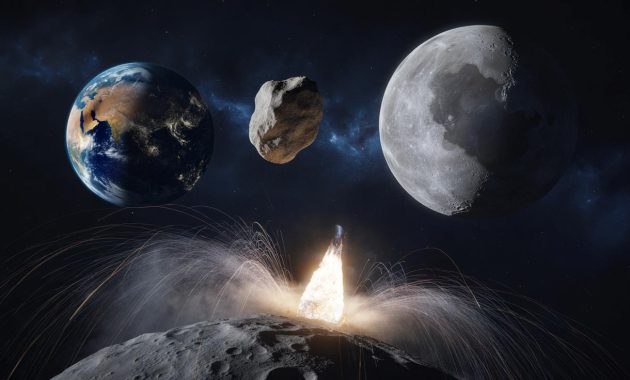
By running thousands of computer simulations, researchers have worked out how near-Earth asteroid 2024 YR4 could slam into our moon in 2032, trigger a flash as bright as Venus, and even send a storm of meteors sweeping through Earth’s skies in the weeks that follow.
What is asteroid 2024 YR4?
Asteroid 2024 YR4 is a near-Earth object roughly 60 metres across, about the height of a 15‑storey building. It was first spotted on 27 December 2024 and quickly raised eyebrows.
Early calculations briefly gave it the highest recorded chance of an Earth impact for any asteroid of this size or larger — around 3.1% for a close pass on 22 December 2032. Follow‑up observations rapidly ruled out a collision with our planet, tightening its orbit and clearing Earth from the firing line.
The moon, though, is not completely in the clear.
NASA currently estimates a 4.3% chance that 2024 YR4 could smash into the lunar surface in December 2032.
That makes it a rare natural “test case” for scientists who usually study impacts only after they have already happened.
Turning the solar system into a giant laboratory
A team led by researchers at Tsinghua University in China and the University of California, Santa Cruz, treated the possible lunar strike as a unique opportunity. They built detailed computer models including the asteroid, the planets, the moon and the sun, then rewound and nudged 2024 YR4’s orbit over and over again.
10,000 simulated collisions
By subtly tweaking the asteroid’s trajectory within the range allowed by current observations, the team ran around 10,000 scenarios. Each run showed a slightly different path and impact site.
- Solar system model: included the sun, all planets and the Earth‑moon system
- 10,000 orbital variations: each one consistent with what telescopes have already measured
- Impact phase simulations: detailed 500‑second models of the actual crash and debris spray
When they layered all those possible futures together, a pattern emerged. The most likely impact sites fell along a corridor about 3,000 kilometres long, running just north of Tycho crater on the lunar near side.
➡️ Soon a driving licence withdrawal for senior motorists after a certain age ?
➡️ If your mind races at night, this grounding trick works surprisingly well
➡️ Few people realize it, but the so-called “old person smell” has nothing to do with poor hygiene
➡️ Creating Innovation That Reflects Diverse Perspectives
The model points to a 1,900‑mile‑long impact “corridor” on the side of the moon that faces Earth, slightly below the lunar equator as seen from the northern hemisphere.
Because the asteroid’s orbit is still being refined, this corridor is more like a probability band than a precise bullseye. Fresh observations in the late 2020s, when 2024 YR4 swings closer, should tighten those predictions.
A flash that rivals Venus
If 2024 YR4 does hit the moon, the immediate show would be brief but dramatic. The impact would release energy equivalent to about 6.5 million tonnes of TNT, making it the largest lunar strike in the era of modern telescopes.
According to the team’s models, the main flash would shine at magnitude –2.5 to –3, similar to Venus at its brightest. That’s easily visible to the naked eye under dark skies.
The primary impact flash could glow as brightly as Venus for several minutes, with at least 10 seconds of clearly noticeable brightness.
The flash is expected to last roughly 200 to 300 seconds. For backyard observers, that would look like a sudden star‑like point of light on the lunar surface that slowly fades away.
Who would see it?
The predicted time of any impact is around 10:19 a.m. Eastern (15:19 UTC) on 22 December 2032. At that moment, only parts of Earth will have the moon above the horizon.
Regions favoured for a potential view include:
- East Asia
- Oceania and New Zealand
- Hawaii
- Western North America
There is a hitch. Around 70% of the moon will be illuminated that day. For the flash to stand out to the naked eye, the impact needs to land in the dark, unlit portion.
Using their 10,000 simulations, the scientists estimate only a few per cent of possible impact points fall into that shadowed region at the right moment.
Even if the asteroid hits the moon, the odds of a naked‑eye flash are estimated at less than 3%.
For small telescopes and sensitive cameras, though, the event would be visible regardless of where on the visible face it strikes.
Thousands of secondary flashes and a “super” meteor storm
The main blast is only the start. A 60‑metre rock hitting the moon at high speed would gouge out a fresh crater and fling vast amounts of rubble back into space.
Part of that debris would arc up only to fall back down, peppering the surface with thousands of smaller impacts. Each of these secondary strikes would briefly flare, creating a glittering sequence of fainter flashes around the new crater over several minutes.
The more dramatic effect for us may come from the fragments that escape lunar gravity entirely.
Simulations suggest up to 100 million kilograms of lunar rock could be blasted into space and sprayed toward Earth’s orbit.
As Earth moves through this plume in the weeks after the impact, the fragments would burn up in our atmosphere, creating exceptionally intense meteor activity: what the researchers call “super meteor storms.”
What a super meteor storm might look like
Normal meteor showers, like the Perseids or Geminids, can reach 100 shooting stars per hour at their peak under good conditions. A storm triggered by a fresh lunar impact plume could be more concentrated and visually dense, with meteors streaking across the sky every few seconds for short bursts.
The models suggest the most active periods would likely fall between two and 100 days after the impact. Exact timings and intensities would depend on the directions and speeds at which the lunar fragments fan out.
| Stage | What happens | Timescale |
|---|---|---|
| Main impact flash | Brilliant Venus‑like burst on the moon | First 3–5 minutes |
| Secondary lunar flashes | Smaller rocks fall back, causing many brief glints | Minutes to hours |
| Meteor storms on Earth | Lunar fragments hit Earth’s atmosphere as meteors | Days to months |
Why scientists care about an impact that may not happen
Even if 2024 YR4 sails harmlessly past the moon, the work done for this study is far from wasted. It shows how quickly astronomers can spin up detailed impact forecasts and observing plans when a new risk emerges.
When the asteroid was first flagged as a possible threat to Earth, observatories worldwide turned toward it. Even the James Webb Space Telescope used some of its scarce discretionary time to measure the rock, helping refine its size and orbit.
That rapid, coordinated response is exactly what planetary defence specialists want to see when a bigger, more dangerous object appears on the lists.
The 2024 YR4 campaign doubled as a rehearsal for real planetary defence, from early warnings to precise orbit calculations.
By running impact simulations ahead of time, scientists can also position telescopes and spacecraft to capture every stage: from flash to crater to debris cloud. That data feeds back into models of how rock and metal behave at impact speeds.
Key terms that help make sense of this story
A few common astronomical terms sit at the heart of this research:
- Near‑Earth asteroid: A rocky body whose orbit brings it close to Earth’s orbit. Most never come dangerously near, but careful tracking is needed.
- Magnitude: The scale astronomers use for brightness. Lower numbers mean brighter objects, and negative numbers are brighter than any normal star.
- Impact energy: Often expressed in tonnes of TNT, this combines the asteroid’s mass and speed to describe how violent a collision would be.
Knowing these basics helps clarify why a relatively small, 60‑metre rock can deliver such a striking light show without posing a serious hazard to life on Earth.
What could amateur astronomers do if the odds sharpen?
If future measurements increase the likelihood of a lunar impact, astronomy groups will almost certainly publish viewing guides. Even modest backyard telescopes could contribute valuable data.
Examples of useful activities include:
- Recording high‑frame‑rate video of the predicted impact area.
- Timing the start and end of the flash as precisely as possible.
- Monitoring the new crater region in the days after the event to watch dust settle and secondary flashes fade.
Coordinated observations from many longitudes would let researchers reconstruct the timing and brightness curve of the impact with much higher precision than from a single professional observatory alone.
For now, Earth is safe, the moon is on a 1‑in‑25 shot, and the scientific community has gained a detailed rehearsal script for a rare celestial spectacle that might, just might, play out in the sky in December 2032.