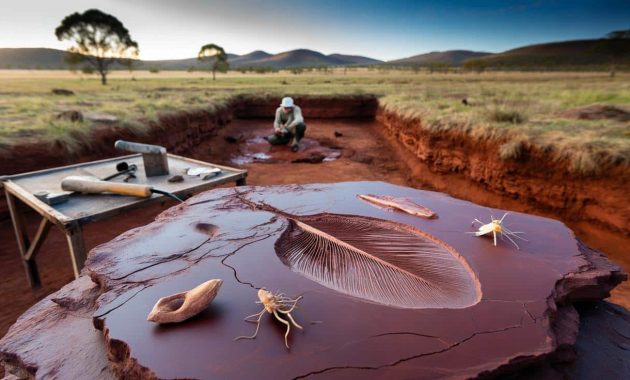
In the middle of quiet Australian farmland, a scarlet stone layer is rewriting what scientists thought fossils could look like.
Hidden below the paddocks of New South Wales, a rust-red rock deposit is preserving an ancient rainforest with microscopic precision, forcing researchers to rethink where on Earth the most detailed fossils can actually form.
Red rocks beneath a modern paddock
McGraths Flat sits in the central tablelands of New South Wales, on land that now looks fairly ordinary: fields, scattered trees, and dry conditions. Yet between 11 and 16 million years ago, during the Miocene epoch, this same spot hosted lush rainforest wrapped around a slow, meandering river.
Today, that vanished ecosystem survives as wafer-thin slices of deep red rock. When researchers split the layers with hammer and chisel, they reveal fish, insects, leaves, feathers, spiders and more, preserved so clearly that individual cells can often be seen under the microscope.
The fossils at McGraths Flat are so finely preserved that pigment cells in fish eyes and delicate spider hairs are still visible.
This level of preservation is rare in any rock, yet it is almost unheard of in material made almost entirely of iron.
Why these fossils are so unexpected
Most “perfect” fossils come from very different rocks
Many classic fossil treasure troves, known as lagerstätten, are hosted in shale, sandstone, limestone or volcanic ash. Famous examples include:
- Messel Pit, Germany – about 47 million years old, with oily shale preserving outlines of fur, feathers and stomach contents.
- Burgess Shale, Canada – roughly 500 million years old, with soft-bodied sea creatures from near the dawn of animal life.
In those places, fine muds buried animals quickly, blocking decay and allowing even soft tissues to fossilise. Iron-rich rocks, by contrast, have usually been considered poor candidates for preserving land-based life.
Most such deposits are ancient “banded iron formations” laid down more than two billion years ago in oceans that lacked oxygen, long before forests, insects or mammals evolved. On continents, iron tends to appear as weathered rust, painting cliffs and deserts red but not capturing fragile biological detail.
Before McGraths Flat, iron-rich sedimentary rocks were seen as some of the least promising places to look for terrestrial soft-tissue fossils.
➡️ Away from William but accompanied by George, Kate Middleton looks stunning at the Festival of Remembrance
➡️ How Many Cubic Metres Of Firewood Do You Really Need For A Worry-free Winter?
➡️ A warm dinner served in a squash: this deliciously stuffed butternut squash puts comfort on the menu!
➡️ Psychologists say that waving “thank you” at cars while crossing the street is strongly associated with specific personality traits
➡️ China is tired of its cars’ bad reputation: it will ban brands from exporting low-quality cars or those without spare parts
➡️ Rape trial puts Norway’s royal family in unwelcome glare of public humiliation nationale
➡️ Working at his daughter’s startup in retirement, Bill Gates showed CEOs the importance of being on the front line
➡️ Goodbye to Retiring at 67 Controversial Move UK Govt Announces the New State Pension Age
The strange case of ferricrete
McGraths Flat breaks that rule completely. The fossil-bearing rock here is ferricrete – basically, natural iron cement. It is almost pure goethite, an iron-oxyhydroxide mineral that gives the slabs their striking brick-red colour.
Under the microscope, this ferricrete is made of particles only about 0.005 millimetres wide. That ultra-fine grain size allowed dissolved iron to seep into and around dead organisms, coating and filling cells before they decayed.
As the iron locked into solid goethite, it effectively cast the soft tissues in stone. This is why researchers can see:
- Retinal pigment cells from fish eyes
- Internal organs of insects and fish
- Microscopic nerve cells and hairs on spiders
- Delicate leaf structures and plant tissues
The result rivals, and in some cases matches, the detail seen in classic shale-based fossil sites, yet the chemistry and texture of the host rock are very different.
Reconstructing a Miocene rainforest
Taken together, the McGraths Flat fossils sketch a vivid picture of a once-humid rainforest environment. Plant remains show dense, moisture-loving vegetation. Insects and spiders point to a complex forest floor and canopy ecosystem. Fish fossils and aquatic insects mark the presence of a slow-flowing river and oxbow lakes.
The Miocene was a crucial time for the evolution of modern ecosystems. Many plant and animal groups that dominate today were diversifying or shifting their ranges in response to changing climates. McGraths Flat catches this moment in high resolution, providing rare detail for a period and region that previously had far fewer soft-tissue terrestrial fossils.
The site functions almost like a time-stamped rainforest snapshot from 11–16 million years ago, captured in iron rather than in mud or ash.
How a rusty lake became a fossil vault
From volcanic rock to iron-rich mud
The new study traces the story back to weathering of basalt, a dark volcanic rock common in the region. Under warm, wet rainforest conditions, acidic water slowly broke down the basalt and leached out iron.
That iron-laden groundwater moved through the subsurface until it met an old river bend – an oxbow lake created when a river loop was cut off and left behind as a crescent-shaped pool.
Inside this stagnant water body, chemical conditions favoured the rapid precipitation of iron-oxyhydroxide particles. These particles settled as fine sediment on the lake bottom where dead leaves, insects, fish and other organisms accumulated.
Fast mineral coats, slow decay
For exceptional preservation, timing is everything. Decay begins quickly once an organism dies, especially in warm, wet environments. At McGraths Flat, the iron particles seem to have coated and infiltrated tissues fast enough to stabilise them before microbes destroyed the fine structure.
| Process step | Role in fossil formation |
|---|---|
| Basalt weathering | Released large amounts of dissolved iron into groundwater. |
| Transport to oxbow lake | Concentrated iron in a calm, low-energy water body. |
| Precipitation of goethite | Created ultra-fine iron sediment that settled on organisms. |
| Tissue infiltration | Iron particles filled cells and replicated soft anatomical details. |
| Solidification into ferricrete | Locked the microscopic structures into hard rock over geological time. |
The study also notes what was not present. Little limestone and very few sulfur-rich minerals such as pyrite appear in the deposit. Those materials can change water chemistry in ways that interfere with iron-oxyhydroxide formation. Their absence probably helped the ferricrete form consistently and preserve detail.
A new map for finding fossil treasure
The implications reach far beyond a single site. If iron-rich ferricrete can host such exquisite fossils in Australia, similar conditions could have done the same on other continents.
McGraths Flat acts as a geological “how-to guide” for finding more iron-hosted fossil sites hiding in plain sight.
Based on the Australian case, researchers suggest looking for areas with:
- Evidence of ancient rivers crossing iron-rich volcanic rocks
- Past climates that were warm and humid enough to drive intense chemical weathering
- Finely layered, very fine-grained ferricrete rather than coarse ironstone
- Limited limestone or sulfur minerals in the surrounding geology
That combination might point to other oxbow lakes or ponds where iron once settled gently over dead plants and animals, mineralising them cell by cell.
Key terms readers keep hearing
What scientists mean by “lagerstätte”
The term “lagerstätte” is German for a rich deposit. In palaeontology it refers to sites where fossils are not only abundant but also preserved with exceptional detail, often including soft tissues such as skin, organs or feathers.
McGraths Flat is now classed as a lagerstätte, joining a short list of globally important fossil localities that let researchers study ancient ecosystems almost as if they were still alive.
Ferricrete and goethite, in plain language
Ferricrete is essentially natural iron concrete. Over long periods, iron-rich water hardens and binds loose sediment into a solid mass. When nearly all of that mass is made from a specific iron mineral, in this case goethite, the rock takes on a deep reddish-brown colour.
Goethite itself is an iron-oxyhydroxide. It commonly forms in soils and rusted surfaces. At McGraths Flat it has built up as ultra-fine particles that faithfully captured the outlines of Miocene life.
Why this matters for climate and biodiversity research
For scientists studying how life responds to climate shifts, McGraths Flat is more than a geological curiosity. The Miocene saw cooling trends, changing rainfall patterns and the spread of more open habitats across parts of Australia. Having a rainforest community preserved in such detail lets researchers trace how species responded, which lineages thrived and which faded.
The fossils can also ground-check climate models. Leaf shapes, insect communities and freshwater fish assemblages are all sensitive to temperature, humidity and water chemistry. When those biological signals match or contradict modelled climate conditions, researchers can refine their simulations of past Earth systems.
There is a practical angle too. Understanding the precise conditions that allow iron to lock away organic material can guide studies of carbon storage in modern soils and wetlands. While fossilisation operates on deep time, the same basic chemistry helps control how much carbon landscapes can hold today.
For anyone fascinated by deep time, McGraths Flat offers a striking reminder: the next big leap in understanding ancient life might come not from a famous shale quarry or limestone cliff, but from a layer of rusty-red rock lying quietly under someone’s farm, waiting for a hammer blow to split it open.
Originally posted 2026-03-03 21:37:56.