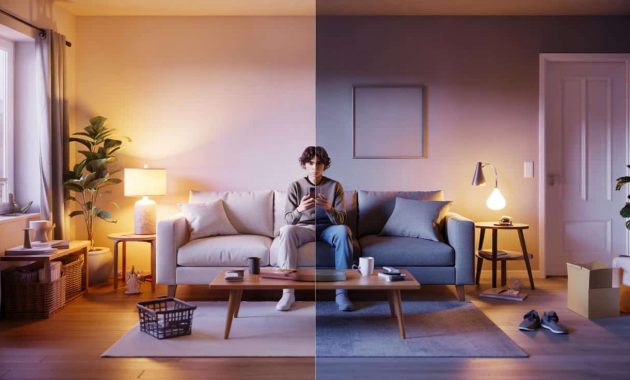
You stand in the doorway with your keys still in your hand, scanning the living room like a critic. The sofa you saved up for. The rug you agonised over for weeks. The gallery wall your friends keep saying looks “so Pinterest”.
And yet, something in your chest tightens.
The place doesn’t feel finished.
You spot the lamp you never truly liked. The coffee table you bought “for now” three years ago. The naked patch of wall you swear you’ll sort out when you “have time”. You sit down, open your phone, and start scrolling through yet another home makeover reel, already half-convinced you need new cushions, different chairs, a better colour, a completely new plan.
You’re not alone.
The real issue is rarely the sofa or the paint colour.
It’s the quiet feeling that the goalpost keeps moving.
Why your home always feels like a work in progress
There’s a strange split-screen that happens in our heads. On one side: your actual home, with its dusty skirting boards, slightly chipped mugs and that basket of “random stuff” you’ll sort out one day. On the other: the bright, edited homes you see on your phone.
Those rooms are frozen in perfect light, styled for a single photo. Yours has to hold weeknight dinners, laundry disasters and chaotic mornings.
That’s the mismatch that gnaws at you.
What you’re comparing is a living space to a still image. And the moving, breathing version will always feel messier, less done, a little unfinished at the edges.
Think about the last time you finished a project at home. Maybe you finally painted the bedroom. For a few days, you walked in and felt that quiet thrill. Then, out of nowhere, your brain zoomed in on the curtains. Suddenly they looked wrong. A bit tired. Not quite “you” anymore.
➡️ No eggs, no toast: this apple and cinnamon breakfast keeps cravings away for hours
➡️ When were boats invented? | Live Science
➡️ Putting a slice of lemon in a cold oven is the bizarre new home trend that experts slam as pointless yet millions swear it secretly works and saves them money
➡️ A new map beneath Antarctica’s ice reveals twice as many hills… and a giant valley
➡️ How income timing affects spending decisions more than people realize
➡️ I tried this homemade recipe and stopped looking for alternatives
➡️ By dumping millions of tonnes of sand into the ocean for over a decade, China has succeeded in creating entirely new islands from scratch
➡️ This invisible change in rain is sharply raising the risk of floods
So you went back online. New tabs, new carts, new YouTube videos on “how to style your bedroom like a boutique hotel”. That little thrill faded and was replaced, almost instantly, by a fresh list of flaws.
This cycle is not an accident. It’s what the home industry runs on. Between new trends, seasonal “must-haves” and the endless promise of “this one thing will totally transform your space”, you’re nudged to believe your home is always one purchase away from done.
Underneath the throw cushions and lamps, there’s something deeper at play. Your home has become a mirror for your identity.
You’re not just choosing a rug. You’re choosing what kind of person you think you are, or want to be. Minimalist or cosy? Calm or colourful? Productive, creative, sophisticated? Each object carries this invisible weight, so no wonder the space never feels quite right.
*If you don’t feel fully settled in yourself, your home will struggle to feel fully settled too.*
That’s the quiet truth. The room keeps changing because you keep changing, and you haven’t quite made peace with that constant movement.
How to create a home that feels “enough”, even when it’s not perfect
Start by flipping the whole question. Instead of asking, “How do I finish this room?”, ask, “How do I want this room to feel for me on a Tuesday night?”
Pick three words. Calm, playful, grounded. Or warm, creative, light. Write them down somewhere visible.
Now walk through your home with those words in your head. Don’t judge. Just notice. Which corners already match those words, even slightly? Which pieces fight against them?
This tiny shift moves you from hunting perfection to curating feeling. You’re not finishing a showroom. You’re tuning a space to your nervous system.
One of the gentlest ways to break the “never done” spell is to set clear, human-sized boundaries. Choose one room, or even just one wall, and declare: “This is done for the next six months.”
That doesn’t mean it’s perfect. It means you stop tinkering. No new cushions. No rearranging every weekend. No late-night browsing for alternatives. You let your body get used to the space as it is.
At first, it can feel uncomfortable, like wearing shoes you haven’t broken in yet. But after a while, something settles. You stop scanning for flaws every time you walk past. You start actually using the room rather than auditioning it for an imaginary photo shoot.
Let’s be honest: nobody really does this every single day. Yet the people whose homes feel deeply lived-in? They repeat some version of this, over and over.
There’s another layer most of us quietly avoid: the emotional backlog hiding in our stuff.
That untouched moving box in the corner. The chair from an ex. The expensive gadget you never use but feel guilty about donating. These things don’t just take up space on your floor. They take up space in your head.
“Clutter is not just physical objects. It’s deferred decisions,” says more than one professional organiser, and they’re right. Every ‘I’ll deal with it later’ is one more open tab in your brain.
- Choose one “emotionally noisy” object this week.
- Ask: Does this support the life I’m living now, or the life I’ve already left?
- Decide: Keep, donate, sell, or recycle — within 10 minutes.
- Notice the small wave of relief once the decision is made.
- Repeat with just one object every weekend for a month.
Each tiny decision makes the room feel fractionally more honest.
Why a truly finished home might not be the goal at all
There’s a quiet, almost taboo thought if you love interiors: what if a perfectly finished home is not actually what you want?
Think of the places where you’ve felt most at ease. A friend’s slightly chaotic kitchen. Your grandmother’s living room with the faded armchair. That holiday rental that wasn’t styled at all, but somehow made you breathe deeper the moment you walked in.
None of those spaces were “done” in the magazine sense. They were layered. A bit mismatched. Clearly used. They held stories. You could feel it even before anyone started talking.
A home that constantly chases “done” can start to feel rigid, like a set. A home that allows for unfinished corners, evolving shelves, and the occasional ugly-but-sentimental object has room for you to grow. Literally and emotionally.
You don’t have to stop wanting beauty or better storage or nicer light. You just don’t have to treat your home like a never-ending self-improvement project. The real shift happens the day you decide that “done for now” counts. And that your life, with all its half-painted walls and unframed prints, is not waiting for the perfect sofa to begin.
| Key point | Detail | Value for the reader |
|---|---|---|
| Feelings over perfection | Define 3 core feelings you want in each room and decorate toward those, not trends | Build a home that actually supports your daily life, not just photos |
| Set “done for now” zones | Freeze one area for 6 months and stop tweaking it | Break the habit of constant dissatisfaction and decision fatigue |
| Clear emotional clutter slowly | Handle one emotionally loaded object at a time with quick, clear decisions | Lighten mental load while making your space feel more honest and grounded |
FAQ:
- Why do I always want to redecorate even when guests say my home looks great?Your brain adapts quickly, so what once felt exciting now feels “meh”. You notice flaws more than visitors do, and constant exposure to styled images keeps raising the bar in your head.
- How do I know when a room is “good enough”?Ask yourself: Can I rest here without mentally rearranging things? If you can read a book or drink a coffee in that space without redesigning it in your mind, it’s good enough for this season.
- Is it wrong to care a lot about how my home looks?No. Caring is not the problem. The tension comes when looks matter more than how the space feels to live in, or when you delay enjoying life until the room is perfect.
- What if my budget is tiny and that’s why it feels unfinished?Money helps, but it’s not everything. Focus on light, layout, and decluttering first. Then add small, meaningful touches — a lamp, a plant, a framed photo — that reflect who you are now.
- How often should I change things in my home?There’s no ideal rhythm, but a helpful guideline is seasonal tweaks, not weekly overhauls. Let things sit long enough for you to actually live with them before deciding they’re wrong.
Originally posted 2026-02-14 16:04:01.