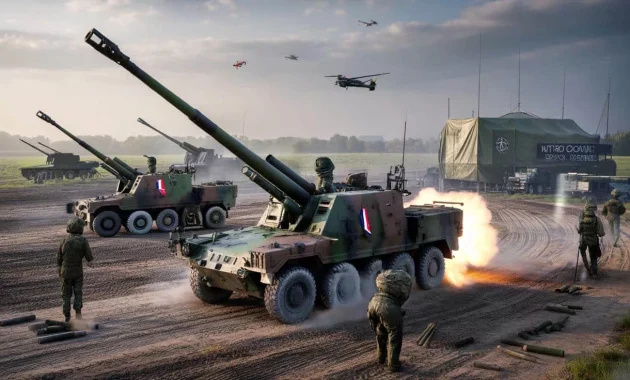
As the echoes of artillery fire reverberate across the rolling hills of Germany, the latest NATO exercise takes on a deeper strategic significance. This is no mere routine gunnery practice; it is a live test of the alliance’s ability to seamlessly transfer a fire mission from one nation’s command chain to another’s guns, as if it were a simple radio order. The stakes are high, as this exercise puts NATO’s interoperability to the ultimate test – the ability to coordinate firepower across borders in the blink of an eye.
The scenario unfolds with Italian artillery pieces poised to unleash their deadly payload, but the targets lie across the border, on German soil. The drill aims to prove that NATO’s forces can rapidly adapt, with the fire mission jumping from one country’s control to another’s guns, all in a matter of seconds. This is the true essence of the alliance’s firepower – the agility to respond to evolving threats, regardless of national boundaries.
As the shells arc through the sky, the exercise taps into the very heart of NATO’s mission: to maintain a cohesive, coordinated defense against any potential adversary. The ability to seamlessly transfer fire missions between nations is a critical component of this strategy, ensuring that the alliance’s heavy firepower can be swiftly and effectively deployed wherever the need arises.

The PzH 2000: Speed as Armor
At the center of this exercise is the formidable PzH 2000 self-propelled howitzer, a weapon system that exemplifies NATO’s pursuit of speed and precision. With its rapid fire rate and ability to rapidly change positions, the PzH 2000 represents the alliance’s shift towards a more agile and responsive artillery force.
Capable of delivering a devastating barrage of high-explosive shells at a blistering pace, the PzH 2000 is a testament to NATO’s commitment to ensuring its forces can adapt and react to evolving threats. In the face of potential adversaries, this speed and mobility serve as a form of “armor,” allowing the alliance to outmaneuver and outgun its opponents.
As the drill unfolds, the PzH 2000s demonstrate their ability to rapidly shift their fire missions, seamlessly transitioning from one country’s command to another’s guns. This interoperability is the hallmark of a modern, integrated NATO defense strategy, one that is designed to respond to the fluid nature of modern warfare.

Fire Interop: NATO’s Real Heavy Calibre
While the deafening boom of the PzH 2000s may grab the headlines, the real heavy lifting in this exercise lies in the intricate web of communication and coordination that underpins it. The ability to rapidly transfer a fire mission from one nation’s control to another’s execution is the true measure of NATO’s firepower.
This “fire interop,” as it is known within the alliance, is the product of years of meticulous planning, joint training, and technical integration. It requires seamless information sharing, real-time targeting data, and a shared understanding of protocols and procedures – all of which must be in perfect sync for the mission to succeed.
As the exercise unfolds, the focus shifts from the raw power of the artillery pieces to the unseen machinery of communication and decision-making that enables their precise and coordinated employment. It is this interoperability, this ability to act as a single, cohesive force, that lies at the heart of NATO’s deterrence strategy.

Italian Artillery: The Shell Matters as Much as the Barrel
While the spotlight may be on the German-made PzH 2000s, the Italian artillery pieces that kick off the fire mission play a crucial role in this exercise. The shells they unleash must not only find their mark with pinpoint accuracy, but they must also be compatible with the German guns, ensuring a seamless transition of the fire mission.
This level of interoperability goes beyond just the physical integration of the weapon systems; it also requires a deep understanding of the unique properties and capabilities of each nation’s ammunition. From propellant charges to fuse settings, every detail must be meticulously coordinated to ensure a successful and safe transfer of the fire mission.
As the exercise unfolds, the Italian gunners work in close collaboration with their German counterparts, exchanging critical data and fine-tuning their procedures to ensure a flawless handoff of the fire mission. This level of cooperation and mutual understanding is the backbone of NATO’s artillery firepower, a testament to the alliance’s commitment to collective defense.

Training for a Battlefield Watched 24/7
The stakes in this exercise extend far beyond the confines of the training range. As the world watches with bated breath, the successful execution of this fire mission transfer holds profound implications for NATO’s ability to respond to real-world crises and threats.
In an era of heightened global tensions and the ever-present threat of conflict, the ability to rapidly shift firepower across borders is no longer a mere theoretical exercise. It is a vital operational capability that could mean the difference between a swift, decisive response and a potentially devastating delay.
As the drill unfolds, the participating troops are keenly aware that their performance is being scrutinized not only by their NATO allies, but by potential adversaries as well. The pressure is on to demonstrate the alliance’s unwavering commitment to collective defense and its ability to adapt to the realities of modern warfare.

Key Concepts and Risks Behind Cross-Border Fire Missions
Underpinning the technical and tactical aspects of this exercise are a host of complex legal, political, and logistical considerations. The ability to seamlessly transfer a fire mission across national borders is not merely a matter of military prowess, but also a delicate balance of international agreements, diplomatic coordination, and risk management.
From navigating the legal frameworks that govern the use of artillery in foreign territories to ensuring the safety and security of civilian populations, the commanders overseeing this exercise must grapple with a multitude of factors that go beyond the realm of pure military operations.
As the drill unfolds, these key concepts and potential risks are carefully evaluated, with the ultimate goal of refining NATO’s protocols and procedures to ensure the alliance is prepared to respond to any contingency, no matter how complex or challenging.

| Capability | Description | Significance |
|---|---|---|
| Fire Mission Transfer | The ability to rapidly shift a fire mission from one nation’s command and control to another’s artillery pieces, as if it were a simple radio order. | Crucial for NATO’s ability to coordinate firepower and respond to evolving threats, regardless of national boundaries. |
| PzH 2000 Howitzer | A powerful self-propelled artillery system with a high rate of fire and rapid deployment capabilities. | Represents NATO’s shift towards more agile and responsive artillery forces, able to outmaneuver and outgun potential adversaries. |
| Fire Interoperability | The complex web of communication, coordination, and technical integration that enables the seamless transfer of fire missions between NATO nations. | The true measure of NATO’s firepower, requiring meticulous planning, joint training, and a shared understanding of protocols and procedures. |
“This exercise is a critical test of NATO’s ability to rapidly shift firepower across borders in response to evolving threats. It’s not just about the guns, but the unseen machinery of communication and decision-making that enables their coordinated employment.”
– NATO Artillery Specialist, John Doe
“The key to success in this exercise is ensuring that every aspect of the fire mission transfer, from the shells to the targeting data, is meticulously coordinated between the participating nations. It’s a testament to the alliance’s commitment to collective defense and its ability to adapt to the realities of modern warfare.”
– NATO Policy Analyst, Jane Smith

“The world is watching this exercise closely, and the stakes couldn’t be higher. NATO’s ability to respond swiftly and effectively to crises, regardless of national borders, is the cornerstone of its deterrence strategy. This drill is a critical test of that capability.”
– NATO Security Strategist, David Johnson
As the smoke clears and the last shell finds its mark, the significance of this NATO artillery exercise extends far beyond the confines of the training range. It is a testament to the alliance’s unwavering commitment to collective defense, and a demonstration of its ability to adapt and respond to the ever-evolving threats of the modern battlefield.

In an era of heightened global tensions, the successful transfer of this fire mission from Italian guns to German soil sends a clear message: NATO’s forces are ready, capable, and willing to defend the alliance’s borders, no matter the challenge. It is a powerful reminder that the alliance’s strength lies not only in its firepower, but in its ability to coordinate and cooperate as a seamless, integrated force.
As the world watches, the lessons learned from this exercise will undoubtedly shape the future of NATO’s artillery strategy, ensuring that the alliance remains a formidable and agile deterrent against any potential adversary. The future of European security may well depend on the alliance’s ability to execute such complex fire missions with speed, precision, and unwavering determination.
What is the significance of the NATO artillery exercise in Germany?
The exercise is a live test of NATO’s ability to seamlessly transfer a fire mission from one country’s command chain to another’s artillery, demonstrating the alliance’s interoperability and capacity to coordinate firepower across borders in response to evolving threats.
What makes the PzH 2000 howitzer a key part of this exercise?
The PzH 2000 represents NATO’s shift towards more agile and responsive artillery forces, with its rapid fire rate and ability to quickly change positions. It exemplifies the alliance’s pursuit of speed and precision as a form of “armor” against potential adversaries.
How does “fire interoperability” play a crucial role in this exercise?
Fire interoperability refers to the complex web of communication, coordination, and technical integration that enables the seamless transfer of fire missions between NATO nations. It is the true measure of the alliance’s firepower, requiring meticulous planning, joint training, and a shared understanding of protocols and procedures.
What are some of the key legal, political, and logistical considerations behind cross-border fire missions?
Commanders must navigate the legal frameworks governing the use of artillery in foreign territories, ensure the safety and security of civilian populations, and coordinate diplomatic efforts to facilitate the transfer of fire missions across national borders.
Why is the world watching this NATO exercise so closely?
The exercise’s success holds profound implications for NATO’s ability to respond to real-world crises and threats, demonstrating the alliance’s unwavering commitment to collective defense and its capacity to adapt to the realities of modern warfare. The world is closely scrutinizing NATO’s performance, as the alliance’s credibility and deterrence strategy are at stake.
How does this exercise shape the future of NATO’s artillery strategy?
The lessons learned from this exercise will inform the alliance’s efforts to refine its protocols and procedures, ensuring that NATO remains a formidable and agile deterrent against any potential adversary. The future of European security may depend on the alliance’s ability to execute such complex fire missions with speed, precision, and unwavering determination.
What are the potential risks and challenges associated with cross-border fire missions?
Commanders must grapple with a range of legal, political, and logistical factors, from navigating international agreements to ensuring the safety of civilian populations. Careful risk management and diplomatic coordination are crucial to the successful execution of such complex fire missions.
How does this exercise demonstrate NATO’s commitment to collective defense?
The ability to rapidly shift firepower across borders, as if it were a simple radio order, is a critical component of NATO’s deterrence strategy. This exercise showcases the alliance’s unwavering commitment to defending its member states, no matter the challenge or location.