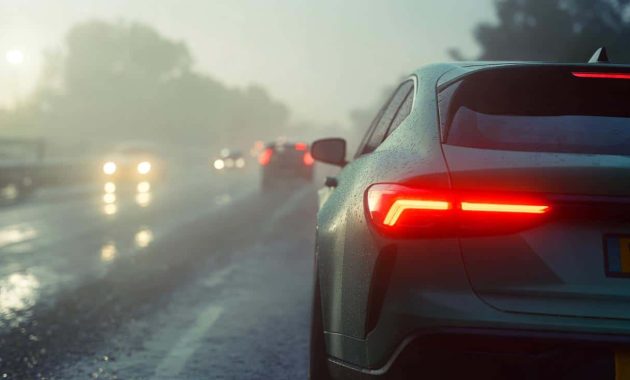
The rain started softly, that kind of steady drizzle that turns the highway into a moving mirror. Wipers slapping, lights on, speed dropping. You know that tense feeling in your shoulders when you’re not quite sure you can really see what’s happening ahead. The car in front disappeared behind a curtain of spray, and all I could see were two blurry red dots floating in the grey.
Then something surprising happened.
The driver next to me switched on a feature I hadn’t paid attention to for years. His rear lights changed, the car suddenly looked sharper, easier to spot through the misty blur. One simple control, forgotten on most dashboards, instantly made his car stand out in the storm.
That tiny button can change the way you’re seen on the road.
The visibility boost hidden right on your dashboard
On most modern cars, there’s a small symbol you’ve probably glanced at a thousand times without registering it. A bent headlamp icon with wavy lines and a little vertical stripe through it. That’s your rear fog light, the forgotten extra lamp that quietly waits for the worst driving days of the year.
It doesn’t look like much. One press and you won’t notice a big difference from behind the wheel. Yet out there, in the murky mix of rain, spray, or thick mist, your car suddenly becomes a bright, clean shape in a world of smudged colors. Not stronger headlights. Smarter visibility.
Think back to those mornings when the highway feels like a tunnel of cotton wool. Cars appear out of nowhere, just a few seconds before you’re on their bumper. That’s exactly the moment when a rear fog light earns its place on your car.
In the UK, for example, transport data regularly lists “poor visibility” as a factor in collisions during autumn and winter. On some foggy days, you can see long lines of cars with only standard taillights glowing faintly through the haze. Then suddenly, one vehicle stands out with a deeper, punchier red glow. That’s the rear fog doing its quiet job, saying to everyone behind: “I’m here, and I’m closer than you think.”
There’s a simple logic behind this little hero. Normal taillights are designed for clear conditions, where the contrast with the road and surroundings is enough. In fog or heavy spray, light gets scattered and diffused, almost erased. A rear fog light boosts intensity and focus right where following drivers are looking.
It doesn’t help you see better forward. It helps others see you sooner. Think of it less as a headlamp and more as a warning beacon. One that gives the driver behind an extra slice of reaction time. On a wet road, that extra half-second can mean the difference between a gentle brake and a hard impact.
➡️ Hygiene after 65 : not once daily not once weekly new medical advice challenges decades of hygiene habits for older adults
➡️ This simple kitchen routine saves time every single day
➡️ Hairstyles after 60 : forget old-fashioned looks this haircut is widely considered the most youthful by professional hairstylists
➡️ Day will turn to night as astronomers officially confirm the date of the century’s longest solar eclipse, a rare event expected to create an extraordinary spectacle across several regions for all
➡️ Psychology suggests that people who sleep in the same bed as their pets often share 10 quiet emotional and personality strengths that critics call codependent and unhealthy
➡️ Clocks changing earlier in 2026 will disrupt UK daily life with darker evenings commuters fearing for safety and divided opinions over whether the change is necessary at all
➡️ Winter tip: instead of salt, sprinkle this common item on the sidewalk to dissolve ice fast
➡️ A hairdresser reveals: Why you should never put shampoo directly on the top of your head
How to use your rear fog light without annoying everyone
First step: actually finding the button. On many cars, the rear fog light is hidden on the same stalk as your main headlights, with a twist or pull motion. On others, it’s a small separate switch near the steering wheel, marked by that bent lamp icon with lines pointing left and a vertical wave.
The basic routine is simple. Turn on your regular lights, then activate the rear fog when visibility drops badly – when you struggle to see the car in front, or it seems to fade into the grey. As soon as conditions clear and you can see more than a few dozen meters, switch it back off. That’s the rhythm: on in the soup, off in the clear.
Most drivers learn the theory once for the driving test and then forget it for the next ten years. Let’s be honest: nobody really does this every single day. We either never touch the rear fog at all, or we leave it on forever, blinding half the highway.
The sweet spot lies in using it like a safety flare, not as a permanent Christmas decoration. When the spray from the car ahead turns into a white wall, that’s your moment. When the rain eases and you can easily read signs and see brake lights far ahead, that’s the cue to let it rest again. Your goal is simple: be clearly visible, not aggressively bright.
There’s one mistake that really gets under people’s skin on the road: drivers who keep rear fogs on in light rain or clear weather. A rear fog lamp is much more intense than a normal taillight, and in good visibility it becomes a red laser pointed straight at the eyes of the person behind. That’s not safety, that’s just tiring.
“A rear fog light is like shouting in a quiet room,” explains a driving instructor I spoke to. “Perfect when there’s chaos and confusion. Annoying and unnecessary once everyone can hear you just fine.”
Here’s a simple checklist to box in your new habit:
- Use the rear fog only when visibility is seriously reduced (fog, heavy spray, thick snow).
- Switch it off as soon as you can see beyond the immediate vehicle ahead.
- Never use it in city traffic or light rain – it dazzles more than it protects.
- Check before night drives that you know where the control is, so you’re not hunting for it in a storm.
Rethinking how we “see” and are seen on the road
There’s a quiet shift that happens when you start paying attention to that small button. You stop thinking only about your own view through the windshield and start imagining the scene from behind your car, through the swirling spray on someone else’s glass. You drive a little less for yourself, and a bit more for the invisible stranger following you.
*That’s where this forgotten feature really changes your relationship with bad weather driving.* It turns a stressful, blurry journey into something you can manage, almost like you’re adding a highlighter pen to your car’s outline. You’re not immune to danger, of course, but you’re no longer a dim shadow in the fog.
| Key point | Detail | Value for the reader |
|---|---|---|
| Use rear fogs only in poor visibility | Fog, heavy spray, thick snow where taillights fade | Stronger presence on the road when others struggle to see you |
| Know the control before you need it | Learn the symbol and switch on your own dashboard | Faster, calmer reaction when weather suddenly worsens |
| Switch them off once conditions improve | Turn off when you can clearly see beyond the car ahead | Less glare for others, more comfortable and respectful driving |
FAQ:
- Question 1What’s the difference between rear fog lights and normal taillights?
- Question 2When exactly should I turn my rear fog light on?
- Question 3Can using rear fog lights in clear weather be dangerous?
- Question 4Do all cars have rear fog lights?
- Question 5Do rear fog lights help me see better, or just help others see me?