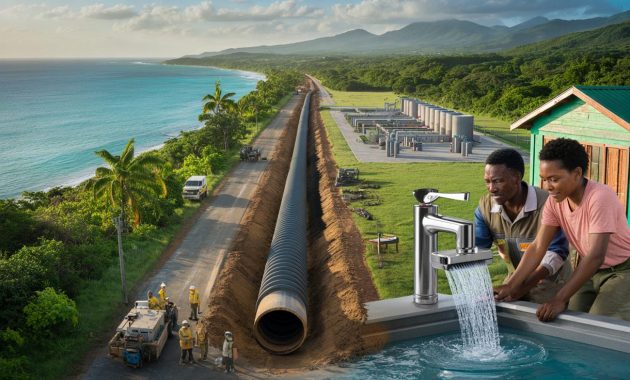
Local families see dry taps, rationed showers, and anxious forecasts.
On Jamaica’s postcard coast, running water has become a strategic asset. As climate shocks hit harder and demand keeps rising, the Caribbean island has turned to French giant VINCI Construction for a €144 million project meant to secure drinking water for the long haul.
A tropical paradise running short of water
Jamaica is the Caribbean’s third-largest island, stretching almost 11,000 square kilometres, with nearly 2.9 million people pressed along a narrow coastal strip around Kingston and Montego Bay.
Inland, the Blue Mountains rise to more than 2,200 metres. Rain falls unevenly across this rugged terrain. Downpours hammer the hillsides, while low-lying districts can go days or weeks with barely a shower.
That mismatch between where water lands and where people live defines the country’s challenge. Extreme dry spells alternate with violent hurricane seasons. The same year can bring drought alerts and flooded rivers.
On an island this size, every glass of tap water is the result of a complex and fragile balancing act.
For households, the stakes are already real. In recent years, some districts around Kingston and Saint Andrew have seen strict restrictions, interrupted service, and a scramble for emergency supplies by truck.
Why Jamaica called in France’s VINCI
The Jamaican government has framed water as both a public service and a national security issue. Prolonged shortages risk school closures, hospital disruptions, crop failures, and social tension in urban areas.
In 2025, faced with sharply lower rainfall and dwindling reserves, authorities released 350 million Jamaican dollars — around €1.9 million — for urgent measures. That pot funded water trucking, storage tanks for vulnerable communities, and quick repairs on critical infrastructure. It also backed drip irrigation and farm resilience projects to keep food production going.
In parallel, Kingston committed around 22 billion Jamaican dollars (about €119 million) to more structural schemes for drinking water, sanitation, and irrigation, including the flagship Western Water Resilience Project and the Rio Cobre supply system, which aims to deliver up to 57,000 cubic metres of water a day.
➡️ “High‑functioning codependence”: the quiet burnout of the partner who always copes
➡️ A state pension cut is now approved with a monthly reduction of 140 pounds starting in December 2025
➡️ He hid an AirTag in his sneakers before donating them: and traced them to a market stall
The new deal with VINCI slots into this wider programme. The contract covers design and construction of 68 kilometres of new water mains in Jamaica’s north-west, a region where tourism booms while networks struggle to keep pace.
The €144 million project is designed as a long-life backbone for the island’s drinking water grid, with a working horizon measured in decades.
Sixty-eight kilometres of pipe, 130 kilometres of problems
On paper, 68 kilometres of piping might sound like a simple straight line. In the field, it is anything but.
The real alignment winds for almost 130 kilometres as it follows existing roads, skirts dense neighbourhoods, and avoids unstable slopes and sensitive wetlands. Every bend brings a new technical puzzle.
Engineering choices built for 50 years
VINCI’s teams plan to use large-diameter ductile iron pipes. This material costs more upfront than plastic, but it offers serious advantages for Jamaica’s conditions.
- High resistance to corrosion in humid, salty air
- Ability to handle strong pressure swings during peak demand
- Tolerance of ground movement in cyclone seasons
- Expected service life of more than half a century
The project will run over roughly 36 months. About 100 people will be involved on a rolling basis: civil engineers, surveyors, heavy machinery operators, environmental specialists, and local workers.
On site, that looks like a travelling technical village. Crews, equipment, and support units will shift gradually along the route, tackling segments while trying to keep disruption to residents and traffic under control.
Working with nature, not against it
Jamaica’s authorities have made environmental constraints non‑negotiable. The scheme is being coordinated closely with the National Environment and Planning Agency to limit scars on rivers, wetlands, and natural habitats.
Crossings are being treated almost like medical procedures. For each, teams must decide:
- Which bank to approach from
- At what depth to bury the pipe
- Whether to open a trench or drill underneath the riverbed
- How to schedule works around breeding seasons for fish, birds, or amphibians
In some spots, the solution is to bore under waterways so the river itself stays undisturbed. In others, work is paused or limited at certain times of year to avoid hitting wildlife at its most sensitive moments.
The job is not meant to be “fast at any cost”. The brief is to strengthen water security without trading it for lasting ecological damage.
A long relationship between VINCI and Jamaica
VINCI is not discovering the island’s terrain. The group has operated in Jamaica since 1999, taking part in road and water projects that exposed its engineers to local geology, cyclone patterns, and tricky soils.
That experience proved crucial in 2025, when Hurricane Melissa lashed the country. After the storm, crews from VINCI helped carry out emergency repairs in Montego Bay, Jamaica’s second-biggest city, to restore drinking water.
Working under pressure, with damaged infrastructure and anxious residents, gave the company a taste of what failure in the system looks like on the ground: schools without sanitation, hotels forced to ration, clinics struggling to function.
Connecting pipes to treatment plants
Alongside the new pipeline in the north-west, VINCI is also involved in building Jamaica’s third-largest drinking water treatment plant at Rio Cobre. The goal is to increase capacity while stabilising quality and reliability.
These projects are linked. A water network is not a stand‑alone object. It ties together springs, rivers, reservoirs, treatment works, pumping stations, cities, and farms.
Strengthen one weak point and the effect can ripple outward: better pressure management here cuts leaks there; more robust mains today prevent emergency shutdowns tomorrow.
A global pattern: water as infrastructure and risk
Jamaica’s deal with VINCI echoes a broader trend. Around the world, mid‑size countries are hiring foreign engineering groups to tackle water scarcity and ageing networks under climate stress.
| Country | Type of project | Main challenge |
| Qatar | Urban drinking water and treated water grids around Doha | Extreme heat and aggressive desert soils |
| Australia | Long-distance water transfer pipelines | Multi‑year droughts and vast distances |
| Morocco | Structuring networks for major cities | Dense urban areas and sensitive river crossings |
| Chile | Long‑range water pipelines | Andean terrain and seismic risk |
For France, this kind of contract is both industrial and geopolitical. It showcases its engineering sector while extending its presence in regions where climate adaptation finance is set to grow rapidly.
What this means for people on the ground
For a Kingston or Montego Bay resident, network upgrades sound abstract. What matters in daily life is simple: does water come out of the tap, and is it safe to drink?
If the project delivers what government planners expect, several changes should follow over the medium term:
- Fewer unplanned cuts linked to bursts and leaks
- Shorter periods of rationing in dry seasons
- More stable supply for hospitals, schools, and hotels
- Less dependence on expensive trucked water in emergencies
For the tourism industry, which underpins much of the north‑west’s economy, reliable water supply means less risk of resort closures, reputational hits, or hurried investment in private backup systems.
Key terms: resilience, drought, and “non‑revenue water”
Jamaica’s strategy revolves around a few ideas that pop up in many water projects:
- Resilience: the capacity of a system to keep working under shocks such as droughts, hurricanes, or contamination incidents.
- Drought mitigation: the mix of short‑term emergency steps and long‑term investments that reduce the impact of dry spells.
- Non‑revenue water: treated water that never reaches paying users, usually lost through leaks or illegal connections.
By replacing old pipes with modern, pressure‑resistant mains and improving monitoring, authorities hope to cut these invisible losses. In many developing networks, they can reach 30–40% of total production.
Scenarios: what if the project stalls, or climate stress accelerates?
Two simple scenarios show why this €144 million venture matters beyond the construction phase.
- If works face major delays: temporary fixes like water trucking stay in place longer, at high operational cost. Leaks persist, and public frustration grows in neighbourhoods that were promised relief.
- If climate shocks intensify faster than forecast: even the upgraded system might only buy time. Authorities would then have to consider desalination, stricter water tariffs, or tighter building rules for hotels and housing.
In both possibilities, early investments in robust pipes and treatment plants still help. They create a sturdier backbone on which future solutions — from smart meters to new reservoirs — can be added.
For now, Jamaica’s bet is clear: spend heavily upfront, partner with a foreign specialist, and try to get ahead of the curve before the combination of population growth and climate volatility turns a water challenge into a chronic crisis.